
A freelance copywriter is a writer who sells persuasive, client-commissioned copy, such as ads, emails, and landing pages, on a project basis rather than as an employee. Rates vary enormously by experience and niche. Worldwide, freelancers charge $21 an hour on average. The real path to higher pay is specialization, a working portfolio, and direct outreach, not another job board.
Key Takeaways
- Global rates sit lower than most guides imply. Payoneer’s global freelancer survey, covering over 7,000 freelancers in 150-plus countries, found an average hourly rate of $21.
- Independent work keeps growing. MBO Partners’ State of Independence research counts 11.5 million US independent professional service providers, up 55% since a prior benchmark year. US-only figure.
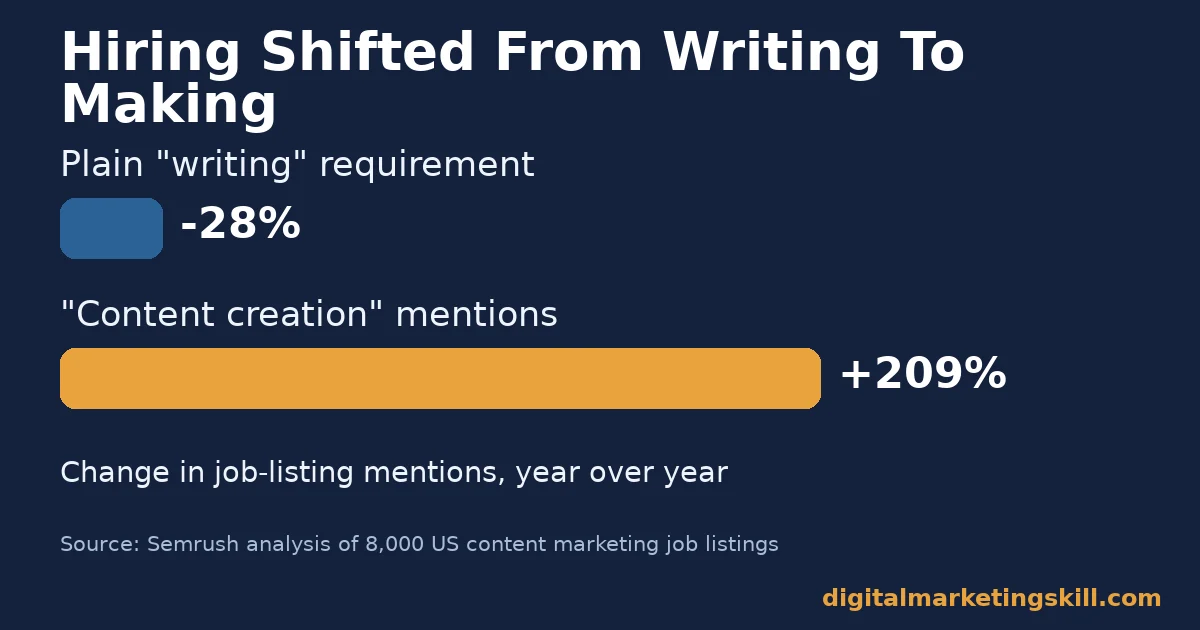
- Hiring has shifted from writing to making. A Semrush study of 8,000 content marketing job listings found plain “writing” requirements fell 28% year over year, while “content creation” mentions rose 209%.
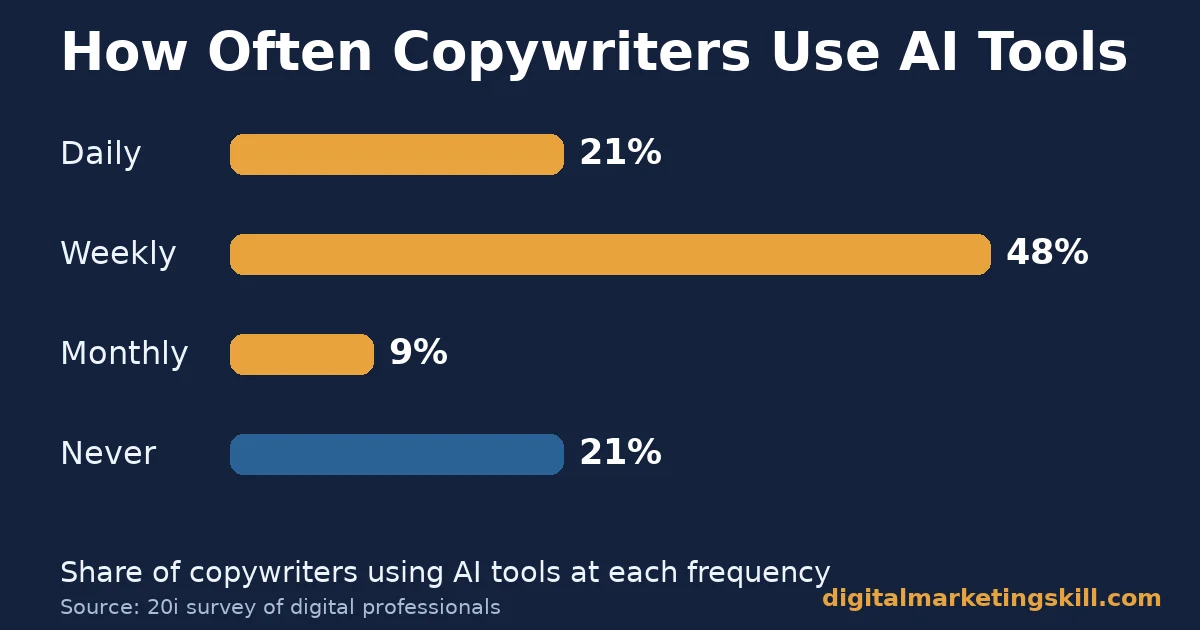
- AI is now part of the job, not a threat that replaced it. A 20i survey of digital professionals found 69% of copywriters use AI tools weekly or daily, most often for generating ideas and drafting copy.
- Specialization compounds. One freelance copywriter’s self-reported revenue grew from a few thousand dollars in her first year to a stable figure near $85,000 a year after going full-time, a pattern that matches wider income-growth claims in the niche.
In this guide
- What Most Freelance Copywriter Guides Leave Out
- How Freelance Copywriting Income Actually Grows
- Where Freelance Copywriting Work Actually Comes From
- What Freelance Copywriters Actually Charge, By Source
- How to Lead With Each Source
- The Skills and AI Tools That Now Decide Who Gets Hired
- How to Measure Whether Your Freelance Copywriting Business Is Working
- The One Decision Rule: Specialize Before You Optimize Anything Else
- A Real Case: One Copywriter’s Published Revenue Over Time
- Frequently Asked Questions About Freelance Copywriters
- Start by Picking One Niche, Then Prove It
What Most Freelance Copywriter Guides Leave Out
Most guides explain what copywriting is, list a few types, and point you at freelance marketplaces. That gets you started. But it skips the parts that decide whether you earn a living: realistic rate data, what AI actually changed about demand, and a clear reason to specialize instead of taking any job that appears.
This guide fills that gap. It shows where real client work comes from and how rates differ by source. It also gives you the one decision that separates copywriters stuck at entry rates from those who raise their prices every year.
A few ground rules. The rate and growth figures below come from named surveys and platforms, not generic averages. Self-reported figures are a snapshot of who answered, not a census. Treat any single income story as one data point, not a guarantee.
How Freelance Copywriting Income Actually Grows
Three forces drive a freelance copywriter’s income: proof of results, a visible niche, and a repeatable way to find clients. Weak output in any one caps the other two.
These forces build on each other instead of working in isolation. Proof earns the right to charge more. A niche makes that proof legible to a stranger fast. A repeatable source of leads turns a one-off project into a career you can plan around.
Proof matters first. A client hiring a stranger cannot judge writing quality from a resume. Instead, a portfolio of real, specific results is what converts a cold lead into paid work.
Why a Niche Compounds Faster Than a Broad Offer
A generalist copywriter competes with every other generalist on price. Specialists compete with almost no one, because few writers understand a narrow industry’s language and buying process well enough to write convincingly inside it.
That is also why AI has not erased demand for skilled copywriters. The Semrush data above shows plain “writing,” listed as a skill, fell 28% year over year, while “content creation” rose 209%. Employers want people who can direct and judge content, not just type it.
Referrals close the loop. A satisfied client in a specific niche knows other businesses in that same niche. Each good project tends to produce the next lead, often without any outreach at all.
Where Freelance Copywriting Work Actually Comes From
Not every source of client work behaves the same way. Picking the wrong one for your stage wastes months.
Marketplaces: Built for Fast Starts, Not High Rates
Freelance marketplaces list huge numbers of buyers in one place. That makes them the fastest way to land a first paid project. The tradeoff is price competition. Marketplace listings are visible to every other bidder, so new copywriters often start near the bottom of the rate range until reviews build trust.
Use marketplaces for proof, not for a career-long income plan. The goal is a handful of strong reviews and a usable portfolio piece, then a move toward higher-paying sources. Our guide to the best freelance websites for your stage compares the main options.
Cold Outreach: Built for Choosing Your Own Clients
Direct outreach means contacting a business that is not actively posting a job, with a short, specific pitch about a gap in their current copy. It takes more effort per lead than a marketplace. But it lets a copywriter target the niche and rate they actually want.
The payoff is selection. A freelancer pitching one hundred businesses in a chosen niche controls who they work with, instead of competing for whoever happens to post a job that week. Our guide on getting clients as a freelancer covers outreach in more depth.
Content and Marketing Agencies: Built for Steady Volume
Agencies take on more client work than their staff can write, so they regularly subcontract to freelance copywriters. Agency work usually pays a fixed, lower rate than a direct client relationship. The agency carries the sales and account-management cost, which comes out of the rate.
What agencies offer instead is volume and consistency. A steady agency relationship can fill a freelancer’s slow weeks while direct-client pitching builds in the background. See our guide to freelance marketplaces and their fees for how agency and marketplace economics compare.
Referrals and Networking: Built for the Best Rates
A referral arrives pre-sold. The new client already trusts the referring client’s judgment, so a referred copywriter rarely has to justify their rate the way a cold pitch does.
Referrals take time to start flowing, because they depend on a backlog of finished, satisfied clients. That is why most freelance copywriters combine a faster source early on with a long-term push toward referral-driven work.
The four sources are not mutually exclusive. A sustainable freelance copywriting business usually blends two or three at once, shifting the mix as the portfolio and client list grow.
What Freelance Copywriters Actually Charge, By Source
The Worldwide Floor, and Why It Is Not Your Ceiling
Rates differ sharply by where the work comes from, not just by skill level. A beginner on a crowded marketplace and a specialist working through referrals can both call themselves copywriters while charging very different amounts for similar effort.
The worldwide average across all freelance fields sits at $21 an hour, according to Payoneer’s survey of over 7,000 freelancers in more than 150 countries. That figure blends every niche and experience level together, so treat it as a floor to beat, not a target. Specialized copywriters in high-value niches, such as finance or software, routinely charge several times that average once they have a proven portfolio.
Location affects cost of living far more than it should affect your rate. A client paying for results, not hours, rarely cares where you live. Price against the value of the project, not against your own local cost of living.
Why Project Pricing Beats Hourly Pricing
The scale of independent work backs this up. MBO Partners’ State of Independence research counts 11.5 million US independent professional service providers, a 55% increase since a prior benchmark year. That is a US-only figure, but it signals how fast this kind of work is normalising.
More buyers treating freelance writers as a standard part of their marketing budget means more room to negotiate a project rate, instead of accepting a client’s first offer.
Project pricing beats hourly pricing once you have enough experience to estimate accurately. A fixed project fee rewards speed and skill, because finishing faster does not cut your pay the way it does on an hourly contract. Hourly pricing still makes sense early on, while you are still learning how long a given deliverable actually takes you.
Signals That Justify a Higher Rate
A client weighs three things when judging whether your price is fair: your portfolio, your specialization, and how clearly you explain the business outcome your copy produces. A generic sample of “nice writing” justifies a generic rate.
By contrast, a sample that names a specific result, such as a measured lift in signups or replies, justifies a premium rate, because it shows the client what their money is actually buying.
How to Lead With Each Source
Understanding where work comes from only helps if it changes your weekly actions. Here is the matching move for each source above.
Marketplaces: Lead With a Narrow First Offer
List one specific, affordable service, such as a five-email welcome sequence, instead of a vague “copywriting services” listing. A narrow offer is easier for a stranger to say yes to. It is also easier for you to deliver fast enough to earn early reviews.
Ask every satisfied client for a short, specific testimonial naming the result, not just a star rating. That testimonial becomes the proof you reuse everywhere else.
Cold Outreach: Lead With a Specific Observation
Open a pitch with one concrete thing you noticed about the business’s current copy, not a generic introduction. A specific observation proves you actually looked at their business, which is rare enough to get a reply.
Send outreach in batches, not one at a time. MBO Partners’ research on independent professionals shows this is now a large, established market, so volume and consistency beat a single perfect pitch.
Agencies: Lead With Reliability, Not Just Talent
Agencies rehire writers who hit deadlines and follow a brief without constant back-and-forth, even more than writers who are simply talented. Treat every agency assignment as an audition for the next one.
Ask an agency contact directly whether they have overflow work in your niche. Agencies rarely advertise freelance openings, so most of this work comes from asking. Keep a short, current sample set ready to send the moment an opportunity comes up, because agencies often need a writer on short notice.
Referrals: Lead With a Direct Ask
Ask a happy client directly for an introduction to one other business owner they know, right after you deliver strong results. Clients rarely refer unprompted, even when satisfied, so the ask has to be explicit.
Make referring easy by giving the client one short sentence they can forward, describing exactly what you do and for whom.
The Skills and AI Tools That Now Decide Who Gets Hired
Being a working freelance copywriter now means directing tools as much as writing from a blank page.
20i’s survey of digital professionals found 69% of copywriters use AI tools weekly or daily. The top uses were generating ideas, cited by 69% of respondents, and copywriting itself, cited by 54%. Most reported being impressed with the results. 85% described themselves as extremely or somewhat impressed.
That shift matches the job-market data above. Employers increasingly expect a copywriter to edit, direct, and fact-check AI drafts into something with a real brand voice, rather than typing every sentence from nothing. A copywriter who refuses AI tools entirely competes on speed against one who does not, and loses. Our guide to the four-part path to paid freelance writing work covers the same shift from the writer’s side.
How to Measure Whether Your Freelance Copywriting Business Is Working
Hours booked is a weak signal on its own. Track the numbers below instead. Each one is defined in a single sentence.
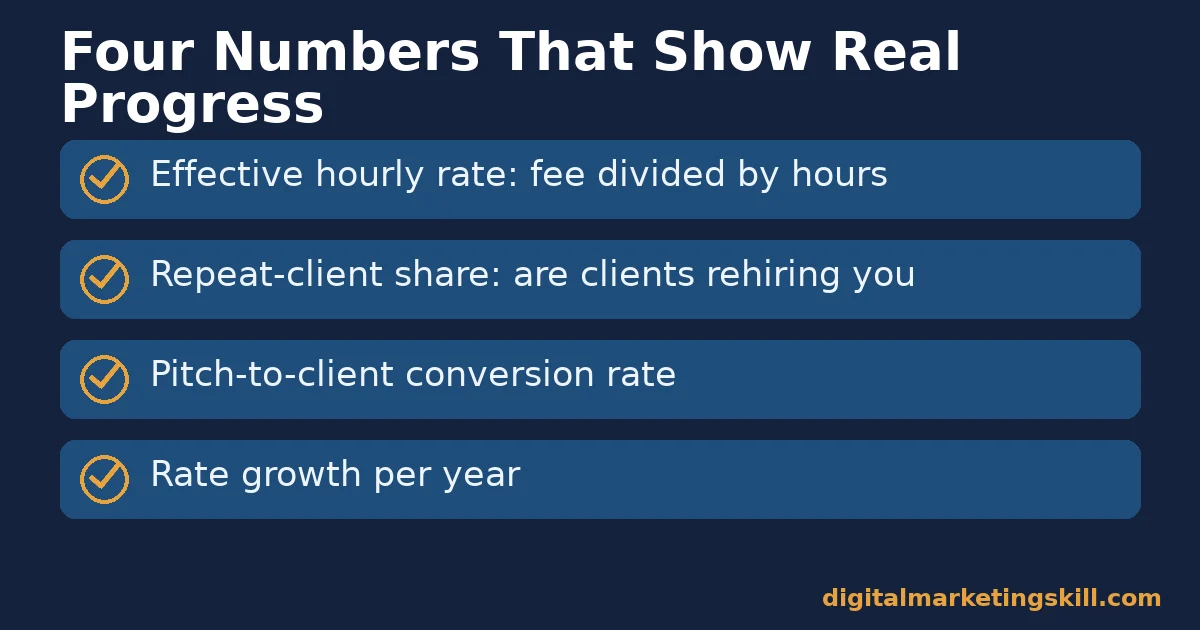
Four Numbers That Show Real Progress
- Effective hourly rate. Total project fee divided by actual hours spent, including research and revisions, showing your true rate rather than your quoted rate.
- Repeat-client share. The percentage of this period’s revenue from clients you have billed before, showing whether you are building relationships or restarting from zero each month.
- Pitch-to-client conversion rate. Paid projects won divided by pitches sent, showing whether your outreach message and offer are actually working.
- Rate growth per year. The percentage change in your average project fee from one year to the next, showing whether specialization and proof are actually raising your price.
How to Read These Numbers Together
Read them in order. If your effective hourly rate is falling, projects are taking longer than quoted. Fix your estimating or your brief process first. If repeat-client share stays near zero, you are either not delivering results worth rehiring for, or not asking for more work.
Review quarterly, not weekly. A single slow month is normal in freelance work. A quarter of flat numbers is a real signal to change your pricing or your niche.
The One Decision Rule: Specialize Before You Optimize Anything Else
If you take one decision rule from this guide, make it this one. Pick a specific industry or copy format before you spend more time polishing your general writing samples or your marketplace profile.
Here is an illustrative example, with invented numbers. Imagine two new freelance copywriters, each sending twenty pitches a month. One pitches “copywriting services” to any small business. The other pitches email sequences specifically to software companies.
The generalist might land one project a month at a modest rate, because every prospect is comparing them to dozens of similar writers. Working in a narrow, well-understood niche, the specialist might land three projects at a higher rate, because far fewer writers can credibly claim that specific expertise.
The lesson is not that broad skills are useless. A narrow, provable specialty is what a stranger can evaluate quickly, and quick evaluation is what wins freelance work.
A Real Case: One Copywriter’s Published Revenue Over Time
Most freelance copywriters never publish their numbers, but a few do. Robyn Bradley, a freelance copywriter, published her own revenue history. It shows growth from a few thousand dollars in copywriting revenue during her first year to more than $55,000 by the year she went fully freelance, and a stable figure near $85,000 a year since.
The detail worth noting is the plateau, not just the growth. Her revenue has stayed roughly flat for several recent years. She attributes that to deliberately protecting time for other creative work rather than chasing every available client. Growth is a choice a freelancer keeps making, not a one-time jump.
Treat this as one writer’s self-reported figures, not an audited result or a typical outcome. These are revenue numbers before tax and business costs, not take-home pay. It illustrates the mechanism of steady, niche-based growth, not a promise of similar results.
Notice what the case does not show, too. It does not show a single breakout year or a viral project. The growth came from years of consistent client delivery, which matches the compounding pattern described earlier in this guide far better than any overnight-success story would.
Frequently Asked Questions About Freelance Copywriters
How much do freelance copywriters actually make?
It varies widely by niche, experience, and client source. Worldwide, freelancers across all fields average $21 an hour, but specialized copywriters in high-value niches can charge far more once they have a proven portfolio.
Do I need a degree to become a freelance copywriter?
No. Clients hire for demonstrated results, usually shown through a portfolio and testimonials, not academic credentials.
Will AI replace freelance copywriters?
Current data suggests the role is changing, not disappearing. Most copywriters surveyed already use AI tools weekly, mainly for ideas and drafting, while still doing the editing and strategy work AI cannot judge on its own.
How long does it take to become a full-time freelance copywriter?
There is no fixed timeline. One published case shows it taking several years of steady client work before replacing a full-time income, so budget time to build a portfolio before relying on freelance income alone.
Should I specialize in one industry as a copywriter?
Yes, once you have enough general experience to know what you enjoy. A narrow, well-understood niche lets a stranger evaluate your expertise quickly, which is what wins freelance work.
Where do freelance copywriters find their first clients?
Freelance marketplaces are the fastest way to land a first paid project and build reviews. Move toward cold outreach, agency relationships, and referrals as your portfolio grows.
What should a freelance copywriter charge when starting out?
Price near the lower end of your marketplace’s typical range while you build reviews. Raise your rate with each new testimonial or specialization milestone, rather than picking one number and holding it indefinitely.
Can I become a freelance copywriter with no previous writing experience?
Yes, but expect to invest unpaid time first. Write sample pieces for a chosen niche before you pitch, so your first real client sees proof instead of a promise.
Start by Picking One Niche, Then Prove It
Being a freelance copywriter is a learnable, measurable business once you treat it like one. Choose one specific niche or format, build three to five strong portfolio pieces inside it, and track your effective hourly rate and repeat-client share from day one. Give the niche a real chance before switching, because the data above shows specialization compounds over months, not days.
If you want structured practice building this as a career, Digital Marketing Skill Institute teaches these skills hands-on, and our guide on transitioning from a full-time job to freelancing covers the move in more detail.
Its Master Diploma in Digital & AI Marketing includes an AI-Powered Lead Generation and Email Automation track, one of four AI-powered tracks totalling ten courses, with a Full Stack option for completing all four.
It comes with unlimited 1-on-1 coaching and mentoring and a U.S. Project Internship that includes a verified U.S. Work Reference Letter. The diploma is dual US and UK accredited and recognised in more than 100 countries.
The programme is 100% online, so you can build client-ready copywriting samples from anywhere in your country. Browse more guides on the Digital Marketing Skill Institute blog, read real outcomes on the reviews page, and when you are ready, apply for the Master Diploma or start from the Digital Marketing Skill Institute homepage.
Every figure in this guide was checked against its original source before publication. Figures marked as illustrative are invented examples, not real results.
![9 Amazing Digital Marketing Skills to Make Money Online [With Proof]](https://digitalmarketingskill.com/wp-content/uploads/2019/07/9-Amazing-Digital-Marketing-Skills-to-Make-Money-Online-With-Proof-17.png)






