
Buying signals are words, actions or events that show a prospect is interested in buying or is moving closer to a decision. Examples include asking about price, booking a demo, visiting a pricing page several times or bringing a manager into the conversation. Sales and marketing teams watch for buying signals so they can reach out at the right moment, with the right message, instead of chasing people who are not ready.
Key Takeaways
- A buying signal is any clue that a prospect is interested in a purchase or ready for the next step.
- Signals can be verbal, behavioural, digital, company-level or found on third-party sites.
- Strong signals, such as pricing questions or demo requests, deserve faster follow-up than weak ones.
- Marketing teams use signals for lead scoring and nurturing; sales teams use them to prioritise outreach and close deals.
- Signals work best when combined, checked for real need and acted on quickly.
What Are Buying Signals?
Every buyer leaves clues. Some are said out loud, such as “How soon could we start?”. Others are actions, such as downloading a price list or comparing plans. Clearbit defines buying signals as actions or behaviours by potential customers that suggest purchase interest. Coldlytics describes a buying signal as a clue or hint that a prospect is interested in making a purchase.
Think of a shop assistant. A customer who just browses is different from one who picks up a product, checks the size and asks if it comes in blue. The second customer is sending buying signals. A good assistant notices and offers help at that moment. Online, the same thing happens, but the clues show up in data: page visits, email clicks, trial sign-ups and form fills.
Why It Matters
Timing is everything in sales. Reach out too early and people feel pushed. Reach out too late and they may already have chosen a competitor. Buying signals help teams:
- Prioritise: focus time on prospects most likely to buy.
- Personalise: tailor messages to what the prospect has shown interest in.
- Move faster: respond while interest is high.
- Align sales and marketing: agree which signals turn a lead into a sales-qualified lead.
Types of Buying Signals
Verbal signals
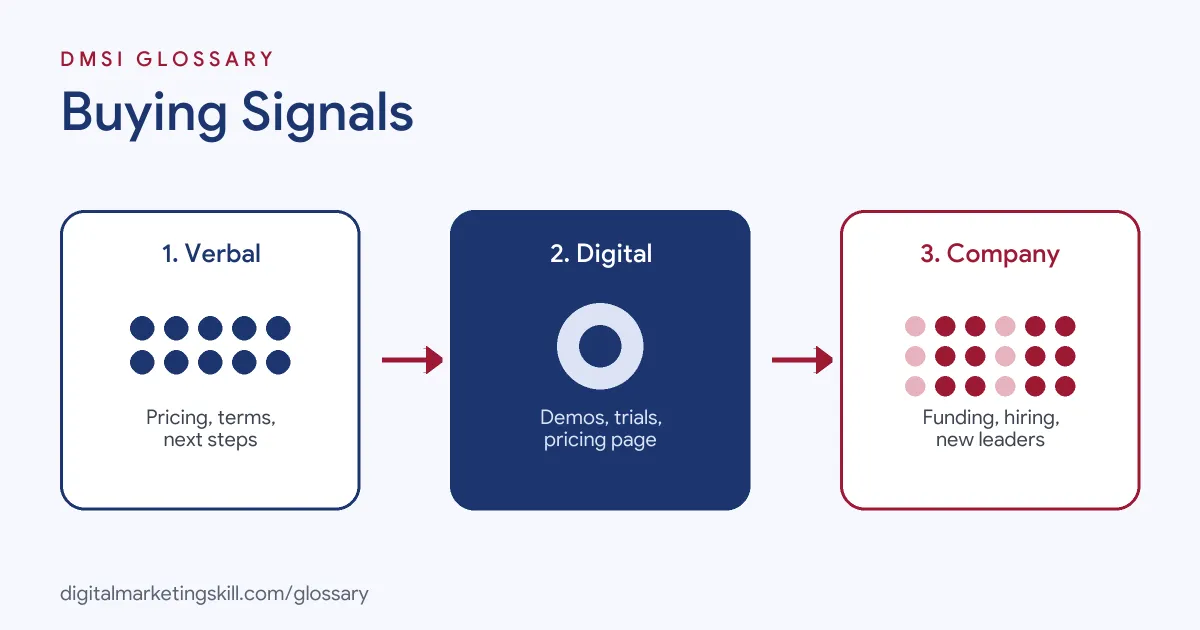
These come up in calls, meetings, chats and emails. Clearbit lists asking about pricing, terms and conditions and next steps among its examples. Others include:
- asking how long setup or delivery takes;
- asking about contracts, payment options or discounts;
- sharing specific problems in detail;
- asking “what happens next?”;
- talking as if they already own the product, for example “When we use this, could our team…”.
Non-verbal signals
In person or on video, signs such as leaning in, taking notes, nodding or a change in tone can show interest. These are useful but easy to misread, so confirm them with questions.
Behavioural and digital signals
These are actions you can track online:
- visiting the pricing page, especially more than once;
- requesting a demo or quote;
- signing up for a free trial;
- downloading gated content such as guides or price lists;
- reading case studies;
- opening and clicking several emails in a row;
- returning to the website often within a short time.
Company and trigger events
In business-to-business sales, changes at a company can signal a need. Examples include new funding, a new leader in the relevant team, rapid hiring, expansion into new markets or a switch away from a competitor.
Third-party intent signals
Some signals happen away from your website, such as researching a topic, reading reviews of products like yours or comparing vendors on review sites. Clearbit includes researching on review sites among its examples. Intent data tools collect some of these signals, but treat them as hints rather than proof.
Strong vs Weak Buying Signals
Not all signals are equal. A useful habit is to rank them by strength.
- Strong signals: demo or quote requests, pricing questions, asking about contracts or start dates, bringing in decision-makers, trial users who invite colleagues.
- Medium signals: repeat visits to product or pricing pages, reading case studies, attending a webinar, replying positively to outreach.
- Weak signals: a single blog visit, following a social account, opening one email.
Strong signals deserve a quick, personal response. Weak signals suit gentle lead nurturing, such as helpful emails or content.
What is not a buying signal?
Coldlytics includes a section on what is not a buying signal, and the point matters. Polite interest, vague compliments or curiosity without any need are not strong signals. A student reading your pricing page for a project is not a buyer. That is why teams check signals against fit: does the person or company match your ideal customer, and do they have a real need, budget and authority?
Are objections buying signals?
Often, yes. A prospect who raises a concern, such as “Will this work with our current system?”, is thinking seriously about using the product. Coldlytics discusses whether an objection is a buying signal. Handle objections with care, because they can show real interest.
Buying Signals in Marketing
Marketing teams use buying signals to decide who to nurture and who to pass to sales. Common steps include:
- Define signals. Agree which actions matter, such as a pricing page visit or a webinar sign-up.
- Score them. Give points to each action in lead scoring, with more points for strong signals.
- Set thresholds. When a lead reaches a set score, it becomes a marketing-qualified lead.
- Trigger actions. Send relevant emails, show retargeting ads or alert a salesperson.
Signals also show where people are in the customer journey, so content can match their stage.
Buying Signals in Sales
Sales teams use signals to decide who to call first and what to say. Good practice includes:
- Respond quickly to strong signals while interest is fresh.
- Reference the signal naturally. For example, “I noticed you were looking at our team plan. Can I help with any questions?” Keep it helpful, not creepy.
- Ask open questions to confirm need, timing and who is involved.
- Propose a clear next step, such as a short call, a demo or a trial.
- Log signals in the CRM so the whole team has context.
In social selling, signals such as profile views, comments on your posts or engagement with your content can open conversations. See our entry on the Social Selling Index.
Buying Signal Examples
Here are simple, illustrative examples. They are not real people or businesses.
- A small business owner downloads a price guide, visits the pricing page twice in two days and opens every follow-up email. Marketing scores the lead highly and passes it to sales.
- During a demo, a prospect asks how long onboarding takes and whether her team can be trained in the first week. The salesperson proposes a start date.
- A trial user invites three colleagues and connects the product to another tool. The account manager offers a call to discuss a paid plan.
- A company announces new funding and posts several marketing job adverts. A marketing software provider reaches out with a relevant case study.
How to Respond to a Buying Signal
A simple way to respond is to acknowledge, ask and suggest. First, acknowledge the interest in a natural way, without pointing out exactly what you tracked. Second, ask a short, open question to learn more about the need and timing. Third, suggest one clear next step that is easy to say yes to, such as a fifteen-minute call or a tailored demo. For weaker signals, respond with something useful instead, like a relevant guide or case study. Over time, review which signals led to real sales and adjust your scoring, so the team keeps focusing on the clues that matter most.
Common Mistakes
- Treating every signal as urgent. This wastes time and annoys people.
- Ignoring fit. A signal from someone outside your target market is rarely worth chasing.
- Waiting too long. Interest fades quickly.
- Being creepy. Saying “I saw you visited our pricing page three times yesterday” can feel intrusive. Offer help instead.
- Not sharing signals. If sales and marketing do not share data, signals get missed.
Buying Signals and Your Career
Spotting and acting on buying signals is a core skill in B2B marketing, sales development, marketing automation and CRM roles. It links content, email, analytics and sales. If you want to build practical skills in lead generation, nurturing and campaign tracking, you can join the Digital Marketing Skill programme.
Frequently Asked Questions
What is meant by a buying signal?
A buying signal is a word, action or event that shows a prospect is interested in buying or getting closer to a decision.
What are examples of buying signals?
Asking about pricing, requesting a demo, signing up for a trial, visiting the pricing page repeatedly, reading case studies and asking about next steps.
What is the strongest buying signal?
Clear commitment to a next step, such as agreeing a start date, asking for a contract or involving decision-makers, is among the strongest.
What is signal-based selling?
It is an approach where sales teams prioritise and time their outreach based on buying signals, rather than contacting everyone on a list in the same way.
How do you track buying signals?
Use website analytics, email and marketing automation tools, CRM records, product usage data and notes from calls and meetings.
What is the difference between intent data and buying signals?
Intent data is one source of buying signals, usually showing research activity. Buying signals is the wider term and includes verbal cues, actions and company events.
Sources: Clearbit: Buying signals definition and examples; Coldlytics: What is a buying signal?; Common Room: Examples of buying signals; Salesforce: Buying signals. We have no connection with these companies.