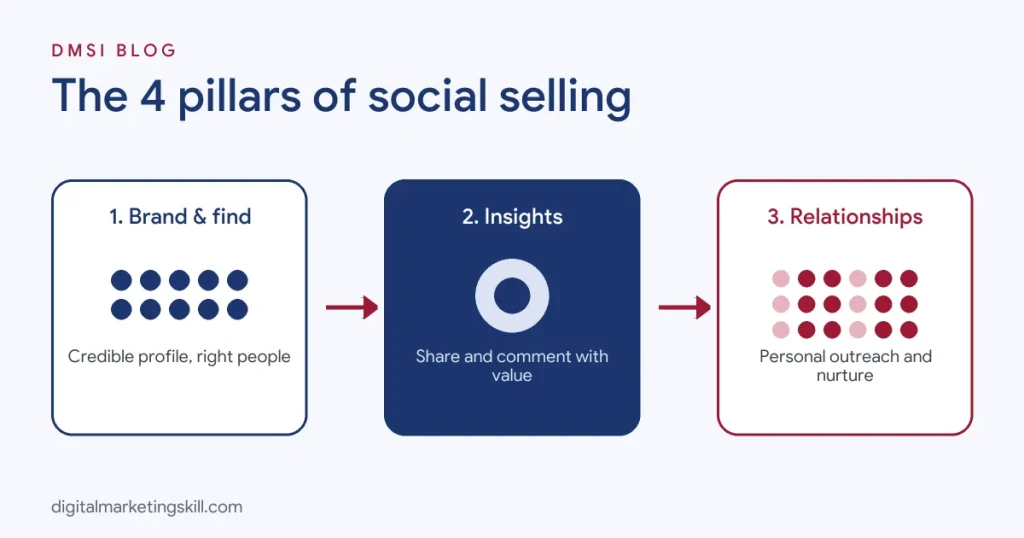
Social selling is the practice of using social networks, especially LinkedIn, to find, connect with and build relationships with potential buyers, so that sales come from trust rather than cold pitches. Instead of calling strangers from a list, a social seller builds a credible profile, shares useful insights, joins conversations where buyers spend time and reaches out when there is a genuine reason. LinkedIn describes it as a strategic method for sellers to connect and build relationships with prospects through social networks, and its Social Selling Index scores it across four pillars: establishing a professional brand, finding the right people, engaging with insights and building relationships. Done well, social selling shortens sales cycles, warms up cold outreach and turns your network into a steady source of opportunities.
This guide explains what social selling is, how it differs from social media marketing and cold calling, the four pillars, a step-by-step method, real examples and message templates, the best tools and how to measure results. It works hand in hand with our guide to LinkedIn lead generation.
Key Takeaways
- LinkedIn defines social selling as a strategic method for sellers to connect and build relationships with prospects through social networks.
- LinkedIn’s Social Selling Index measures four pillars: professional brand, finding the right people, engaging with insights and building relationships.
- LinkedIn has reported that sales professionals who excel at social selling create more opportunities and are more likely to reach quota than peers who do not.
- LinkedIn says it has more than one billion members, making it the largest professional network for B2B social selling.
- Social selling is not spamming: it relies on relevant content, listening for buying signals and personalised outreach.
In this guide
- What Most Social Selling Guides Miss
- What Is Social Selling?
- Social Selling vs Social Media Marketing vs Cold Calling
- Benefits of Social Selling
- The 4 Pillars of Social Selling
- How to Start Social Selling: A Step-by-Step Method
- Social Selling on Different Platforms
- Social Selling Examples
- Social Selling Message Templates
- Social Selling Tools
- B2B Social Selling and Team Programmes
- How to Measure Social Selling
- Challenges and Mistakes to Avoid
- The One Rule for Social Selling
- An Illustrative Case
- Frequently Asked Questions About Social Selling
- Your Next Step
What Most Social Selling Guides Miss
Many guides describe social selling as “posting on LinkedIn and connecting with prospects.” That leads to the most common failure: profiles full of sales pitches and inboxes full of copy-paste messages that nobody answers.
- Social selling is a long game. Its value comes from being known and trusted before a buyer needs you. People who expect sales in a week usually quit just before it starts working.
- Listening matters more than posting. The best social sellers spend as much time reading, commenting and noticing buying signals as they do creating content.
- It is not only for salespeople. Freelancers, consultants, founders, recruiters and job seekers all use social selling. If you sell your skills, you are a seller.
What Is Social Selling?
Social selling means using social media to build relationships that lead to sales. Wikipedia describes it as the process of developing relationships as part of the sales process, often through networks such as LinkedIn. Salesforce calls it a lead-generation technique where salespeople interact directly with prospects on social media.
In practice, social selling has four parts:
- Be credible: a professional profile that shows who you help and how.
- Be visible: share and comment with useful insights where your buyers are.
- Be attentive: watch for signals that someone may need what you offer.
- Be personal: reach out with relevant, human messages, and nurture relationships over time.
It sits at the meeting point of personal branding, lead generation and relationship selling.
Social Selling vs Social Media Marketing vs Cold Calling
| Social selling | Social media marketing | Cold calling | |
|---|---|---|---|
| Who does it | Individuals: salespeople, founders, freelancers | Brands and marketing teams | Sales reps |
| Goal | One-to-one relationships that lead to deals | Awareness and engagement at scale | Immediate meetings or sales |
| Approach | Personal insight, conversation and timing | Content, ads and community | Unsolicited calls to lists |
| Prospect’s view | A familiar, helpful contact | A brand they follow or see | An interruption |
| Best for | Considered purchases, B2B, services | Broad reach, consumer brands | Simple offers, high volume |
Social selling and cold outreach are not enemies. Many sellers use social selling to warm up a contact before a call or cold email, so the prospect recognises their name.
Benefits of Social Selling
- Warmer conversations. Prospects who have seen your insights or exchanged comments are more open to talking.
- Better targeting. LinkedIn’s professional data lets you find decision-makers by job title, company and industry.
- Buying signals. Job changes, funding news, new hires and posts about problems tell you when to reach out.
- Credibility at scale. One useful post can be seen by hundreds of potential buyers.
- Lower cost. Organic social selling costs time rather than ad spend.
- Stronger relationships. Staying visible keeps you front of mind for referrals and repeat business.
LinkedIn has long reported that sales professionals who score highly on its Social Selling Index create more opportunities and are more likely to hit their targets than those who do not. Whatever the exact figures for your industry, the pattern is consistent: being visible and helpful beats being a stranger.
The 4 Pillars of Social Selling
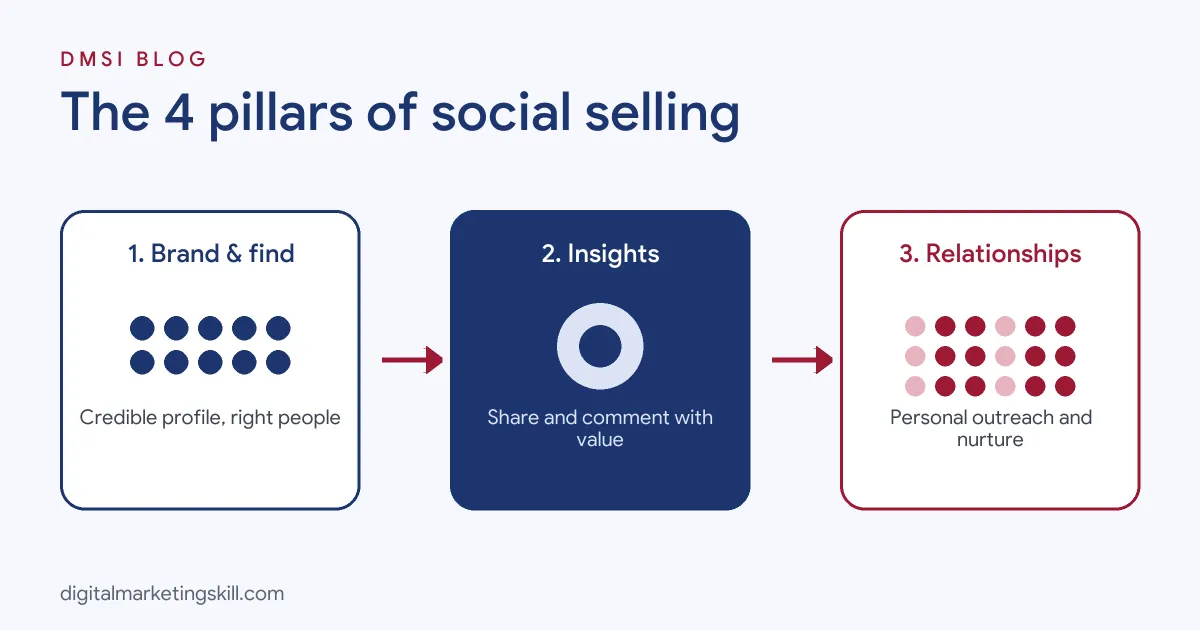
LinkedIn’s Social Selling Index scores members out of 100 across four pillars, each worth up to 25 points. They make a useful framework for any platform.
1. Establish Your Professional Brand
Your profile is your shop window. Use a clear photo, a headline that says who you help and how, an About section focused on buyers’ problems, a featured section with proof such as case studies, and recommendations from clients. Our guide to LinkedIn profile optimisation walks through each section.
2. Find the Right People
Define your ideal customer profile: industry, company size, location and the job titles of decision-makers and influencers. Use LinkedIn search filters, or LinkedIn Sales Navigator for advanced searches and saved lead lists, to find them.
3. Engage With Insights
Share content that helps your buyers: lessons, data, opinions, short case studies and practical tips. Comment thoughtfully on prospects’ posts. Insight-led engagement shows expertise without pitching.
4. Build Relationships
Connect with personalised notes, follow up with value, and keep conversations going over months. Relationships, not single messages, produce deals and referrals.
How to Start Social Selling: A Step-by-Step Method
Step 1: Define Who You Want to Reach
Write a one-paragraph description of your ideal buyer. For example: “Marketing managers at UK B2B software companies with 50 to 300 employees who struggle to generate leads from content.” Be specific enough to search for.
Step 2: Optimise Your Profile for Buyers
Rewrite your headline from your job title to the value you bring: “Helping B2B SaaS teams turn content into pipeline” beats “Marketing consultant.” Add proof, a clear call to action and a link to a relevant resource.
Step 3: Build a Targeted Network
Connect with ideal buyers, their colleagues, partners and peers in your industry. Add a short personalised note explaining why you want to connect. Quality beats quantity.
Step 4: Post Useful Content Consistently
Aim for two to four posts a week on topics your buyers care about. Mix formats: short text posts, carousel documents, short videos and occasional polls. Talk about problems and lessons, not just your services.
Step 5: Engage Daily
Spend 15 to 20 minutes a day commenting on posts from prospects and industry voices. Add a real point of view, a question or a resource. Comments are often seen by more people than your own posts.
Step 6: Listen for Buying Signals
Watch for job changes, new roles, company growth, funding announcements, new product launches and posts about challenges you solve. These are natural reasons to reach out.
Step 7: Reach Out With Relevance
When you message, reference something specific, offer value and ask a low-pressure question. Never paste a sales pitch into a connection request.
Step 8: Move Conversations Forward
When interest is clear, suggest a call, share a relevant case study or invite them to a webinar. Track every conversation in a CRM so nothing slips.
Step 9: Nurture and Review
Not everyone is ready to buy. Stay in touch with useful updates and check your results monthly: which posts, messages and signals led to real conversations? This is lead nurturing through social channels.
Social Selling on Different Platforms
| Platform | Best for | Social selling tips |
|---|---|---|
| B2B, professional services, recruiting, careers | Optimise profile, post insights, use search or Sales Navigator, comment on prospects’ posts | |
| X (Twitter) | Tech, media, real-time conversation | Join industry conversations, reply to prospects, share quick insights |
| Consumer brands, creators, coaches, local businesses | Use Stories and DMs, share behind-the-scenes, respond to comments | |
| Facebook Groups | Communities, local markets, niche professions | Answer questions helpfully, follow group rules, build reputation |
| Follow-up and relationships in many markets, including across Africa | Move warm conversations here with permission; share updates via Status |
For B2B, LinkedIn is usually the centre of social selling. For consumer brands and local businesses, Instagram, Facebook and WhatsApp often matter more. Our guide to B2B social media covers platform choice in more depth.
Social Selling Examples
- The helpful comment: A cybersecurity consultant sees an IT director post about a phishing incident. She comments with two practical prevention tips, without pitching. A week later, the director messages her for advice.
- The trigger event: A recruiter notices that a startup just announced funding. He congratulates the founder and shares a short guide on hiring the first sales team. The founder books a call.
- The content magnet: A freelance designer posts weekly before-and-after website redesigns with short explanations. Small business owners start messaging her for quotes.
- The referral loop: An accountant regularly shares tax deadline reminders and congratulates connections on milestones. Clients tag him when friends ask for recommendations.
- The event follow-up: After a virtual event, a sales rep connects with attendees, referencing a specific session and sharing a related resource.
- The job-seeker version: A junior digital marketer wants a remote role with UK agencies. Instead of mass-applying, she follows ten agency founders, comments thoughtfully on their posts for a month and shares a short case study of a campaign she ran during her internship. When one founder posts a vacancy, he already recognises her name and invites her to interview. Social selling works just as well when the product you are selling is your own skills, which is why it is now a core habit for freelancers and job seekers as well as sales teams.
Social Selling Message Templates
Use these as starting points, then personalise every message.
Connection Request
“Hi Amara, I enjoyed your post on hiring remote marketers, especially your point about trial projects. I write about B2B lead generation and would love to connect.”
After a Buying Signal
“Congrats on the new Head of Growth role, Tom. Many people in their first 90 days focus on quick wins in paid search; I put together a short checklist on that. Happy to share if useful.”
Follow-Up After Engagement
“Thanks for your comment on my post about landing pages, Grace. You mentioned conversion rates dropping after a redesign; that is common. Would a quick audit of your top page help? No pressure either way.”
Reviving a Quiet Connection
“Hi Kunle, I came across this report on email deliverability and thought of our chat last spring. Hope things are going well at the agency.”
Notice what these share: a specific reference, something useful and a soft question. That is the formula for outreach that gets replies.
Social Selling Tools
- LinkedIn Sales Navigator: advanced lead search, saved lists, alerts for job changes and company news, and InMail.
- LinkedIn’s Social Selling Index: a free score that shows your strengths and gaps across the four pillars.
- A CRM such as HubSpot, Pipedrive or Salesforce, to track conversations and deals. See our guide to CRM in digital marketing.
- Social listening tools to monitor mentions, keywords and competitor activity. See our guide to social listening.
- Scheduling tools like Buffer, Hootsuite or Sprout Social to plan posts.
- Content tools such as Canva for carousels and graphics, and AI writing assistants for drafting, always edited in your own voice.
- Employee advocacy platforms that help teams share approved content. See employee advocacy.
B2B Social Selling and Team Programmes
B2B social selling means applying these methods to sell products and services to other businesses, usually involving several decision-makers and longer sales cycles. Social selling suits B2B well because buyers research suppliers long before talking to sales.
Companies that roll out social selling across a team usually:
- Train sellers on profile optimisation, content and outreach etiquette.
- Provide a library of useful content they can share and adapt.
- Align marketing and sales on target accounts, often with account-based marketing.
- Set simple weekly habits, such as five thoughtful comments a day and two posts a week.
- Track results in the CRM and share wins to keep momentum.
How to Measure Social Selling
| Metric | What it shows |
|---|---|
| Social Selling Index | Overall activity and effectiveness across the four pillars |
| Connections and followers in your target audience | Network quality |
| Profile views from target job titles | Whether your activity attracts buyers |
| Post engagement from prospects | Content relevance |
| Reply rate to outreach | Message quality and relevance |
| Conversations and meetings booked | Pipeline creation |
| Opportunities and deals influenced by social | Revenue impact |
Track activity metrics weekly and outcome metrics monthly. Add a “source” field in your CRM so you can see how many deals started or advanced through social channels. Our upcoming guide on LinkedIn analytics explains the platform data in detail.
Challenges and Mistakes to Avoid
- Pitching in the connection request. It feels like spam and gets ignored or reported.
- Copy-paste messages. Generic templates are obvious. Personalise every message.
- Posting only about yourself. Share insights that help buyers, not just company news.
- Inconsistency. Social selling compounds. Sporadic effort produces sporadic results.
- Automation abuse. Mass automated connection requests and messages can break platform rules and damage your reputation.
- Not tracking results. Without measurement, you cannot prove social selling works or improve it.
- Giving up too soon. Most people need several months of steady activity before inbound conversations become regular.
The One Rule for Social Selling
Give before you ask. Share insights, help in comments and make useful introductions long before you pitch. When the time comes to talk business, the prospect already knows, likes and trusts you, which is the whole point.
An Illustrative Case
Imagine a freelance email marketer in Lagos who wants UK ecommerce clients. For months, she sends connection requests with a pitch attached and hears almost nothing back.
She changes her approach. She rewrites her headline to “Email marketing for UK ecommerce brands | Klaviyo flows that recover revenue,” posts twice a week with short teardowns of real welcome emails and spends 20 minutes a day commenting on posts from UK ecommerce founders. When a founder posts about high cart abandonment, she comments with two quick tips and later messages a short checklist.
After three months, her Social Selling Index rises from 38 to 66, profile views from ecommerce founders triple and she has five discovery calls a month, mostly from people who saw her comments. Two become retainer clients. She did not send more messages. She became someone worth hearing from.
This example is illustrative, not a real person, but it reflects how social selling turns attention into trust and trust into business.
Frequently Asked Questions About Social Selling
What is the meaning of social selling?
Social selling means using social networks to find, connect with and build relationships with potential buyers, so sales come from trust and relevance rather than cold pitches.
What are some examples of social selling?
Commenting helpfully on a prospect’s post, congratulating someone on a new role with a useful resource, sharing case studies that attract inbound enquiries and following up event attendees with relevant content.
What is B2B social selling?
It is social selling aimed at business buyers, usually on LinkedIn, where sellers build relationships with decision-makers over longer, multi-person buying processes.
Is social selling only for LinkedIn?
No. LinkedIn is the main platform for B2B, but social selling also works on X, Instagram, Facebook Groups and messaging apps like WhatsApp, depending on your audience.
What is the Social Selling Index?
It is LinkedIn’s free score out of 100 that measures your activity across four pillars: professional brand, finding the right people, engaging with insights and building relationships.
How long does social selling take to work?
Expect several months of consistent activity before inbound conversations become regular. Some quick wins can come sooner from well-timed, personalised outreach.
Is social selling better than cold calling?
For considered purchases and B2B services, social selling usually creates warmer conversations. Many teams combine both, using social activity to warm up contacts before calling.
Do I need LinkedIn Sales Navigator for social selling?
No. You can start with a free LinkedIn account. Sales Navigator adds advanced search, lead lists and alerts that help as you scale.
Can freelancers use social selling?
Yes. Freelancers and consultants are among the biggest beneficiaries, because social selling builds the personal credibility that wins clients.
What should I post for social selling?
Post insights that help your buyers: lessons, mini case studies, tips, opinions on industry trends and answers to common questions. Keep promotion to a small share of your posts.
Your Next Step
Social selling combines personal branding, content, lead generation and relationship building, skills every modern marketer needs. The Master Diploma in Digital & AI Marketing at Digital Marketing Skill Institute includes a Lead Generation and Email Automation track and an AI-powered Social Media Management and Advertising track, alongside Google, and WordPress and SEO.
From day one, you work on a real U.S. company’s project through the U.S. Project Internship, so you finish with real results and a verified U.S. work reference letter. You also get unlimited one-on-one coaching. The program carries dual US and UK accreditation, is recognised in more than 100 countries, and runs 100% online over three months.
You can build those skills wherever you live, anywhere in your country. Read student reviews, then apply for the 65% partial scholarship to see if you qualify.
Every figure in this guide was checked against its source before publication: LinkedIn Sales Solutions, LinkedIn’s Social Selling Index, Salesforce and Wikipedia. Results from social selling vary by industry and effort. The case above is an illustrative example, not a real result.