
A Quiz Funnel is a lead generation path where people answer a short online quiz, get a personal result, and are then guided towards an offer that fits their answers. It turns a cold visitor into a lead by giving them something useful first. Also, every answer tells you more about what the person wants. As a result, your follow-up can feel personal rather than generic.
Key Takeaways
- A quiz funnel uses questions, a result and a follow-up offer to turn visitors into leads.
- Each answer gives you data you can use to segment and personalise your marketing.
- Branching logic shows people only the questions that apply to them.
- The quiz result should be useful on its own, even if someone skips the email form.
- In the UK, you need specific consent before you send marketing emails to individuals.
What Is a Quiz Funnel?
Most funnels start with a form. For example, you offer a free guide and ask for an email address. A quiz funnel works differently. Instead of a form, it starts with a few questions about the visitor. Then it gives them a result, such as a skin type, a budget range or a “best plan for you”.
Think of a good shop assistant. They don’t just point at the shelves. First, they ask what you need. Then they suggest the two or three products that suit you. A quiz funnel does the same job online, at any hour, for every visitor.
Quiz tools make this easy to build. For example, Typeform explains that its Logic Jump feature “lets you create a typeform that responds based on people’s answers.” So two visitors can take the same quiz but see different questions and different results. It is a close cousin of the lead magnet, but more interactive.
Why It Matters
Why use a quiz instead of a simple form? First, people like learning about themselves, so a quiz gives them a reason to start. Second, the answers are data the person chose to share. Marketers often call this zero-party data. In addition, you can match each result to the right offer. On the other hand, a weak quiz with a vague result can feel like a trick, so quality matters.
How a Quiz Funnel Works
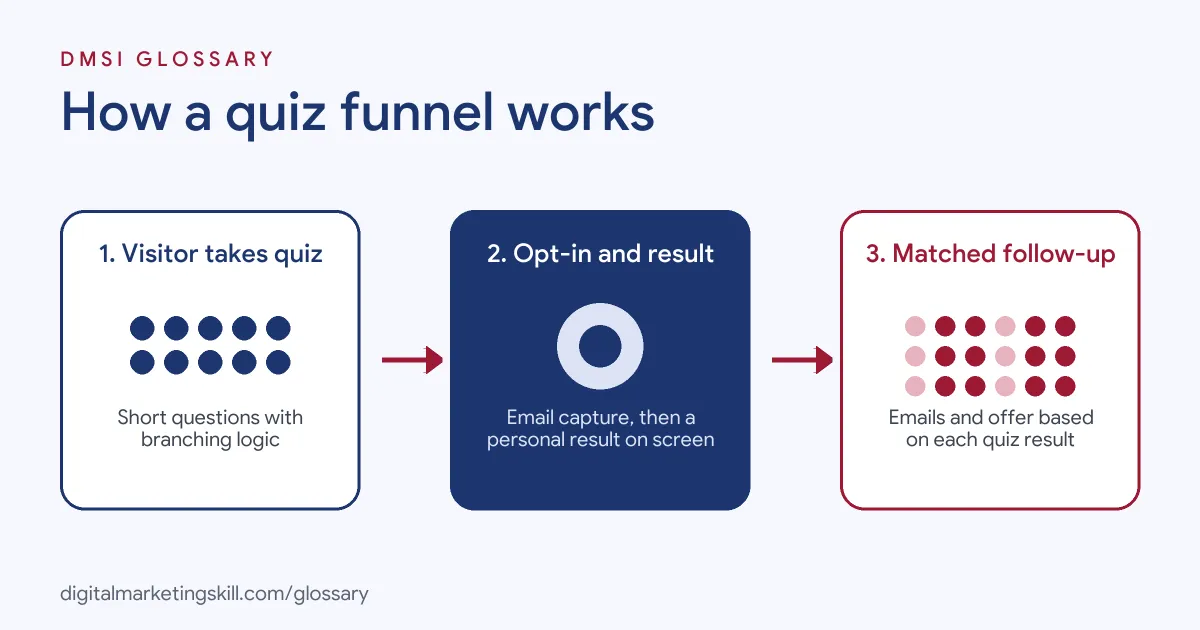
A quiz funnel has a few clear stages. Each one has its own job. So if results are poor, you can check each stage on its own and fix the weak spot.
Stage 1: The Hook and the Questions
First, traffic arrives from ads, social posts or your website. The visitor sees a clear promise, such as “Find the right plan in two minutes.” Then they answer a short set of questions. Good questions are easy to answer and help you sort people into groups. Also, branching logic can skip questions that don’t apply. As Typeform puts it, “Respondents never have to skip irrelevant questions — because with Logic Jump, they’ll never even see them.”
Stage 2: The Opt-In
Next, you ask for an email address. Some quizzes ask before showing the result. Others show the result first and offer a fuller report by email. Interact suggests that you “place the opt-in before the outcome with a clear option to skip when appropriate.” It also advises that “If somebody skips the opt-in, the on-screen outcome should still answer the quiz’s core question.” So the quiz still gives value, even without the email.
Stage 3: The Result
Then the visitor sees their result. A good result names their type, explains it simply and suggests one next step. For example, a fitness brand might show “Beginner strength plan” with a short reason and a link to the matching product. As Interact notes, “The outcome is already a useful summary of the person’s answers.”
Stage 4: The Follow-Up
Finally, the lead moves into your email or CRM tool. Here, you use the result as the main segment. Interact advises you to “Start with the final quiz outcome as the main branch.” After that, each group gets its own email sequence with tips, proof and an offer. Also, timing matters. Interact says, “The first message should arrive when the person expects it.”
Measuring Each Stage
Because each stage has one job, you can measure it with one number. For example, the start rate shows how well your hook works. Then the completion rate shows if the questions are too long. Next, the opt-in rate shows how much people trust the offer. Finally, sales or booked calls per result show which outcomes bring real value. So when results dip, you know which stage to fix first. In addition, tracking each result’s conversion rate helps you spot weak follow-up emails.
Examples of Quiz Funnels
- A skincare shop. The quiz asks about skin type, concerns and routine. Then each person gets a matching routine and a product bundle. Later emails share tips for that skin type only.
- A financial adviser. The quiz asks about goals and time frames. As a result, each lead lands in a group such as “saving for a home” or “planning to retire”. The adviser then offers a call to the groups that fit best.
- A software company. The quiz asks about team size and main problem. So the result recommends a plan, and sales gets the answers before the first call.
Quiz Funnel vs Lead Magnet vs Landing Page Form
| Point | Quiz funnel | Lead magnet | Landing page form |
|---|---|---|---|
| What the visitor gets | Personal result | Free guide, checklist or template | Quote, demo or call |
| Data you collect | Email plus many answers | Usually name and email | Contact details and a few fields |
| Personal follow-up | High, based on result | Medium, based on topic | Depends on form fields |
| Effort to build | Medium to high | Medium | Low |
| Best for | Products with several options or types | Teaching a topic | Ready-to-buy visitors |
How to Build a Quiz Funnel
- Pick one goal. Decide what the quiz should lead to, such as a product sale, a booked call or a trial.
- Define your results. Start with three to five outcomes. Each one should match a real offer you can make.
- Write the questions. Keep them short and easy. Then make sure each answer points towards one or more results.
- Add branching where it helps. Use logic so people skip questions that don’t apply to them.
- Set up the opt-in. Choose when to ask for the email. Also, add a clear consent box for marketing emails.
- Connect your tools. Send leads, answers and results into your email or CRM platform.
- Build the follow-up. Write a short sequence for each result, so every group gets relevant advice.
- Test and improve. Finally, track starts, completions, opt-ins and sales, then fix the stage with the biggest drop.
Best Practices for Quiz Funnels
- Make the result useful. Give real advice on screen, not just a teaser.
- Keep it short. Ask only questions that change the result or the follow-up.
- Use the answers. Feed them into segmentation and lead scoring, so sales can focus on the best leads.
- Be honest about the offer. Recommend what truly fits, even if it is the cheaper option.
- Ask for consent clearly. Explain what emails people will get and let them say no.
- Test one change at a time. Run an A/B test on the headline, the opt-in place or the result page.
Common Mistakes to Avoid
- Too many questions. Long quizzes lose people before the result.
- Vague results. A result that could fit anyone feels pointless.
- Hiding everything behind the form. If the result needs an email, people may leave or give a fake address.
- Ignoring the data. Collecting answers but sending everyone the same emails wastes the main benefit.
- No consent. Under UK rules, you must not send marketing emails to individuals without specific consent.
- Only tracking leads. Instead, track sales too, so you know which results bring real value.
Where You’ll Use Quiz Funnels at Work
Quiz funnels show up in copywriting, affiliate and conversion roles. For example, real remote job listings say:
- “You’ll own both the copy and the strategy for those pages: listicles, advertorials, quiz funnels, and pages tailored to a single ad.” (Landing Page Copywriter & Strategist).
- “Collaborate with internal creative and dev teams to launch and test new advertorials, VSLs, and quiz funnels.” (Affiliate Manager, Nutra).
- “you will own a client’s website and quiz-funnel experimentation roadmap from opportunity identification through execution and analysis.” (CRO and Website Optimization Specialist).
Learn It in the Lead Generation and Email Track
You can learn to plan quiz funnels and the email follow-up behind them in the AI-Powered Lead Generation and Email Automation track. Every track includes a U.S. Project Internship from day one, with unlimited 1-on-1 mentoring.
Frequently Asked Questions
How many questions should a quiz funnel have?
No single number suits every quiz. Keep only the questions that change the result or the follow-up, and test shorter versions.
Should I ask for the email before or after the result?
Both can work. If you ask before, give a clear option to skip, so the quiz still answers the visitor’s question.
What tools can I use?
Quiz builders such as Typeform and Interact let you add questions, logic and results. Then they can send leads to email and CRM tools.
Is a quiz funnel only for online shops?
No. Service firms, coaches, software companies and advisers also use quizzes to sort leads and suggest the right next step.
Do I need consent to email quiz leads?
In the UK, yes. The ICO says you must not send marketing emails to individuals without specific consent, so add a clear opt-in.
Sources: Typeform Help: What is Logic Jump?; Interact: How to Build a Marketing Funnel with Your Quiz; ICO: Electronic mail marketing; remote job listings on Himalayas, Himalayas and Himalayas.