Google ranking factors come down to three things working together. Content genuinely written to help the reader. Links other sites choose to give you because that content earned them. A page that loads and behaves well. Chase any one Google ranking factor alone and progress stalls. This guide covers all three, the tactics that now backfire, and the numbers worth tracking.
Key Takeaways
- Google’s own spam policy explicitly prohibits buying or exchanging links for ranking credit and large-scale guest-posting schemes. Any paid or traded link needs a rel=”nofollow” or rel=”sponsored” attribute to stay compliant.
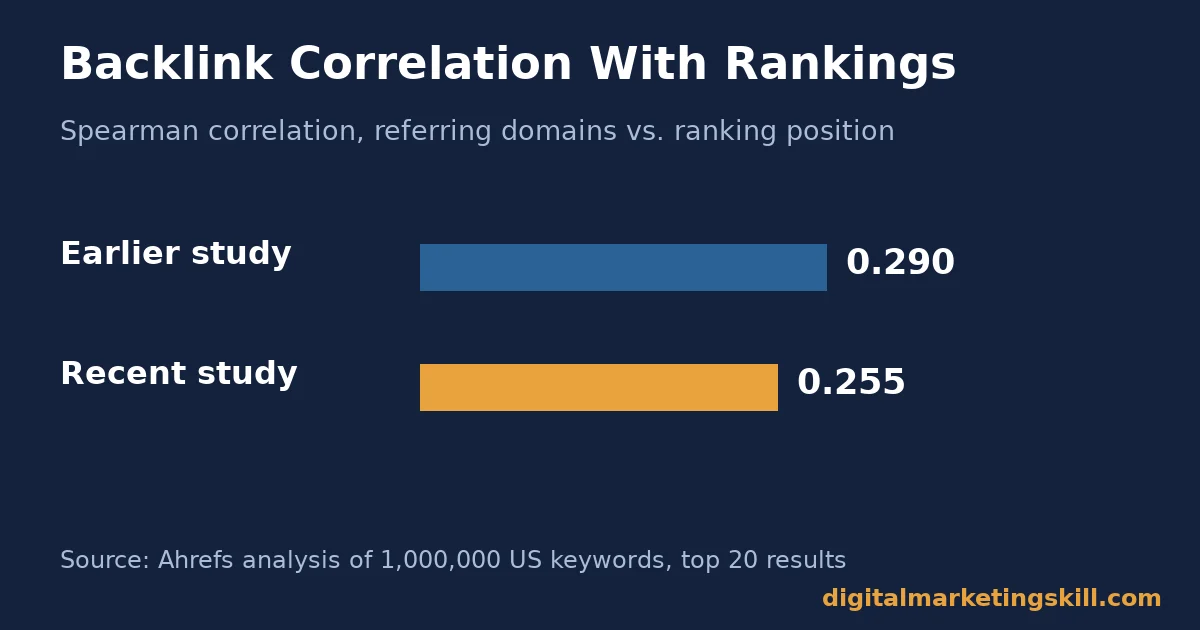
- Ahrefs’ analysis of the top 1,000,000 US keywords found referring domains correlate with rankings at just 0.255 on the Spearman scale. That is a weak link, down from 0.29 in an earlier study of the same kind.
- Google’s own Core Web Vitals thresholds call for a Largest Contentful Paint under 2.5 seconds, an Interaction to Next Paint under 200 milliseconds, and a Cumulative Layout Shift under 0.1. All three are measured at the 75th percentile of real visits.
- Google states plainly that fifteen percent of the searches it sees are ones it has never seen before. That is why genuinely useful, original content keeps mattering more than keyword-matching tricks.
- One named decision rule (below) tells you whether your next hour is best spent on content, on earning links, or on page speed.
In this guide
- The Gap Most Guides to Google Ranking Factors Miss
- How Google Actually Ranks a Page
- What Each Google Ranking Factor Actually Does
- How To Lead With the Right Priority For Your Site
- Measuring Google Ranking Factors That Work
- The One Decision Rule For Where To Put Your Next Hour
- A Real Case: What Changed When Content Replaced Link Volume
- Frequently Asked Questions About Google Ranking Factors
- Build Your SEO Skills With the Right Training
The Gap Most Guides to Google Ranking Factors Miss
Search any older guide to ranking on Google. You will find the same advice: submit to web directories, swap links with other sites, post the same article across a dozen low-quality blogs.
That advice was written for a search engine that no longer exists in that form. Today, several of those exact tactics sit on Google’s own list of practices that can get a site penalised. Following them now does not just fail to help. It actively works against the site that uses them.
Two ground rules before the detail. First, this is an informed approach built from Google’s own published guidance and independent data, not a guarantee. Every site’s results depend on its niche, competition, and history. A tactic that works well in one niche can do almost nothing in another, which is why copying a competitor’s exact playbook rarely works as well as it looks like it should.
Second, Google changes its systems constantly. Treat the figures here as a current snapshot, not a permanent ranking. Re-check Google’s own Search Central documentation periodically rather than trusting any single blog post, including this one, forever.
Keep a simple log of what you publish and when rankings move. Without it, it is easy to credit the wrong change for a result that actually came from something else entirely. A page that climbs after a content update, for instance, can easily get credited to an unrelated backlink that landed the same week.
How Google Actually Ranks a Page
Before chasing individual Google ranking factors, it helps to know what the system is actually doing. For the traffic tactics that work alongside good rankings, see this guide to ways to increase website traffic.
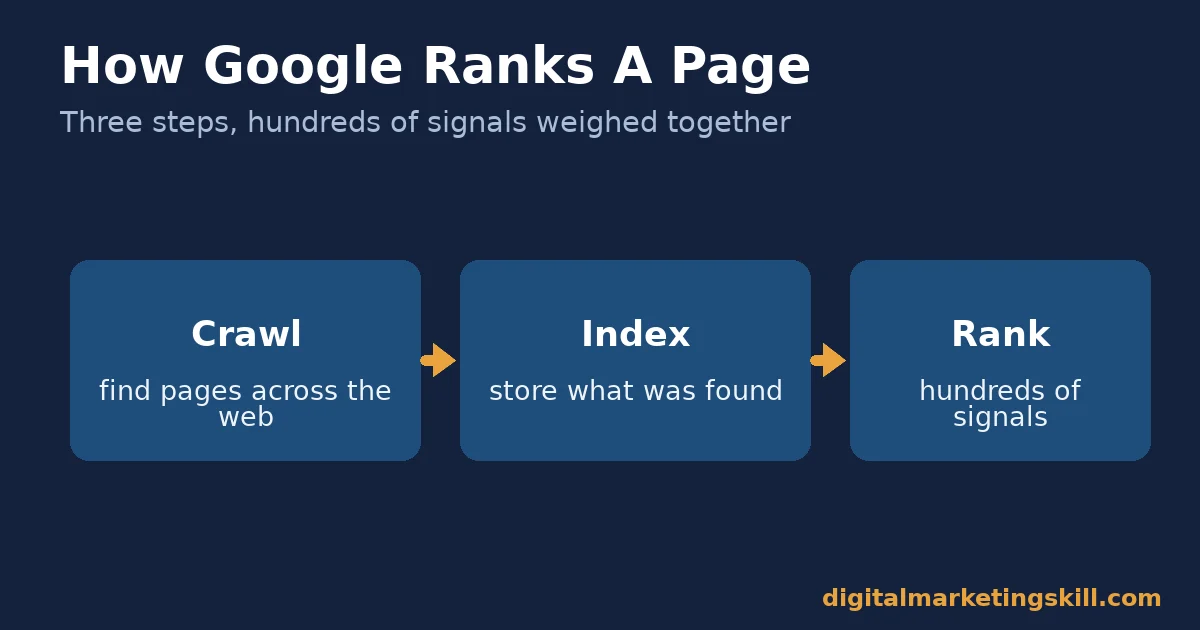
Google crawls pages, then indexes what it finds. It then ranks indexed pages for a specific search using a large set of automated systems. Those systems weigh the words on the page, the expertise behind the content, the user’s language and location, and hundreds of other signals together.
Google’s own documentation on creating helpful content states that its systems are designed to prioritise information created to genuinely help people. It is not built to favour content made mainly to attract search visits.
One figure makes the scale of this clear. Google’s own how Search works page says fifteen percent of the searches it handles every day are queries its systems have never seen before. No fixed set of tricks can be pre-built for a question nobody has asked yet. That is the real argument for genuinely useful content over keyword games.
Why the Old Link-Building Tactics Now Backfire
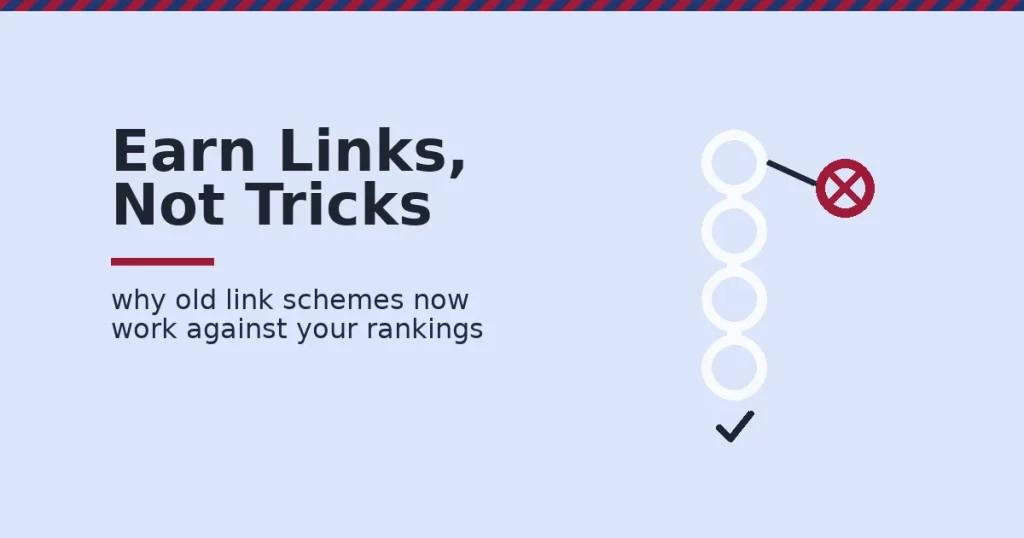
Google’s own spam policies name several once-common tactics directly. Buying or selling links that pass ranking credit. Excessive reciprocal link exchanges. Large-scale guest posting or article campaigns built mainly around keyword-rich anchor text.
A paid or traded link is still allowed to exist. It just cannot pass ranking credit unless it carries a rel=”nofollow” or rel=”sponsored” attribute. A sponsorship mention, an affiliate link, or a paid placement is fine as long as it is marked correctly. The problem only starts when that marking is skipped to quietly pass ranking value.
This matters because a lot of older SEO advice treated link volume as the main lever to pull. Independent data no longer supports that as the dominant factor among Google ranking factors. It is one input among many, not the whole system.
What Each Google Ranking Factor Actually Does
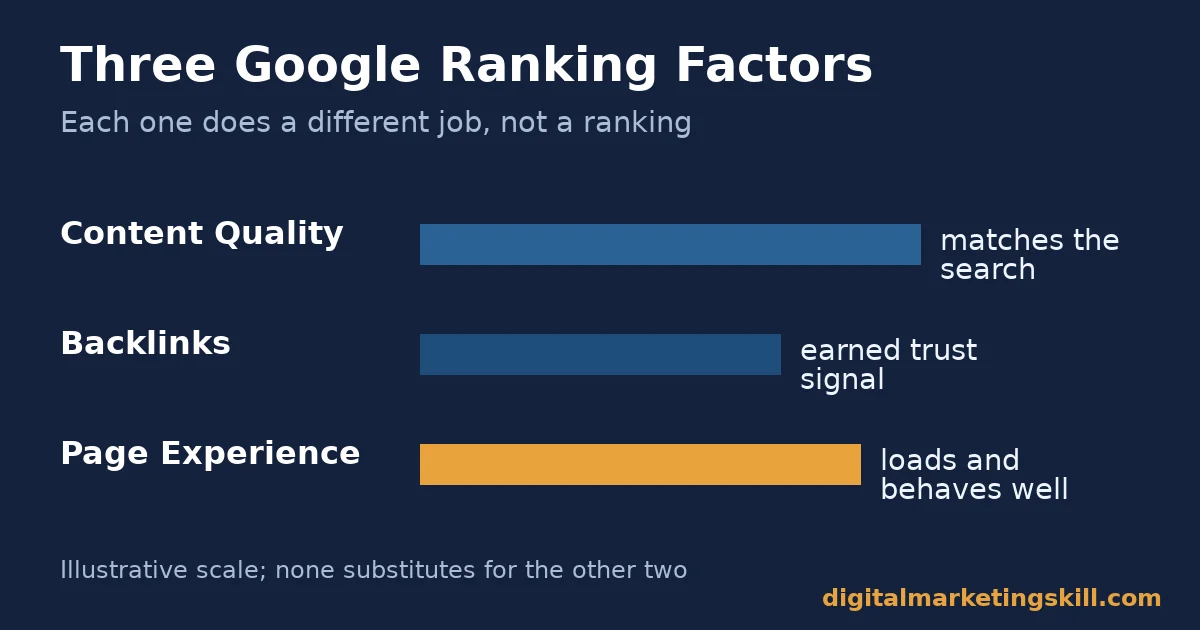
Three broad Google ranking factors matter most in practice, and each does a different job. None of them substitutes for the others. Strength in one area cannot fully cover a serious weakness in another.
Content Quality: Built For Relevance, Not Volume
Content is what Google’s systems ultimately try to match to a searcher’s question. More pages are not inherently better than fewer, better ones. Google’s helpful-content guidance specifically warns against mass-producing content on trending topics without real expertise behind it.
Backlinks: Built For Earned Trust, Not Easy Volume
Ahrefs’ large-scale correlation study found referring domains to be the strongest-correlating backlink metric with rankings. But at 0.255 on the Spearman scale, that correlation is still classed as weak. It has also fallen from 0.29 in an earlier comparable study. Links still matter. They matter less, on their own, than they once did, and manufactured links carry real policy risk.
Page Experience: Built For Usability, Not Decoration
Core Web Vitals measure whether a page loads fast, responds quickly to taps and clicks, and stays visually stable while it loads. Google’s own published thresholds are clear: a Largest Contentful Paint under 2.5 seconds, an Interaction to Next Paint under 200 milliseconds, and a Cumulative Layout Shift under 0.1.
Each is measured at the 75th percentile of real visits, so a handful of slow loads do not unfairly dominate the picture. A page that fails one of these three can still rank, but it is working against itself while the gap stays open.
How To Lead With the Right Priority For Your Site
Knowing what each factor does only matters if it changes what you work on next.
Content: Lead With Real Expertise, Not Keyword Stuffing
Write the page a genuine expert on the topic would write. Then make sure the keyword your audience actually searches appears naturally within it. Answer the question completely enough that a reader does not need to open a second tab.
Credit real sources, and update a page when the facts inside it change, rather than publishing once and leaving it untouched for years. Where you place that keyword matters too, which is covered in this guide to keyword placement.
Backlinks: Lead With Reasons To Link, Not Requests For Links
Instead of asking for links directly, build the kind of page other sites want to cite on their own. An original resource. A genuinely useful tool. Data nobody else has published. Something a writer in your niche would reach for instead of writing their own version from scratch.
A link-worthy content strategy earns links passively over months. That is slower than a link exchange, but it carries none of the policy risk. It also tends to attract links from sites that actually send traffic, not just ranking credit, which a manufactured link rarely does.
Page Experience: Lead With Your Single Biggest Bottleneck
Run your site through a free Core Web Vitals report. Fix whichever metric is furthest from the threshold first, rather than tweaking all three at once. A single oversized hero image is a common cause of a failing Largest Contentful Paint score, and it is usually the fastest fix on the list. For a broader technical starting point, see this guide to WordPress SEO.
Measuring Google Ranking Factors That Work
These are the KPIs worth tracking monthly, each defined in one sentence:
- Organic sessions is the number of visits your analytics tool attributes to unpaid search results. It tells you whether your overall visibility is growing, not just one page’s rank.
- Average position, from Search Console, is the typical ranking spot for a page across the queries it shows up for. It tells you how close a page sits to the visible top results.
- Click-through rate (CTR), also from Search Console, is the share of people who saw your result and clicked it. It tells you whether your title and description are persuasive at your current position.
- Core Web Vitals pass rate is the share of your pages meeting all three Google thresholds. It tells you whether technical page experience is helping or quietly working against your content.
- Referring domains is the number of distinct websites linking to you. It tells you whether your content is earning outside trust over time, not just internal traffic.
Read these together. Rising average position with flat click-through rate usually means your title and description need work, not your content.
Strong content with a falling Core Web Vitals pass rate usually means a technical issue is quietly capping results that would otherwise improve. A falling referring-domains count alongside flat content output usually just means the content has stopped earning new attention. That is a signal to publish something newly citable, not to panic about the existing pages.
How Often to Check These Numbers
Review Search Console data monthly rather than daily. Rankings move day to day for reasons entirely outside your control. Reacting to daily noise usually wastes more effort than it saves. A monthly review, done consistently, catches a genuine trend without chasing every small wobble in between.
The One Decision Rule For Where To Put Your Next Hour
With limited time, use this rule. If a page’s content is thin or outdated, spend the hour improving the content itself before anything else.
A page whose content is genuinely strong but earns few outside links calls for an hour of outreach, or an hour turning part of it into something more citable. When the content and links are both solid but Core Web Vitals are failing, spend the hour on the technical fix instead.
Illustrative, invented numbers: imagine a page that ranks around position 14, has a thin 400-word article, and loads in 4.8 seconds. Following the rule, the content is the clear bottleneck here. The hour goes into expanding and improving the article first.
Page speed matters too, but a technically fast page built on thin content rarely outranks a genuinely useful one that loads a little slower. Fix the bottleneck that is actually holding the page back, not the one that is easiest to fix. Easiest and most impactful are often two different tasks entirely.
A Real Case: What Changed When Content Replaced Link Volume
Among the stories published on the Institute’s own student reviews page, a pattern shows up in the SEO-focused stories specifically. Students who had been chasing link volume through directories and exchanges saw more durable progress once they shifted that same effort into improving the content itself. They also spent time fixing clear technical issues.
The shift was not a secret tactic. It was spending the hour on the actual bottleneck instead of the easiest task.
For some students that meant rewriting thin pages from scratch. For others it meant fixing a slow-loading theme that had quietly capped every page on the site. The specific fix varied. The habit of identifying the real bottleneck first did not. As with any student outcome, results vary by effort, niche, and market, and the Institute makes no income or results guarantees; see the earnings disclaimer for details.
None of this requires expensive tools to start. A free Search Console account and an honest read of your weakest page is enough to find the first real bottleneck, and the same approach applies to any site working through the same Google ranking factors.
Frequently Asked Questions About Google Ranking Factors
What are the most important Google ranking factors today?
Genuinely helpful content, a reasonable number of earned backlinks from other sites, and solid page experience as measured by Core Web Vitals. Google’s own systems weigh hundreds of signals together, but these three groups cover most of what a site owner can directly control.
Do backlinks still matter for ranking on Google?
Yes, but less on their own than commonly assumed. Ahrefs’ large-scale study found a weak correlation between referring domains and rankings. That correlation has fallen over time, consistent with Google’s own statements that many other signals matter alongside links.
Is link exchanging or buying links against Google’s rules?
Buying or selling links that pass ranking credit is explicitly against Google’s spam policies, as is excessive reciprocal link exchanging. Any paid or traded link needs a rel=”nofollow” or rel=”sponsored” attribute to stay compliant.
What are Core Web Vitals and why do they matter?
They are Google’s three published measures of real-world page experience: loading speed, interaction responsiveness, and visual stability. Google’s thresholds are under 2.5 seconds, under 200 milliseconds, and under 0.1 respectively, each measured at the 75th percentile of actual visits.
How long does it take to see a ranking improvement?
There is no fixed timeline. Content changes can show movement within weeks. Earned backlinks and overall domain trust typically build over months instead. Treat any guide, including this one, that promises a fixed number of days with caution. A realistic plan budgets weeks for content, months for backlinks, and both working together for the strongest result.
Should a small business worry about Google ranking factors at all?
Yes, but proportionally. A small, genuinely useful site competing on a specific, well-chosen topic can realistically outrank larger, generic competitors on that topic, even with far fewer backlinks overall. Picking that narrow topic well matters more than most small sites realise. A broad, crowded term is rarely worth the fight when a narrower, underserved one is sitting right next to it.
What is the single biggest mistake sites still make with SEO?
Treating an old tactic list as permanent. Advice that worked years ago, such as mass link exchanges or directory submissions, now sits on Google’s own list of discouraged practices. A strategy needs periodic review against current guidance, not a one-time setup.
Does publishing more content always help rankings?
No. Google’s own helpful-content guidance warns specifically against mass-producing pages on trending topics without real expertise behind them. A handful of genuinely strong pages usually outperforms a large volume of thin ones. Quality and quantity are not opposites, but when forced to choose, quality wins almost every time.
Can a brand-new site compete on Google ranking factors at all?
Yes, on a narrow enough topic. A new site has no backlink history and little trust yet, so it rarely competes on broad, high-volume terms early on. It can still rank well on a specific, less-contested question if the content answers it better than anything already indexed.
Where should I check my own site’s Google ranking factors first?
Start with Search Console. It shows your actual average position, click-through rate, and flagged Core Web Vitals issues for real pages on your own site, which is more useful than any general benchmark for deciding what to fix first.
Build Your SEO Skills With the Right Training
Understanding Google ranking factors works best as one piece of a wider digital marketing skill set, alongside the content and technical skills that support it. Digital Marketing Skill Institute’s Master Diploma in Digital & AI Marketing covers nine practical courses built around that mix. It comes with unlimited one-on-one coaching and mentoring and real project work inside a U.S. company, so what you learn gets tested on a live account rather than a hypothetical one.
The program is dual US and UK accredited, and recognised in more than 100 countries. It is delivered 100% online, so you can study from your country on your own schedule. Coaching covers SEO alongside the rest of the mix, so questions about a specific page or a specific set of Google ranking factors get a real answer, not a generic template.
Wherever you live, the fundamentals behind Google ranking factors stay the same: genuinely useful content, earned trust, and a page that works well for real visitors. Explore the Master Diploma in Digital and AI Marketing program, browse more lessons on the digital marketing blog, or go straight to the application page to start. Learn more about Digital Marketing Skill Institute at https://digitalmarketingskill.com/, or return to https://digitalmarketingskill.com/ any time to explore other free lessons.
Every figure in this guide was checked against its original source before publication. Figures marked as illustrative are invented examples, not real results.
![9 Amazing Digital Marketing Skills to Make Money Online [With Proof]](https://digitalmarketingskill.com/wp-content/uploads/2019/07/9-Amazing-Digital-Marketing-Skills-to-Make-Money-Online-With-Proof-17.png)