

LinkedIn for professional growth works when you fix visibility first. A complete profile with a photo and listed skills gets found, read and messaged far more than a bare one. That gap decides who gets the interview, the client or the mentor. This guide shows you how to use LinkedIn for professional growth with specific, sourced numbers, wherever in your country you happen to be sitting.
Key Takeaways
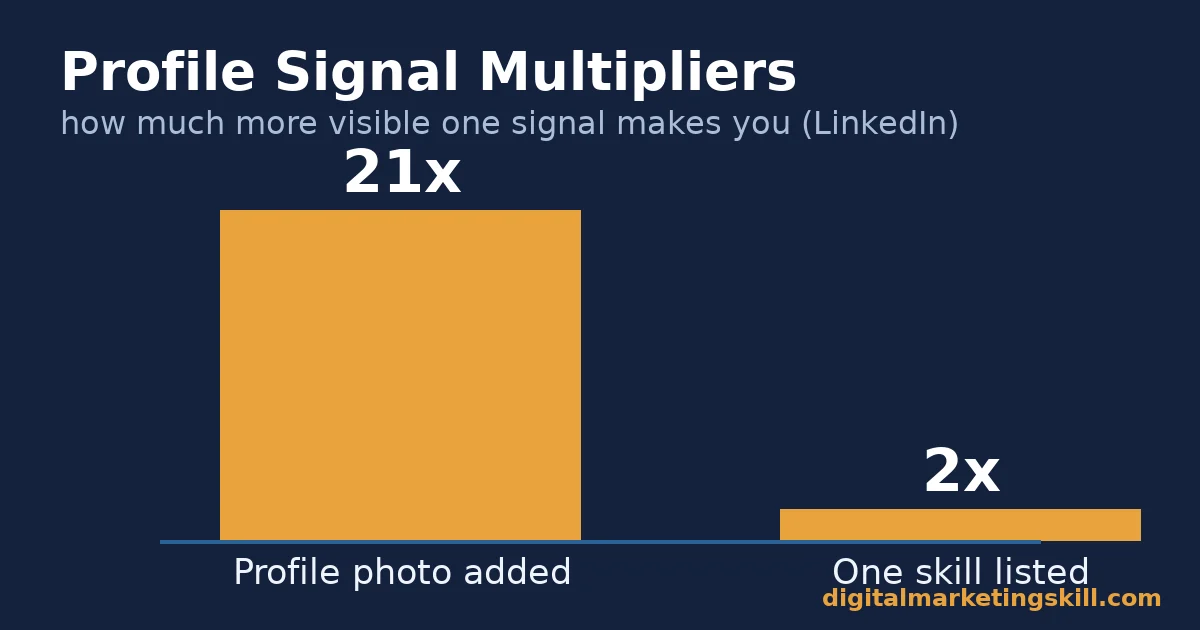
- Members who list at least one skill get up to 2x more profile views and connection requests, and up to 4x more messages, according to LinkedIn’s own talent data.
- A profile photo alone drives 21x more profile views and 9x more connection requests, per LinkedIn’s own sales data.
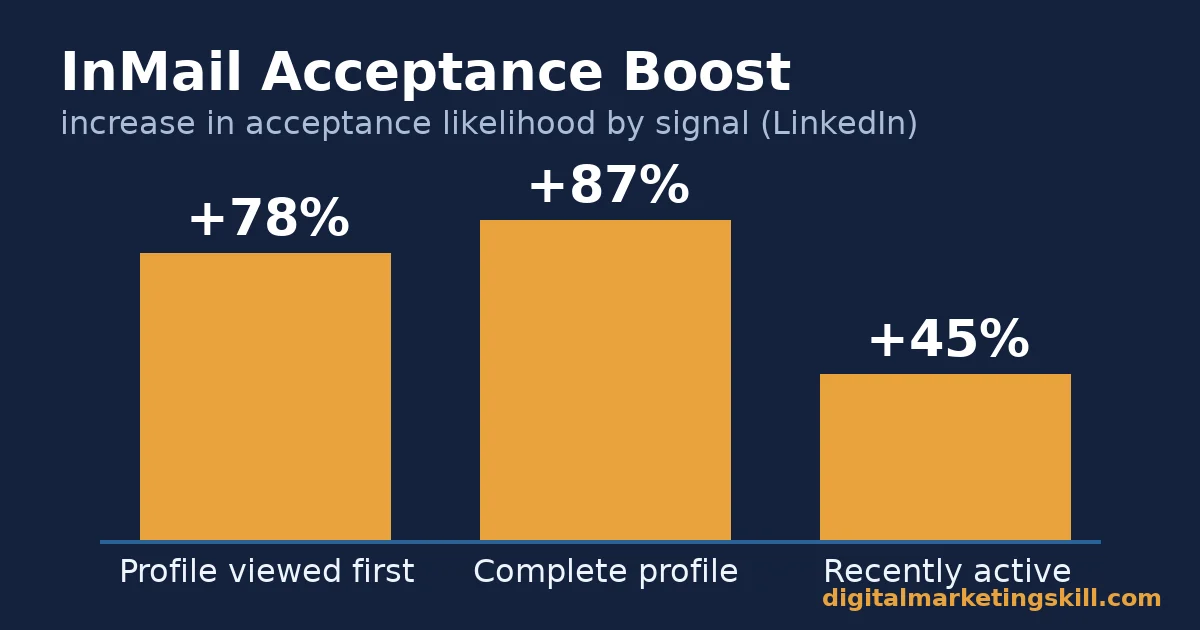
- Viewing someone’s profile before you message them makes that person 78% more likely to accept an InMail, according to LinkedIn’s own InMail acceptance analysis.
- A fully completed profile raises InMail acceptance by 87%. Recent activity on the platform raises it by a further 45%. A static profile loses twice over.
- Referrals make up roughly 40% of hires despite being only about 7% of applications, per Jobvite’s recruiting data.
In this guide
- The Gap in Most LinkedIn for Professional Growth Advice
- How LinkedIn for Professional Growth Actually Works
- What Differs by Career Stage
- How to Lead With Each Stage
- How to Measure Your LinkedIn Growth
- The One Decision Rule: Fix Visibility Before You Fix Volume
- Common LinkedIn for Professional Growth Mistakes to Avoid
- What Doing This Right Looks Like
- Frequently Asked Questions About LinkedIn for Professional Growth
- Start Using LinkedIn for Professional Growth Today
The Gap in Most LinkedIn for Professional Growth Advice
Most advice on LinkedIn for professional growth stops at two lines: post more, and connect with everyone. That advice treats LinkedIn like a content feed. It is not one. LinkedIn is a search and discovery system first.
Recruiters, clients and collaborators rarely scroll a feed looking for you. Instead, they search for a role, a skill or a name. Because of that, the platform’s own ranking decides whether your profile surfaces first, surfaces late, or never surfaces at all.
The ground rule for this guide is simple. Every tactic below is built to change how often you get found, not just how often you post. Where a figure comes from one company’s report, this guide names that limit, because a benchmark that is years old, or self-reported by a single vendor, is a useful signal rather than a settled fact.
Because of that distinction, you will see the actual source named next to every number in this guide, instead of a vague “studies show.” If a claim has a real limit, such as being US-only or self-reported, that limit is stated alongside it, so you can weigh the figure correctly before you act on it.
How LinkedIn for Professional Growth Actually Works
LinkedIn now counts more than 1 billion members across more than 200 countries and territories, according to LinkedIn’s own company page. Nobody browses a network that size. Search and recommendation decide who gets seen. Visibility, not raw member count, is the thing you actually control.
LinkedIn’s search system reads your profile as a set of signals. It does not read it as a story. A photo, a headline, a list of skills, a recent post and a recent connection each add weight. Together they decide how often you appear in a recruiter’s search, or in a colleague’s “people you may know” list.
Remove one signal and your visibility drops. The system simply has less text to match against a searcher’s query. Think of it like a filing system: fewer labels on a file mean fewer ways anyone can find it later.
Why Two Similar Profiles Perform Differently
Two professionals with almost identical experience can get wildly different results from LinkedIn for professional growth. One lists five relevant skills. She updates her headline every time her role changes. The other leaves a blank “About” section. His headline still reads “Student,” two promotions later.
According to LinkedIn’s own talent blog, that gap runs up to 4x more messages. It also runs up to 2x more profile views and connection requests, for a profile with even one listed skill compared with a profile with none. The same page reports that 48% of hirers on LinkedIn now use skills data directly to fill roles. The platform is not being unfair here. It is matching text against text. A thin profile simply matches fewer searches.
Activity compounds the same mechanism. A member who has posted, commented or reacted recently reads to the system as more findable. A frozen profile tells the search index nothing new to rank. That is a mechanical reason, not a popularity contest. Recent activity refreshes the exact signals the index uses.
What Differs by Career Stage
The signals above are the same for everyone. Which one matters most changes with where you are in your career. Treat these three stages as a diagnostic, not a rigid ladder you must climb in order.
Early Career: Built For Discovery
If you have fewer than a handful of years of experience, your biggest problem is simple. You are not being found at all. A recruiter searching for a specific skill will never see a profile with a vague headline like “Looking for opportunities.”
Your profile needs to answer one question fast: what can you already do, even without a long job history? List every genuinely relevant skill. Include skills from coursework, freelance work, or a internship. LinkedIn’s search weighs skills heavily, and you have little work history to compensate.
A specific headline beats a vague one, because it matches more exact searches. “Digital Marketing Graduate: Social Media and Email Automation” will surface for more searches than “Digital Marketing Graduate” alone.
Established Professional: Built For Authority
With five or more years of experience, discovery is rarely the problem. Being mistaken for “just another candidate” is. Your profile already shows up in searches, so the job shifts. You now need to prove depth once someone clicks through, which is the exact gap a layout-level profile audit is built to catch.
A list of job titles with no outcomes attached reads as generic, no matter how senior the titles are. Because of that, recommendations and endorsements do more work at this stage than at any other. A peer’s written account of one specific project carries more weight than a bare bullet point ever can.
A senior profile with zero recommendations after a decade of work is a visible gap. Recruiters notice this gap quickly, and so do potential clients running the exact same search.
Career Switcher: Built For Translation
If you are moving into a new field, such as from an unrelated career into digital marketing, your challenge is translation. It is not visibility, and it is not depth. Search algorithms and human recruiters both struggle to connect “ten years in retail management” to “digital marketing coordinator” on their own.
You have to make that link explicit. Your “About” section should carry the translation work, in a fixed order: the transferable skill, then the new skill you added, and finally one concrete result from using it.
A switcher who only lists the new job title, without naming the bridge between old and new, gets filtered out. Search terms assume a straight-line career path unless you tell them otherwise.
How to Lead With Each Stage
Diagnosing the gap above is step one of using LinkedIn for professional growth. Leading with the right habit, consistently, is what actually moves the numbers.
Early Career: Lead With Consistent Presence
Post or comment on relevant content at least weekly. Recent activity is itself a ranking signal, and early-career profiles have the least existing authority to fall back on without it.
A short comment that adds one specific insight does more for visibility than a long post nobody reads. That is because comments appear inside the original author’s network too, not just your own. For example, a two-line comment that adds one real number to someone else’s post about hiring can reach hundreds of people you have never connected with directly.
Request connections from people you have actually interacted with first. Classmates, workshop leaders, and people whose posts you engaged with all count. Cold requests sent in bulk get ignored far more often. A thin acceptance rate quietly signals low relevance back to the algorithm, which then shows your profile to fewer people.
Established Professional: Lead With Original Insight
Share a specific lesson from a real project. Skip the generic industry opinion everyone has already read a dozen times. Specificity is what makes a senior post worth reading, and it is also what makes other professionals comment, which raises your visibility further.
Ask for a recommendation immediately after finishing a project, while the details are still fresh for the person writing it. A specific request works better than a vague one. Name the project. Name the outcome you want mentioned. That produces a far more useful recommendation than a generic “can you write me something.”
Career Switcher: Lead With Transferable Proof
Publish one piece of real proof. A project you built while learning the new skill works well here. Do not only claim the skill in text. A link to a real campaign, a real analysis, or a real small project does more to override a recruiter’s doubt than any adjective in your headline.
Join two or three groups specific to the new field, and answer questions inside them before you ask for anything. LinkedIn’s own group limits allow a member to belong to up to 100 groups, so being selective about relevance matters far more than hitting that ceiling. Demonstrated knowledge inside one relevant group reaches people who already care about the exact skill you are translating into.
How to Measure Your LinkedIn Growth
Three numbers tell you whether your changes to LinkedIn for professional growth are working. Each one answers a different question. If you are actively applying for roles, pair these with how recruiters actually decide who to contact, since the two mechanisms reinforce each other.
Profile views measure whether people are finding you at all. A rising weekly count, visible in your own analytics tab, means your signals are getting matched more often by search.
Search appearances measure how many different queries your profile is matching. If views rise but search appearances stay flat, people are finding you through posts or shared connections, not cold search. That gap points you back to the skills and headline work above.
Connection and message acceptance rate measures quality, not just reach. A low acceptance rate on a growing number of requests usually means your targeting is too broad. A high acceptance rate on a small number sent means you are already being selective enough. Volume, not precision, is your next lever in that case.
Why These Three Numbers Compound
LinkedIn’s own analysis of InMail acceptance shows how much these signals compound. Viewing a profile first makes that person 78% more likely to accept a message. A complete profile raises acceptance by 87%. Recent activity on the platform adds a further 45%. Track all three numbers together. A profile that only chases views, without checking acceptance rate, often ends up widely seen and rarely trusted.
The One Decision Rule: Fix Visibility Before You Fix Volume
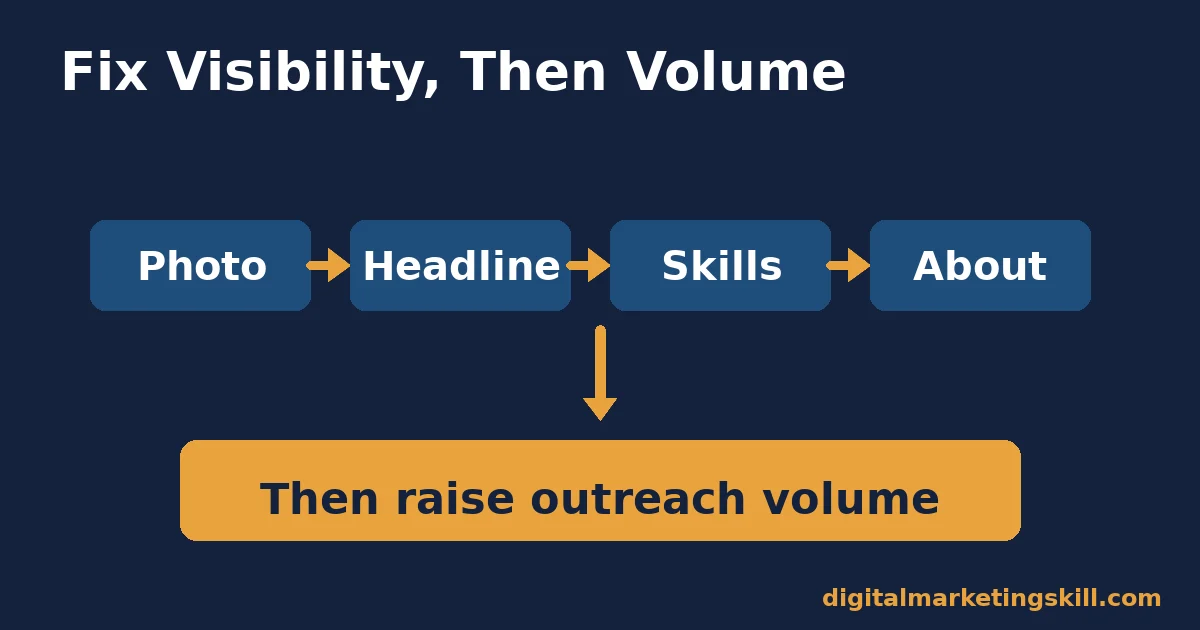
If you take one rule from this guide, take this one: when it comes to LinkedIn for professional growth, fix visibility before you fix volume. Do not increase how much you post, connect or message until your core profile signals are complete: photo, headline, skills, and “About” section. Volume on top of a thin profile wastes the extra effort, because your underlying match rate stays low no matter how many messages you send.
Here is an illustrative, invented example to show the logic, not a real result. Imagine two professionals each send 50 connection requests in a month. One has a complete profile with five listed skills and a specific headline. The other has a bare profile with no photo at all.
Suppose the complete profile converts at double the rate, which is plausible given the multiplier effect LinkedIn’s own data shows for photos and skills. In that case, the complete profile nets roughly twice the accepted connections from the identical effort. Therefore, fixing the profile first is cheaper than doubling your outreach to compensate for skipping it.
Common LinkedIn for Professional Growth Mistakes to Avoid
Three mistakes show up again and again once you look at profiles through the visibility lens above. Each one quietly cancels out effort you already put in.
Treating the Headline as a Formality
A headline that only repeats your job title wastes the single most-searched field on your profile. Because recruiters often search by skill rather than title, a headline with zero named skills simply fails to match those searches, no matter how senior the title is.
Sending Bulk Outreach Before Fixing the Profile
Sending more connection requests from a thin profile does not fix low acceptance. Instead, it lowers your acceptance rate further, since the algorithm reads a string of ignored requests as a weak relevance signal. Fix the profile first, then raise outreach volume, in that order.
Going Quiet Once the Profile Looks Finished
A profile is not a one-time project. Once it looks finished, many people stop updating it, and their visibility quietly fades over the following months. Because recent activity is itself a ranking signal, a profile that never changes slowly loses the matches it used to win.
A simple fix works here. Set a short, recurring reminder to review your profile once a month. Add a new skill when you learn one. Update your headline the day your role changes, not months later. Each small update refreshes the signals the search index reads, which keeps your LinkedIn for professional growth effort compounding instead of flatlining.
What Doing This Right Looks Like
Olajire Jacob moved into digital marketing from a background in pharmacy. He described charging an average of $500 to set up email marketing flows for clients soon after finishing his training. He then scaled that work to $5,000 a month as his network and visible track record grew, as published on Digital Marketing Skill Institute’s reviews page.
His account shows the same mechanism this guide describes. A specific, demonstrable skill set, connected to real client outcomes, made visible to the right network. As a result, that combination beats a vague profile hoping to be noticed, every time. Individual results vary, and LinkedIn visibility is one input among many into any income outcome. See the earnings disclaimer for the full context behind student income figures like his.
Frequently Asked Questions About LinkedIn for Professional Growth
How often should I post on LinkedIn for professional growth?
Once a week is a reasonable floor. Recent activity is a ranking signal, and infrequent posting lets that signal go stale. Consistency matters more than frequency here. A short, specific comment every few days beats one long post a month.
Do LinkedIn recommendations actually matter for visibility?
They matter more for trust than for search ranking directly. A specific, written account of your work reduces a recruiter’s doubt in a way a bullet point cannot. Ask for recommendations while the project is fresh, and name what you would like mentioned.
Is a LinkedIn profile photo really necessary?
Yes. LinkedIn’s own sales data shows a profile photo drives 21x more profile views and 9x more connection requests. Skipping it is one of the highest-cost shortcuts anyone takes on the platform.
How many skills should I list on my profile?
List every skill that is genuinely true and relevant, rather than chasing a specific number. LinkedIn’s data shows the jump from zero to one listed skill already produces up to 2x more profile views and connection requests, and up to 4x more messages.
Should I connect with everyone who sends a request?
No. A smaller, more relevant connection count that accepts and engages at a high rate helps your visibility more than a large, disengaged one. Acceptance and engagement are themselves signals the platform reads and ranks you on.
How long does it take to see results from these changes?
Profile view changes often show within a few weeks, because they depend on search matching, which updates quickly. Network effects, such as referrals and mentorship, take longer. Real relationships build over time, not through a single profile edit. Expect weeks for the first signal, and months for the first referral, and plan your effort around that honest timeline instead of expecting both at once.
What is the single most common mistake people make?
Increasing outreach volume before fixing a thin profile. The decision rule in this guide exists because that one mistake quietly wastes more effort than any other mistake on the platform.
Start Using LinkedIn for Professional Growth Today
LinkedIn for professional growth is not about posting more, or connecting with more strangers. It is about making your real skills visible to the right people, then proving them once someone looks closer. Fix your profile signals first. Lead with consistent, specific activity suited to your career stage. Measure views, search appearances and acceptance rate together, so you actually know what is working.
If you want the skills behind that visible track record, not just the profile tips, Digital Marketing Skill Institute’s Master Diploma in Digital & AI Marketing builds real, demonstrable skills. The program runs through four AI-powered tracks: AI-Powered Social Media Management and Advertising, AI-Powered Lead Generation and Email Automation, AI-Powered Google Specialist, and AI-Powered WordPress and SEO Specialist. Together they total ten execution-first courses, with a Full Stack option for completing all four.
Every track includes unlimited 1-on-1 coaching and mentoring, plus a U.S. Project Internship with a verified U.S. Work Reference Letter. That internship is the kind of concrete proof this guide recommends putting on your profile in the first place. The program is dual US and UK accredited, recognised in more than 100 countries, and 100% online, so you can build that track record anywhere in your country.
Where to Go Next
Explore the program and apply here, or browse more guides on the Digital Marketing Skill Institute blog. Learn more at digitalmarketingskill.com, wherever you live, and take the first step toward real LinkedIn for professional growth on digitalmarketingskill.com today.
Every figure in this guide was checked against its original source before publication. Figures marked as illustrative are invented examples, not real results.
