
Most people trying to make money from freelancing search for one more platform or one more gig. That’s not the real problem. The real problem is pricing and positioning. This guide uses sourced numbers to show what separates freelancers who earn a steady living from those stuck chasing low-paying work.
Key Takeaways
- The worldwide average hourly rate freelancers charge is $21. This comes from a survey of 7,000 freelancers across more than 150 countries (Payoneer).
- Writing, design, programming and IT are the most popular freelance fields. Payoneer’s data shows they often pay less than rarer categories, simply because supply is high.
- Freelancers over 55 earn more than double what younger freelancers earn on average. Female freelancers earn around 84% of what male freelancers earn across all fields (Payoneer).
- Toptal accepts fewer than 3% of applicants through its five-stage screening funnel. It’s a real example of how strict proof of skill supports premium rates (Toptal).
- The two numbers that predict freelance survival are effective hourly rate and repeat-client rate. The number on your rate card matters far less.
In this guide
- Why Most Advice on How to Make Money From Freelancing Falls Short
- How Freelancers Actually Make Money
- What Differs by the Type of Freelance Work You Choose
- How to Make Money From Freelancing With Each Skill Type
- How Long It Realistically Takes to Make Money From Freelancing
- Where to Find Freelance Work That Actually Pays
- How to Price Your Freelance Work So You Actually Make Money
- Tools That Help You Make Money From Freelancing Without Wasting Time
- How to Measure Whether Your Freelance Business Is Working
- The One Rule for Making More Money From Freelancing
- A Real Case: What a Strict Vetting Funnel Looks Like in Practice
- Common Mistakes That Stop People From Making Money From Freelancing
- Frequently Asked Questions About Making Money From Freelancing
- Freelancing Works the Same Way Wherever You Live
- Turning Freelance Skills Into a Repeatable Income
Why Most Advice on How to Make Money From Freelancing Falls Short
Most beginner guides focus on where to find gigs. They list platforms. They share proposal templates. A pep talk about being your own boss usually follows.
That advice helps with your first job. But it rarely explains why two freelancers doing the same type of work earn wildly different amounts. This is an informed framework, not a fixed formula, because freelance markets shift by skill, region and platform. Treat every figure here as a snapshot, not a permanent ranking.
The real gap is this: learning how to make money from freelancing is a pricing and positioning problem first. Finding work comes second.
Think about two freelancers with the same skill. Both work the same hours each month. One prices by the hour with no scope limit. They take any client who asks.
The other prices by project. They pick a niche. They say no to a mismatched client. Over a year, the second freelancer almost always earns more. They work fewer unpaid hours. They keep more of the clients they already have. Nothing about their raw skill changed. Only their pricing and positioning did.
How Freelancers Actually Make Money
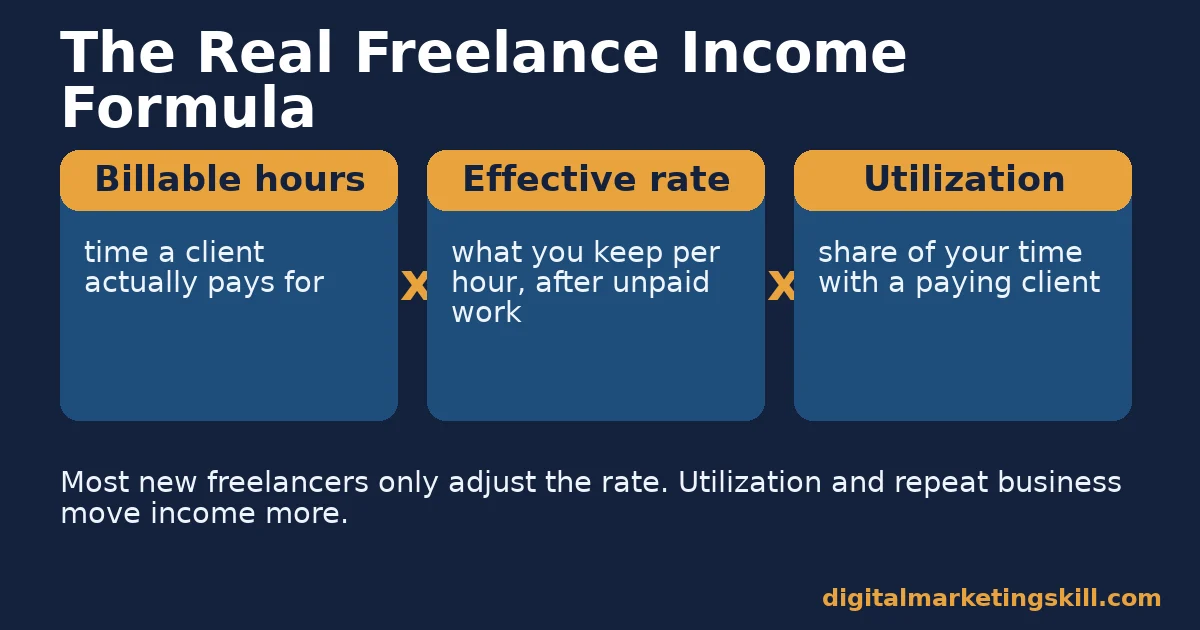
A freelancer’s income is not simply hours worked times a rate. Three things multiply together instead.
First, billable hours: the time a client actually pays for. Second, effective rate: what you keep per hour after unpaid admin, proposals and revisions. Third, utilization: the share of your working time that is billable at all.
Most new freelancers only adjust one number: the rate on their profile. They raise it or lower it and hope income follows. But the multipliers that actually move total income are utilization and repeat business. Utilization means how much of your time has a paying client attached. Repeat business means how much of your pipeline you don’t have to rebuild every month through new pitching.
This also explains Payoneer’s global freelance income survey. Writing, design, programming and IT pay less on average than rarer categories. Thousands of freelancers compete for the same visible jobs. That competition drives the achievable rate down, even when demand for the work itself is high.
What Differs by the Type of Freelance Work You Choose
Not all freelance categories behave the same way. Broadly, freelance skills split into two groups. Each group needs a different strategy.
Fast-Entry Skills: Built for Volume, Not Premium Rates
Writing, data entry, virtual assistance, social media posting and basic admin support share one trait. The barrier to start is low. So the pool of competing freelancers is large.
Clients can compare dozens of similar profiles side by side. That pushes prices toward the middle of the market, not the top.
These categories are still useful for a first portfolio and first reviews. Clients hiring for them often accept freelancers without a long track record. The tradeoff is a lower ceiling on price per hour, until you narrow your niche. For example, move from “general writing” to “SaaS onboarding emails.”
Technical and Specialized Skills: Built for Fewer, Higher-Paying Clients
Web development, programming, specialized design systems and niche technical consulting sit at the other end. Fewer freelancers can credibly do this work. So clients have fewer profiles to compare, and the achievable rate rises.
The tradeoff is the entry cost. Clients usually want proof first: a portfolio, a certification, a referral, or a vetting process like Toptal’s own screening funnel. As a result, you spend more unpaid time learning and demonstrating the skill before your first paid project.
How to Make Money From Freelancing With Each Skill Type
Once you know which group your skill sits in, your strategy for the first twelve months should look different.
Fast-Entry Skills: Lead With a Narrow Niche and Speed
If you’re starting in a crowded category like writing or virtual assistance, don’t compete on being cheapest. Instead, narrow your niche until you’re the obvious pick for one specific type of client. Pick one industry. Pick one content format. Then choose one software tool and stick with it.
Then prioritize fast, reliable turnaround. A narrow niche lets you reuse templates and research across clients. That raises your effective hourly rate, even if your sticker rate stays modest.
Technical Skills: Lead With Proof and Positioning
If your skill is technical or specialized, invest early in a portfolio of real projects, or clearly labelled practice projects. Write a short, specific description of who you solve problems for.
Apply to at least one rigorous, vetted platform or client process. Toptal reports an acceptance rate under 3% for its own funnel. That kind of screening signals to future clients that your skill was checked by someone other than you.
How Long It Realistically Takes to Make Money From Freelancing
There’s no fixed timeline for how long it takes to start earning as a freelancer. It depends on your niche, your proof of skill, and how much time you can put into outreach each week.
Fast-entry skills, like basic writing or data entry, often land a first small project within days or weeks. The barrier to entry is low, and clients move quickly.
Technical and specialized skills usually take longer to land a first client, often a few months. Clients want more proof before they pay a premium rate. Neither path is wrong. They just need different patience, and different proof, before you start to make money from freelancing at a pace you can rely on.
What tends to matter more than the calendar is momentum. Picture a freelancer who lands one small project. They deliver well. They ask for a testimonial or referral. That freelancer almost always reaches steady income faster than one who waits for a perfect first client. Treat your first few projects as proof-building, not pure income. That framing alone helps many beginners make money from freelancing sooner than they expect.
Where to Find Freelance Work That Actually Pays
Once your positioning is clear, where you look for work matters more than how many places you apply to.
General marketplaces like Upwork and Fiverr give you volume and visibility, especially early on. But they also put you in direct price comparison with thousands of other freelancers. See our breakdown of which freelance platforms fit which stage of your career for a closer look.
Beyond the big two, dedicated freelance marketplaces organized by fee structure and vetting level are worth comparing before you commit your time to one. Niche job boards built around one skill work differently. Writing-specific boards like ProBlogger or Freelance Writing are a good example. They tend to attract clients who already expect to pay for a specialist, not a generalist.
Referrals from past clients are the highest-paying source for most freelancers. A referred client already trusts your work before the first conversation starts. That’s one more reason repeat-client rate, not platform choice, is the number worth tracking from day one.
Direct outreach is another option: a short, specific email to a company you’d like to work with. Our guide to finding real remote work and avoiding scams covers this cold-pitch approach in more detail. It’s slower to start, but it often skips the price competition entirely. It works best once you already have one or two portfolio pieces to point to.
How to Price Your Freelance Work So You Actually Make Money
Pricing mistakes are the single biggest reason freelancers fail to make money from freelancing, even when they have steady clients.
Start by pricing the outcome, not the hour, whenever you can. A client who wants a landing page doesn’t care how long it takes you; they care what it does for their business. Pricing by project protects your effective hourly rate far better than an hourly quote with no cap. Set a fixed scope. Set a fixed number of revisions.
When you do quote hourly, build in a buffer. Unpaid work hides around every project: calls, revisions, file handoffs, admin. Most new freelancers underestimate this buffer by half.
Tools That Help You Make Money From Freelancing Without Wasting Time
The right tools don’t make you money from freelancing on their own. But the wrong setup quietly eats your effective hourly rate, invoice by invoice.
A simple contract template, even a free one, is the single highest-leverage tool for a new freelancer. It sets scope and revision limits before a client can push past them.
If you’re working with US clients, the U.S. Small Business Administration’s guidance on independent contractors is a useful starting point. It explains how that relationship is usually classified. Pair it with a basic time-tracking habit, even a plain spreadsheet. That way you know your real hours on a project instead of guessing.
Freelancers who are self-employed in the US also need to budget for self-employment tax, as outlined on the IRS Self-Employed Individuals Tax Center. Freelancers elsewhere should check their own country’s equivalent rules.
For invoicing and payment, use a dedicated tool that enforces upfront deposits and due dates. It removes a huge source of unpaid work: chasing late payments by email. For project and client organization, a simple board-style tool keeps deadlines and client notes out of your inbox. That matters more as your repeat-client list grows.
None of this requires a large budget. Most freelancers who make money from freelancing reliably start with free or low-cost tools. They upgrade only once a specific bottleneck shows up.
How to Measure Whether Your Freelance Business Is Working
Track a small number of figures instead of just total revenue. Revenue alone hides whether you actually make money from freelancing or just stay busy. A freelancer can bill a lot of hours and still earn little once unpaid work is counted.
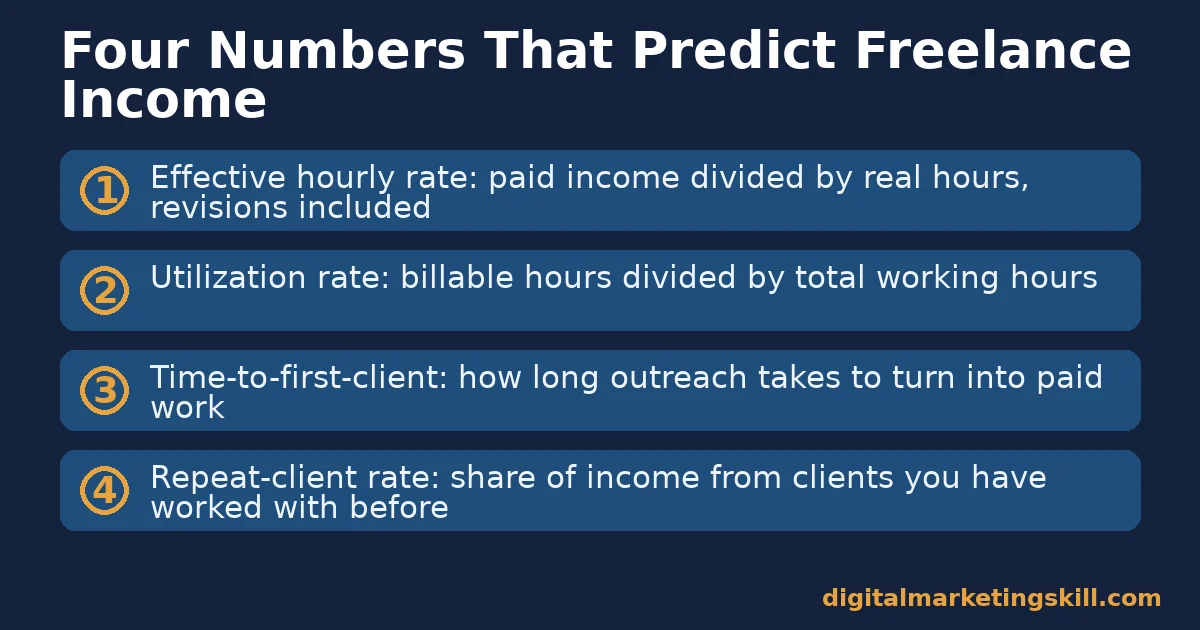
- Effective hourly rate: total paid income for a project, divided by total hours it took, including unpaid revisions. This is usually lower than your quoted rate. It tells you whether a project was actually worth taking.
- Utilization rate: billable hours divided by total working hours in a period. Low utilization with a high quoted rate still produces low income.
- Time-to-first-client: how long it takes from starting outreach to your first paid project. A rate that improves across projects means your positioning is working. A flat or worsening rate means it isn’t.
- Repeat-client rate: the share of income in a period that comes from past clients. A rate near zero means you rebuild your entire pipeline every month. That caps how much you can earn, no matter your hourly price.
The One Rule for Making More Money From Freelancing
Decision rule: before you raise or lower your rate, calculate your effective hourly rate on your last three projects. Use that number, not your quoted rate.
If your effective rate is below target because of unpaid revisions or slow-paying scope creep, fix your contract and scope. Don’t cut your price. If your effective rate is already at target, grow income with a higher quoted rate or a better repeat-client rate. Don’t just work more hours.
Illustrative, invented numbers: a freelance writer quotes $40 an hour and plans for 10 hours on a project. Unpaid revisions push the real time to 16 hours. Effective rate: $400 divided by 16 hours equals $25 an hour, not $40. The fix is a revision cap in the contract, not a rate cut.
A Real Case: What a Strict Vetting Funnel Looks Like in Practice
Toptal, a freelance talent platform, publishes its own acceptance funnel. Of the thousands of monthly applications it receives, about 26.4% pass an initial language-and-personality review. Then 7.4% pass an in-depth skill review. Then 3.6% pass a live screening, and 3.2% pass a paid test project. The whole process narrows to fewer than 3% accepted overall, typically over three to eight weeks.
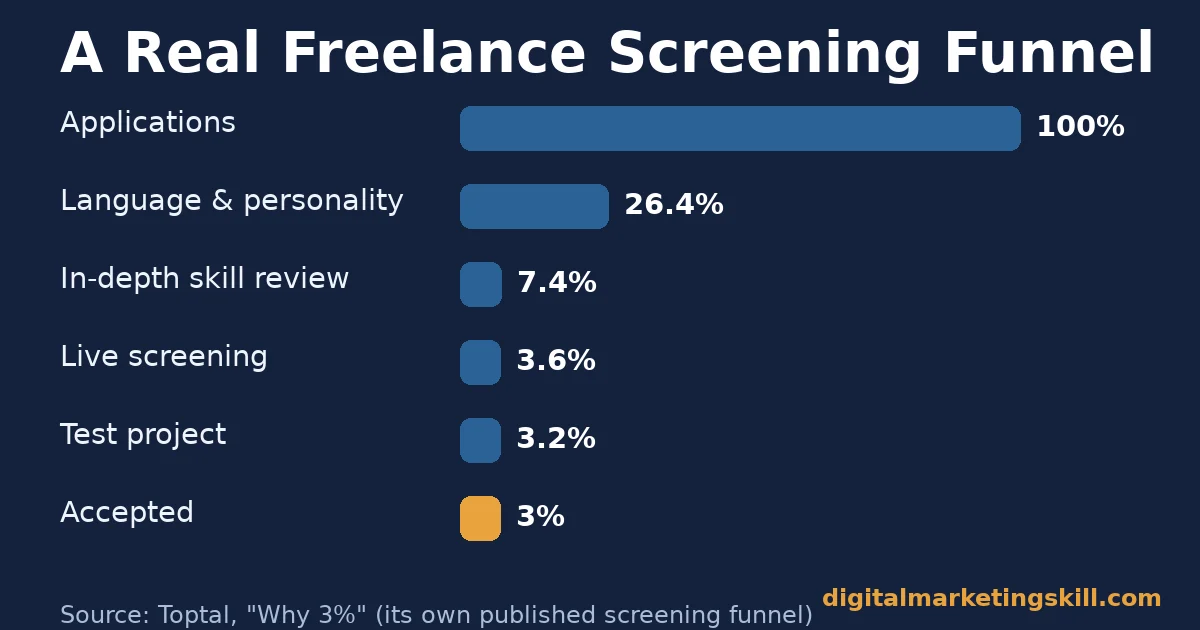
The limit: this is one company’s self-reported funnel, published partly to market its own selectivity. It’s not an independent audit, and it only describes one platform, not the whole freelance market. Still, it shows something reliable: rigorous proof-of-skill screening is a real, working mechanism. Some platforms use it to justify charging clients premium rates for vetted freelancers. That’s the positioning strategy from earlier, visible in practice.
Common Mistakes That Stop People From Making Money From Freelancing
Three mistakes show up again and again in freelancers who struggle to make steady income.
The first is competing on price in a crowded category instead of narrowing a niche. The second is quoting by the hour with no scope or revision limit, which lets effective rate quietly collapse. A third common mistake is treating every project as a one-off. Repeat clients need less pitching and less negotiation over time, so building toward them pays off.
Fixing even one of these three, on purpose, usually moves a freelancer’s income more than switching to a new platform ever does. Pick the mistake that sounds most familiar, and fix only that one first; it’s often the fastest way to make money from freelancing without changing anything else about your work.
Frequently Asked Questions About Making Money From Freelancing
How do I start making money from freelancing with no experience?
Start with a narrow, low-barrier service, such as writing for one specific industry or basic virtual assistant tasks (our guide to freelancing for beginners covers this first stretch in more depth). Take on one or two reduced-rate or sample projects to build real portfolio pieces. Then raise your rate as soon as you have two or three genuine results to show.
How much can a freelancer realistically earn?
It varies enormously by skill, niche and location. Payoneer’s global survey puts the worldwide average freelance hourly rate at $21. Specialized, well-positioned freelancers charge far more. New freelancers in crowded categories often start below that average.
Do I need a certification to freelance?
No certification is required in most fields, though some clients do care how you’re classified; the IRS page on independent contractor status explains the US distinction.
Proof of skill usually matters more than a credential. That proof can be a portfolio, a test project, or a vetting process, especially when a client compares freelancers they don’t already know. Training can still help you make money from freelancing faster, mainly by shortening the time it takes to build that first proof.
Is freelance writing still a good way to make money from freelancing?
Yes, but it’s one of the most crowded categories. Profitability depends heavily on niching down and building repeat clients, rather than relying on one-off gigs from open marketplaces.
How do freelancers avoid scope creep and unpaid work?
Written contracts help most: a defined number of revisions, a clear scope, and partial upfront payment. Tracking your effective hourly rate also exposes scope creep quickly, because the number drops the moment unpaid work piles up.
What is the fastest-growing part of freelancing right now?
Specialized technical and AI-assisted skills are in high demand. That includes AI-assisted content production, automation setup, and specialist SEO or ads management. Fewer freelancers can credibly deliver these compared with general writing or admin work.
Should I freelance full-time or part-time first?
Many freelancers start part-time, alongside existing income, to build a client base and measure their real effective hourly rate. There is no guaranteed income level, so test this before leaving other work. Once your effective hourly rate matches or beats your current pay for a few months in a row, that’s usually a safer signal than any fixed timeline.
Can you make money from freelancing without a website?
Yes. Many freelancers start with just a profile on a marketplace or a simple portfolio document. A website helps later, mainly for referrals and repeat clients, but it isn’t required to land your first paid project.
Freelancing Works the Same Way Wherever You Live
The mechanics in this guide don’t change by country. Billable hours, effective rate and utilization work the same way whether your clients are local or on the other side of the world.
What does change is currency, cost of living, and which marketplaces are most active in your region. A freelancer anywhere in your country can apply the same pricing and niche strategy described above; only the numbers on the invoice look different.
Payment platforms, contract templates and time-tracking tools are available almost everywhere, so there’s rarely a technical reason you can’t start today. More than 6 billion people are online worldwide, according to DataReportal’s Digital Global Overview Report. That means most of the clients and tools a freelancer needs are already reachable.
The skill gap, not the location, is usually what decides whether someone makes money from freelancing within their first year. That’s good news: it means the strategy in this guide applies no matter where you’re reading it from.
Turning Freelance Skills Into a Repeatable Income
In short: the freelancers who make steady money from freelancing anywhere in the world aren’t the ones who found one secret platform. They’re the ones who treat pricing, positioning and measurement as seriously as the work itself.
If you want structured help building skills that freelance clients pay premium rates for, the Digital Marketing Skill Institute’s Master Diploma in Digital & AI Marketing can help. It’s built around four AI-powered tracks: AI-Powered Social Media Management and Advertising, AI-Powered Lead Generation and Email Automation, AI-Powered Google Specialist, and AI-Powered WordPress and SEO Specialist.
That’s ten courses in total, with a Full Stack option for completing all four. The program includes unlimited 1-on-1 coaching and mentoring, plus a U.S. Project Internship with a verified U.S. Work Reference Letter. It’s dual US and UK accredited and recognised in more than 100 countries. It’s 100% online, so you can study wherever you live and still make money from freelancing on your own schedule.
No income level is guaranteed by any course or certification, in freelancing or otherwise. See our earnings disclaimer for details.
Explore the Master Diploma program, browse more guides on the digital marketing blog, read student reviews, or apply to get started from anywhere in your country. Learn more at digitalmarketingskill.com, and visit digitalmarketingskill.com again to see the full curriculum.
Every figure in this guide was checked against its original source before publication. Figures marked as illustrative are invented examples, not real results.
![9 Amazing Digital Marketing Skills to Make Money Online [With Proof]](https://digitalmarketingskill.com/wp-content/uploads/2019/07/9-Amazing-Digital-Marketing-Skills-to-Make-Money-Online-With-Proof-17.png)






