You can promote your YouTube channel for free, and you don’t need a huge budget to do it well. The fastest-growing channels treat every title, thumbnail and first fifteen seconds as a test. This guide shows you exactly how to promote your YouTube channel using the signals the algorithm rewards most: retention, click-through rate, consistency and smart distribution.
Key Takeaways
- Channels that post on a consistent schedule grow subscribers 67% faster. They also see 89% higher retention and 156% more total watch time than irregular posters (vidIQ analysis of over 61 million channels).
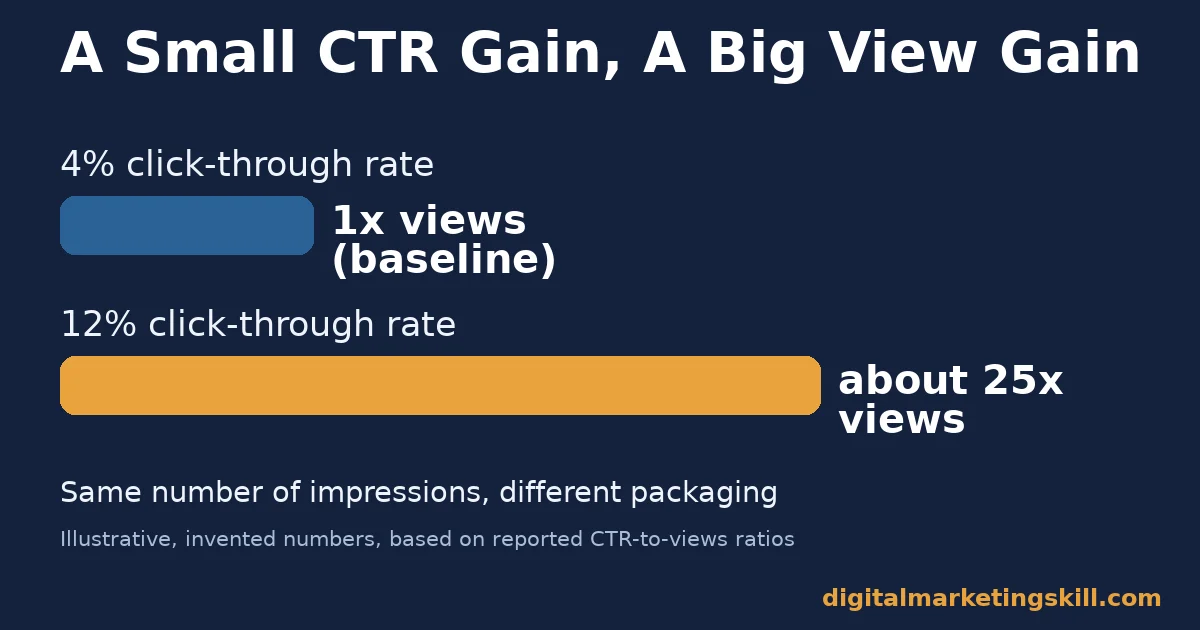
- A jump from 4% to 12% thumbnail click-through rate can mean roughly 25 times more views from the same impressions. The algorithm rewards early clicks with wider distribution.
- Only 7.9% of channels reach 10,000 subscribers, and just 1.3% reach 100,000. Most free-promotion advice only matters once you clear the first 1,000-subscriber mark.
- Growth slows as channels get bigger. Channels under 100 subscribers grow about 1.26% a month, while channels past 1 million grow closer to 0.24% a month (Creaticalc benchmark data).
- A clear, expressive face on a thumbnail can lift click-through rate by 20-30% over a plain frame grab. If you only act on one idea from this guide to promote your YouTube channel, make it this one.
In this guide
- Why Most Advice to Promote Your YouTube Channel Falls Short
- How YouTube’s Recommendation System Works
- What Differs Before and After 1,000 Subscribers
- How to Promote Your YouTube Channel: Fixes by Lever
- Fix Discovery: Promote Your YouTube Channel Through Search
- Fix Click-Through: Design the Thumbnail Like a Headline
- Fix Retention: Deliver the Promise Fast
- Fix Distribution: Promote Your YouTube Channel Everywhere
- Fix Community: Promote Your YouTube Channel Through Loyal Fans
- Fix Momentum: Use Short-Form Video to Feed the Algorithm
- How to Measure Whether Your Promotion Is Working
- The One Decision Rule: Fix the Metric That Fails First
- A Real Case: Consistency Compounding Over Time
- Frequently Asked Questions About Promoting a YouTube Channel
- Turn This Into a Repeatable Marketing Skill
Why Most Advice to Promote Your YouTube Channel Falls Short
Most lists on how to promote your YouTube channel repeat the same ten tactics. They rarely say which ones matter at which stage. They rarely explain how to tell if a tactic is actually working. This guide closes that gap. It breaks down what to prioritize before 1,000 subscribers, what changes after that, and how to measure real progress instead of vanity numbers.
Two ground rules first. This is an informed reading of public creator-analytics research, not a guaranteed formula. YouTube changes its ranking weights often and never publishes the full algorithm. The channel-size benchmarks below are a snapshot, not a permanent ranking of what counts as normal growth in your niche.
How YouTube’s Recommendation System Works
YouTube’s recommendation system tries to maximize satisfied watch time across the whole platform. It does not reward any single tactic by itself. Every time your video gets shown, YouTube tests a simple question: will this viewer click, and if they click, will they stay? Two metrics answer that question better than any other.
Click-Through Rate and Audience Retention
Click-through rate measures what share of people who saw your thumbnail actually clicked it. Audience retention measures how much of the video they then watched. A thumbnail that pulls a high click rate but low retention sends a bad signal. It tells the algorithm your packaging oversold the content, so distribution drops.
A short video with 70% retention on four minutes beats a 20-minute video with 20% retention. Total satisfied watch time is what the system optimizes for, not runtime.
The Cold-Start Problem for New Channels
A channel with no watch history gives YouTube nothing to test against. That is one reason the average channel takes roughly fifteen months to reach 1,000 subscribers. Growth usually speeds up once a channel passes the 500-to-1,000-subscriber mark. By then the algorithm has enough session data to recommend your content confidently to people who don’t already follow you.
What Differs Before and After 1,000 Subscribers
The tactics that move a brand-new channel are not the tactics that move an established one. The constraint shifts from “no data” to “diminishing returns on existing data.” Here is how the priorities split by stage when you promote your YouTube channel.
New Channels: Built for Discovery, Not Polish
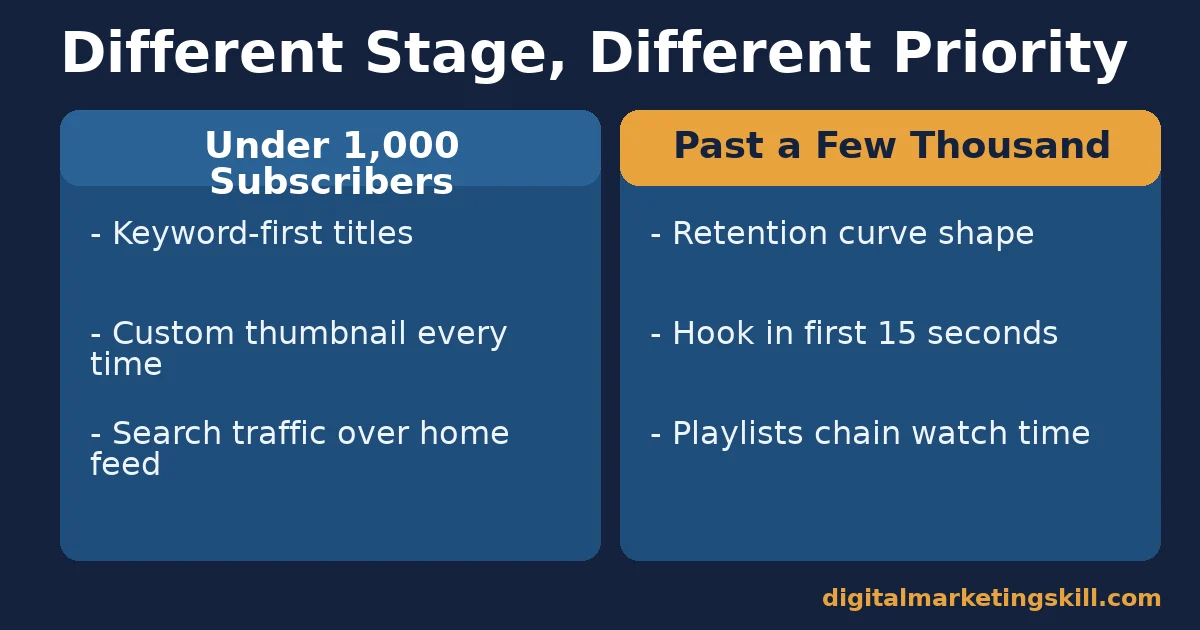
Below 1,000 subscribers, your single highest-leverage move is YouTube SEO. Put your target keyword in the title, in the first line of the description, and in at least one tag. Search traffic does not require an existing audience the way the home feed does.
YouTube is the second-largest search engine after Google by query volume. A well-targeted title earns impressions a brand-new channel would never get from recommendations alone.
Read a full walkthrough of ranking factors in our YouTube SEO guide for beginners. If you haven’t picked a niche yet, settle the groundwork first with three decisions to make before creating a YouTube channel. Pair your keyword work with a custom thumbnail from video one. Roughly 90% of top-performing videos use a custom thumbnail instead of an auto-generated frame, according to creator-analytics research on thumbnail click-through rate.
Established Channels: Lead With Retention Engineering
Past the first few thousand subscribers, keyword-stuffing a title stops helping. The channel already has recommendation momentum, so the real constraint becomes the shape of your retention curve. This is where small production choices matter most: a cut or camera change every 20-30 seconds, a strong hook in the first 15 seconds, and playlists that chain videos into one longer session.
A playlist that auto-advances into the next related video can meaningfully extend total session watch time. That is one of the strongest trust signals you can send the algorithm, because it shows real viewers choosing to stay on your content.
How to Promote Your YouTube Channel: Fixes by Lever
These are the concrete, free actions that map to the levers above. Match each one to your channel’s current stage.
Fix Discovery: Promote Your YouTube Channel Through Search
Research your target keyword the way you would for a blog post. Type your topic into the YouTube search bar and note the suggested phrases. Then check a keyword tool such as TubeBuddy, YouTube Analytics or Google Keyword Planner for monthly search volume.
Put the exact phrase near the start of the title, in the first sentence of the description, and in one tag. Keep titles under roughly 66 characters so Google does not truncate them in search results.
Write the full description as if a stranger will read only the first two lines, because that is all that shows before the “show more” fold. Lead with a plain-language summary of what the video delivers.
Add a timestamped outline for longer videos. Timestamps give viewers an easy way to jump to the part they want, and they also give YouTube’s systems extra context about each section’s topic, which can help the video surface for more specific searches.
Fix Click-Through: Design the Thumbnail Like a Headline
Treat the thumbnail and title as one unit. The thumbnail earns attention; the title confirms the promise. A clear subject, a short readable word or two of text, and a facial expression that matches the video’s mood all measurably lift click-through rate versus a plain frame grab. A jump from 4% to 12% CTR can be worth roughly 25 times the views on the same impressions.
This is the highest-return design choice most new creators skip.
Fix Retention: Deliver the Promise Fast
State clearly, in the opening line, what the viewer will get and when. Cut dead air. Skip a long musical intro. Use a jump cut or on-screen text at the first sign of a lull.
Structure the middle around one idea at a time, so a viewer who came for one answer never has to wait for it. Watch your own retention graph after each upload and mark the exact second where the steepest drop happens. That single data point usually tells you more about where to simplify the script than any general rule of thumb ever could.
Fix Distribution: Promote Your YouTube Channel Everywhere
Share the native YouTube link on every other channel you run. Post a short teaser clip on a social feed with the full video linked in the caption or bio. Embed the video inside a relevant email. Embed it inside a related blog post too.
None of this costs money. Each one gives a fresh audience a reason to click through to the watch page, where retention data starts compounding.
Fix Community: Promote Your YouTube Channel Through Loyal Fans
Reply to comments on your own videos within the first hour after you publish. Early engagement is itself a signal the algorithm reads. Ask one specific question in the video or description instead of a generic “like and subscribe.” Specific prompts get measurably higher reply rates.
A branded hashtag, used consistently and kept within YouTube’s own documented hashtag limits, gives repeat viewers an easy way to find your back catalogue.
Fix Momentum: Use Short-Form Video to Feed the Algorithm
A long-form upload schedule can feel slow when you are trying to promote your YouTube channel from zero. Short-form video fills that gap. A 30-to-60-second cut of your best moment, posted alongside the full video, gives the algorithm a second, faster way to test your content with new viewers.
Channels that mix short-form and long-form uploads grow measurably faster than channels using only one format, based on the benchmark research cited in the real case below. Treat each short as a trailer for the long-form video, not a replacement for it, and link back to the full video in the description or a pinned comment so interested viewers can find it.
How to Measure Whether Your Promotion Is Working
Track these numbers in YouTube Studio’s Analytics tab after every upload. They tell you whether your effort to promote your YouTube channel is actually working. Judge each tactic by its effect here, not by subscriber count alone.
- Impressions click-through rate: the share of people shown your thumbnail who clicked it. A sustained drop below your channel’s own average usually means thumbnail or title fatigue.
- Average view duration: how much of the video, in time and as a percentage, the average viewer watched. This is the strongest proxy for whether your content delivers on its packaging.
- Retention graph shape: where viewers drop off inside the video. A sharp early drop usually means a weak hook. A sharp mid-video drop usually means weak pacing.
- Traffic source mix: how much of your views come from search, suggested videos, browse, playlists or outside links. Relying on one source leaves you exposed if that source’s weighting shifts.
- Subscribers per 1,000 views: a ratio that lets you compare videos of very different view counts fairly.
- Returning viewers percentage: the share of views coming from people who have watched your channel before. A rising share here means your community-building tactics are working, not just your discovery tactics.
Check these numbers weekly rather than daily. A single upload is too small a sample to judge a tactic fairly, and daily swings often reflect normal noise rather than a real trend. Compare at least three to five uploads before deciding whether a change to your thumbnail style, title format or posting schedule actually helped.
The One Decision Rule: Fix the Metric That Fails First
If you only have time to fix one thing before your next upload, fix whichever metric fails first in the viewer’s path. A weak thumbnail matters before a weak middle section. A video nobody clicks never gets a chance to prove its retention.
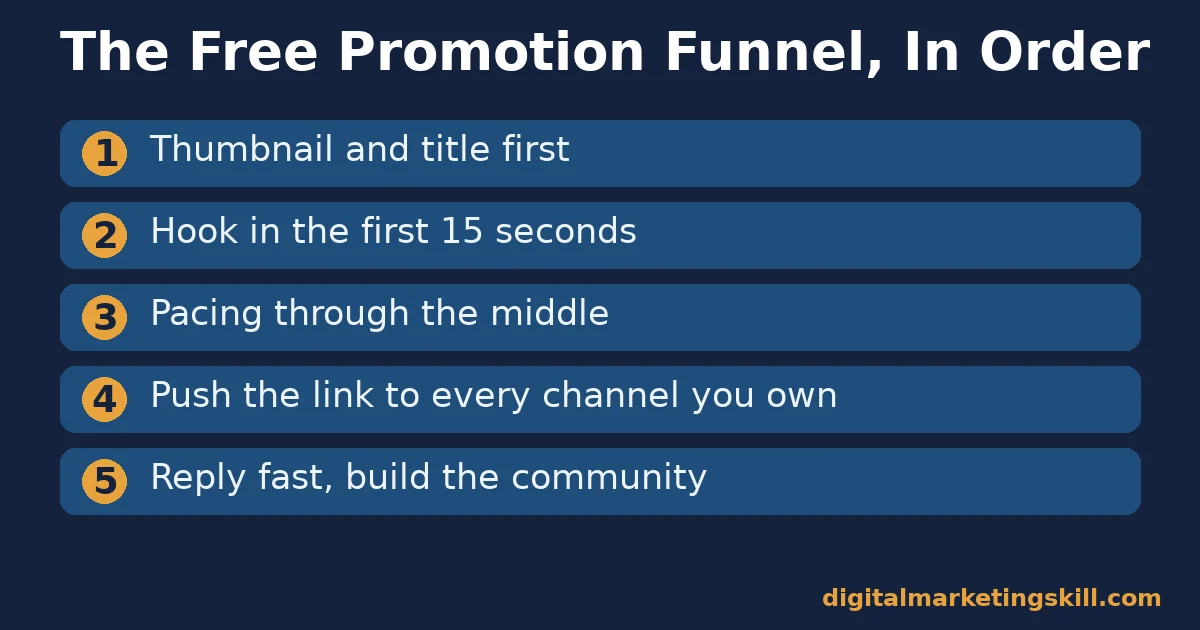
Work the funnel in order: thumbnail and title first, then the opening seconds, then pacing through the middle, then the call to action at the end. This order is the fastest way to promote your YouTube channel without wasting effort on the wrong fix.
Illustrative, invented example: a channel publishing weekly tutorials notices its click-through rate sitting at 3%, against a channel average of 6%. Instead of reshooting the video, the creator redesigns only the thumbnail and title for the next three uploads. Each test uses one clear subject and one benefit-led title, then compares results before changing anything else.
This is the same logic you would use to promote your YouTube channel with a limited amount of weekly time: spend it on the one lever most likely to be the actual bottleneck, verify the result with real numbers, and only then move to the next lever in the funnel.
A Real Case: Consistency Compounding Over Time
A large-scale vidIQ benchmark study, built from more than 61 million channels, found that channels publishing on a consistent schedule grew subscribers 67% faster than irregular publishers. These channels also saw 89% higher audience retention and 156% more total watch time.
The same study found that channels combining short-form and long-form uploads grew 41% faster than channels using only one format. None of these channels bought views, ran paid ads, or used any tactic outside normal upload and promotion habits. The gains came purely from how consistently, and in what formats, they published.
The limits of this data matter too. It reflects aggregate behavior across all niches and channel sizes. It comes from vidIQ’s own analytics panel, not from YouTube’s own disclosure. And it shows correlation between consistency and growth, not a guaranteed causal lever for any single channel.
For a broader view of the audience these channels compete for, DataReportal’s global digital report tracks YouTube’s worldwide audience size. It is worth checking directly rather than trusting an old cached figure.
Frequently Asked Questions About Promoting a YouTube Channel
How long does it usually take to reach 1,000 subscribers?
If your goal is to promote your YouTube channel toward its first big milestone, benchmark data puts the average time to 1,000 subscribers at around fifteen months. This varies widely by niche, upload frequency, and whether a channel mixes short-form and long-form video, which research links to roughly 41% faster growth.
Is YouTube SEO still worth doing for free?
Yes. Search traffic does not depend on an existing subscriber base the way suggested and home-feed traffic do. Keyword research, a keyword-first title, and a description that repeats your target phrase naturally all cost nothing. They remain one of the most reliable ways for a new channel to get its first views.
Do custom thumbnails really make a measurable difference?
Yes. Creator-analytics research reports that custom thumbnails with a clear subject and expressive face can lift click-through rate by 20-30% or more over an auto-generated frame. A CTR gap that size can translate into many more views from the same impressions.
Should a new channel focus on views or subscribers first?
Watch time and retention matter more to early distribution than raw subscriber count. The algorithm uses session data, not subscriber totals, to decide who else to show your video to. Subscribers tend to follow once a channel is already being recommended consistently.
How many hashtags should one YouTube video use?
Keep it well under YouTube’s documented limit. Past that limit, YouTube ignores every hashtag on the video, so a small, relevant set works better than a maximized one.
What is the biggest mistake in most free-promotion advice?
Treating every tactic as equally important no matter the channel’s size. A brand-new channel gets more from search-optimized titles and a strong thumbnail. An established channel gets more from retention engineering and playlist sequencing, because its constraint has already shifted from discovery to attention.
Does promoting a video on other platforms actually help YouTube rankings?
Indirectly, yes. Traffic from an external click still counts toward watch time and session data once the viewer lands on the watch page, even though the click happened off-platform. It won’t fix a weak thumbnail or poor retention on its own, but it adds real sessions for the algorithm to evaluate.
Once promotion works, how do creators turn views into income?
There are several real paths beyond ad revenue alone. Our breakdown of real paths to making money on YouTube covers four of them, once a channel has steady watch time to build on.
Do YouTube Shorts actually help a channel grow, or just rack up low-value views?
They can do both, depending on how they are used. A short that stands alone, with no link back to the main channel or playlist, often earns views that do not translate into watch time elsewhere.
A short that works as a trailer for a related long-form video, with a clear reason to click through, tends to feed real session data back into the channel. That matters more than just inflating a view count.
How often should a new channel upload to see real growth?
Consistency matters more than raw frequency. A realistic, sustainable schedule you can keep for months, whether that is weekly or twice a month, outperforms a burst of uploads followed by a long gap. The benchmark research above ties consistency itself, not upload volume, to faster subscriber growth and higher retention.
Is it worth paying for promotion once a channel has some traction?
Paid promotion can accelerate a channel that already has a strong retention curve, because ads sent to a video that already holds attention tend to perform better and cost less per view over time. Paid promotion sent to a video with weak retention mostly wastes budget, since the underlying content still fails the same test the algorithm uses for free distribution. Fix retention and click-through rate first, then treat paid promotion as an amplifier rather than a fix.
Turn This Into a Repeatable Marketing Skill
Learning to promote your YouTube channel well is really applied digital marketing. It blends audience research, copywriting for titles and hooks, analytics reading, and distribution strategy into one workflow. For the bigger picture of where channel growth fits into a wider strategy, see our overview of what YouTube marketing covers beyond a single channel.
If you want to build that skill set properly, rather than piecing it together from scattered posts, look at the Master Diploma in Digital & AI Marketing at Digital Marketing Skill Institute. It is built around four AI-powered tracks drawn from ten execution-first courses: AI-Powered Social Media Management and Advertising, AI-Powered Lead Generation and Email Automation, AI-Powered Google Specialist, and AI-Powered WordPress and SEO Specialist, with a Full Stack option for completing all four.
The program includes unlimited 1-on-1 coaching and mentoring, plus a U.S. Project Internship with a verified U.S. Work Reference Letter. It is dual US and UK accredited, recognised in more than 100 countries, and delivered 100% online, so you can study anywhere in your country.
See the full Master Diploma program structure, read real outcomes on the student reviews page, or browse more guides on the digital marketing blog. When you’re ready, apply now wherever you live. The whole application runs through digitalmarketingskill.com, no matter which time zone you’re learning from.
Every figure in this guide was checked against its original source before publication. Figures marked as illustrative are invented examples, not real results.