
To start a blog, pick one narrow topic, choose a platform you can own rather than rent, and publish on a schedule you can sustain for months. The platform matters less than most guides suggest. The topic and the consistency matter far more.
Key Takeaways
- Most posts never get found. Ahrefs analysed about 14 billion pages and found 96.55% get zero organic traffic from Google.
- WordPress still leads by far. W3Techs reports WordPress runs 39.7% of all websites, and 58.4% of sites whose content management system it can detect.
- Writing takes real time. Orbit Media’s survey of 211 bloggers found the average writer spends 3 hours and 28 minutes creating one article.
- Trust drives sharing more than ads do. Nielsen’s global study found 88% of people trust a recommendation from someone they know over any other channel.
- A documented plan still separates serious bloggers from hobbyists. Content Marketing Institute’s own B2B survey found only 32% of marketers have a documented content strategy at all.
In this guide
- The Start-A-Blog Gap: Why Most Blogs Stall By Month Three
- How A Blog Actually Grows
- What Differs By Blog Type
- How To Lead With Each Blog Type’s Strength
- Measuring Whether Your Blog Is Working
- The One Decision Rule For Starting Your Blog
- A Real Case: Writing Became The Service Itself
- Frequently Asked Questions About Starting A Blog
- Your Next Step To Start A Blog That Lasts
The Start-A-Blog Gap: Why Most Blogs Stall By Month Three
Most “how to start a blog” guides spend most of their length on picking a platform and installing a theme. That is the easy part. The hard part is choosing a topic narrow enough to rank for. The real test is sticking with it after the first few posts get almost no traffic.
This guide spends less time on setup. It spends more time on three decisions that actually decide whether a blog survives. Which model are you building? How do you measure early progress? What do you do when week six feels like nothing is working?
How A Blog Actually Grows
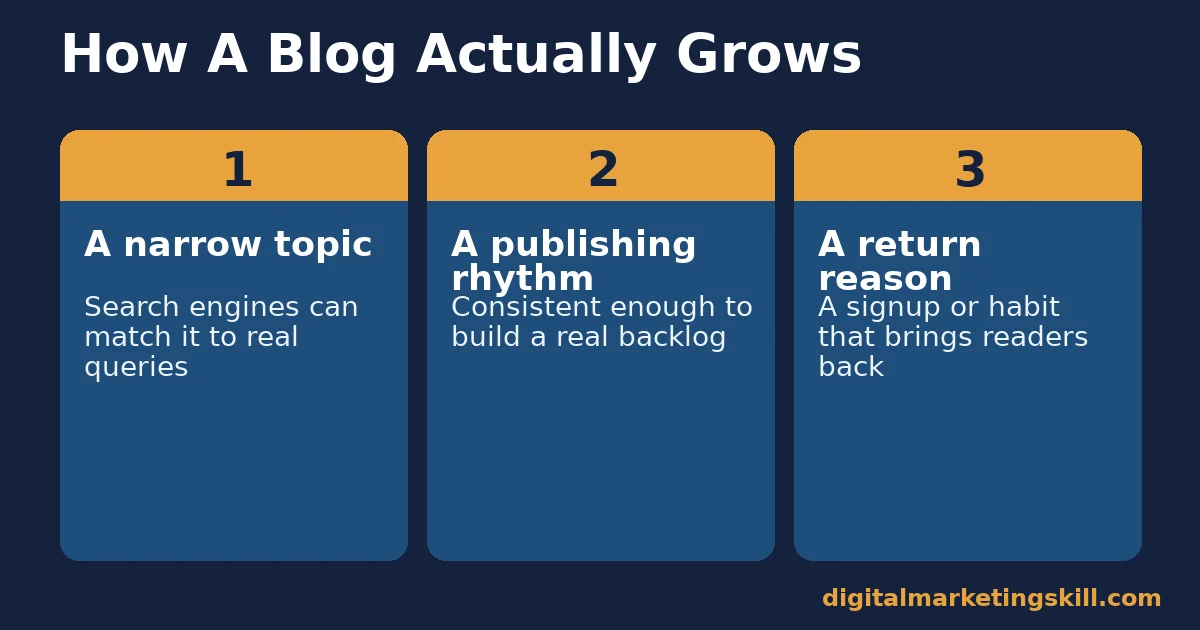
To start a blog that actually grows, three forces have to work together. A narrow topic lets a search engine match your pages to real queries. A publishing rhythm, consistent enough to build a backlog, gives those pages time to earn trust. And a reason for readers to come back, or sign up, keeps them from leaving for good.
Miss the narrow topic, and you compete against far larger sites for broad, high-competition terms. Miss the rhythm, and search engines have too few signals to understand what your site is about. Without a return reason, every reader is a one-time visitor you win all over again.
Most content never clears the first hurdle. Ahrefs’ analysis of roughly 14 billion pages found that 96.55% get zero organic traffic from Google. Only 1.94% get ten visits a month or fewer. Google’s own guidance on helpful, people-first content asks whether a reader leaves “feeling they’ve learned enough” to solve their problem. Starting a blog is easy. Getting one found, by that standard, is the actual work.
The platform you pick to start a blog still matters, even if it is not the deciding factor. W3Techs reports WordPress runs 39.7% of all websites. That scale means far more themes, plugins, tutorials and paid help exist for it than for almost any alternative, which matters the first time something breaks.
What Differs By Blog Type
Not every blog does the same job. The three common types below differ in how they make money or deliver value, how fast they show results, and what “winning” even looks like.
Authority and Personal Blogs: Built For Reputation First
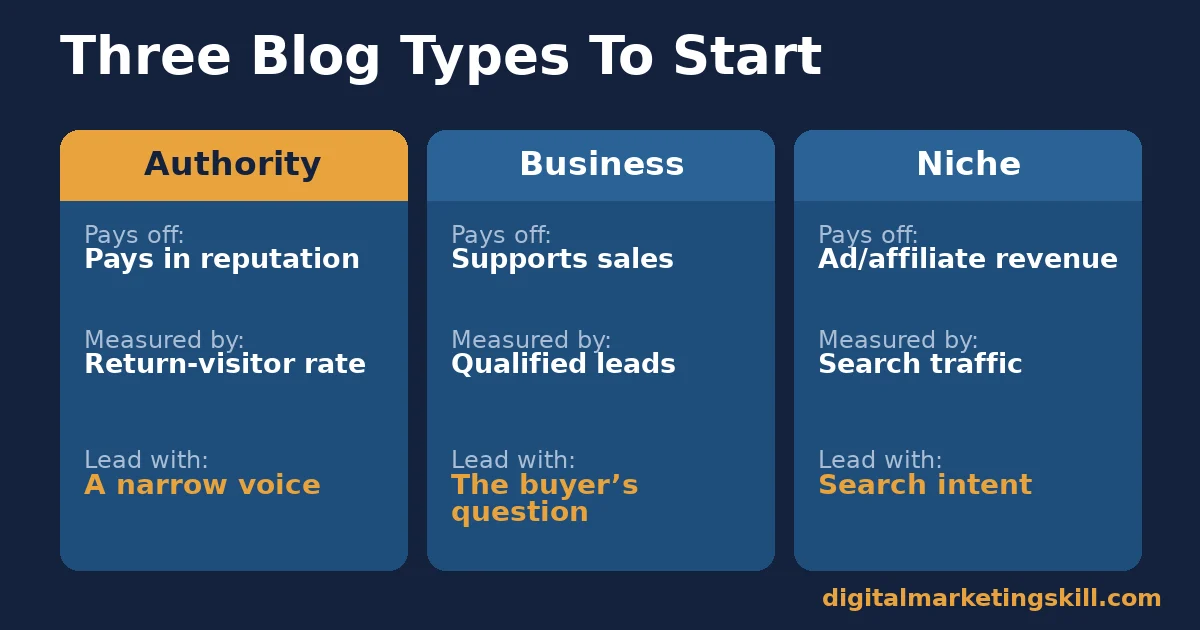
An authority blog builds your name or expertise in a topic, whether or not it earns direct income. Readers come for your perspective, not a single product. Trust and consistency matter more here than almost anywhere else.
This model pays off slowly in direct terms, but it compounds in reputation. A body of well-answered, narrow topics can turn into speaking invitations, job offers or client leads years after a single post was published, long after the writing effort is forgotten.
Business and Content Marketing Blogs: Built To Support Sales
A business blog exists to bring prospective customers to a company’s website and move them toward a purchase. Every post should connect, even loosely, to a product, service or stage of the buyer’s decision.
This model is measured differently from a personal blog. Traffic matters less than qualified traffic. A smaller audience that converts well can beat a larger one that does not. Our guide to content marketing tools can help manage this type of blog at scale.
Niche and Monetised Blogs: Built For Direct Revenue
A niche blog is built around one specific, often commercial topic. Revenue comes from ads, affiliate links or its own digital products. The topic is chosen for earning potential and search demand, as much as for personal interest.
This model needs the most patience before it pays anything at all, because ad and affiliate income usually requires meaningful traffic volume first. It also needs the most discipline around search engine optimization, since organic search is usually its main traffic source.
How To Lead With Each Blog Type’s Strength
Picking a type is step one. Succeeding in it means leading with what that type actually rewards, instead of copying advice meant for a different kind of blog.
Authority Blogs: Lead With A Consistent, Narrow Voice
Write about one topic area long enough that readers know what to expect from you. A consistent, narrow voice turns occasional visitors into people who check your site on purpose.
Publish on a schedule you can actually sustain. One well-researched post every two weeks beats three rushed ones. Orbit Media’s bloggers reported spending an average of 3 hours and 28 minutes per article. Budget for that kind of time, or your schedule will slip within a month.
Business Blogs: Lead With The Buyer’s Question, Not Your Product
Write the post a prospective customer is actually searching for. Let your product appear as the natural answer, not the headline. A post that reads like an advert gets less trust, and less organic reach, than one that genuinely helps first.
Connect each post to a clear next step: a related guide, an email signup or an email marketing sequence. Without that connection, a business blog can generate traffic that never becomes a lead.
Niche Blogs: Lead With Search Intent, Not Personal Interest
Choose topics by what people actually search for, and what competitors are missing, not purely by what interests you personally. A niche blog’s traffic is almost entirely earned through search. Matching real search intent matters more here than in the other two models.
Diversify income sources early, rather than relying on one ad network or affiliate programme. A niche blog built on a single income source is exposed to that one partner’s policy changes in a way a blog with two or three sources is not.
A Simple Starting Toolkit
Whichever type you choose, the starting toolkit is small. You need hosting, a domain name, an SEO plugin and an email service to collect subscribers from day one. Delay anything fancier, like custom design work, until the blog has proven it can attract real readers.
What To Decide Before You Start A Blog
Before you start a blog, write down three things in one sentence each: who the reader is, what question every post should answer for them, and what you want them to do next. If you cannot answer all three clearly, the topic is probably still too broad.
Also decide, before you start a blog, how you will know it is working. Google’s own documentation on how search works explains that new pages are discovered, crawled and indexed before they can rank at all, which is part of why a brand-new site needs patience before judging results.
A Simple Writing Process To Start A Blog Post
Start with the reader’s exact question, written as a search query, before you write a single sentence of the post itself. If you cannot phrase the question in under ten words, the topic is still too broad to answer well in one piece.
Draft an outline of three to six subheadings that each answer one part of that question, then write the body under each one. Answer the core question in the opening paragraph before adding background, because most readers and search engines both reward posts that lead with the payoff.
Finally, edit for length, not just grammar. Cut any paragraph that does not move the reader closer to an answer, even if it was enjoyable to write. A tighter post that fully answers the question will usually outperform a longer one that wanders.
Measuring Whether Your Blog Is Working
Four numbers tell you more about a blog’s progress than “traffic feels higher this month.” Check them monthly from your very first post.
The Four Metrics To Track
- Indexed and ranking pages. How many of your posts actually appear in search results for any query at all. A rising count means your topic and structure are working. A flat count after months of publishing is the clearest early warning sign.
- Organic sessions per post. Traffic divided by the number of published posts. This shows whether new posts add real reach, or whether you are publishing into a void.
- Return-visitor rate. The share of visits that are not someone’s first time on your site. A rising return rate means you are building an audience, not just winning one-time search clicks.
- Email or follower signups per 1,000 visitors. This measures whether your blog actually converts attention into something you can reach again, rather than hoping readers come back on their own.
Read these four together. Rising traffic with a flat return-visitor rate often means one thing. The content answers a question well, but gives readers no reason to come back. That usually points to a missing email signup or follow step.
The One Decision Rule For Starting Your Blog
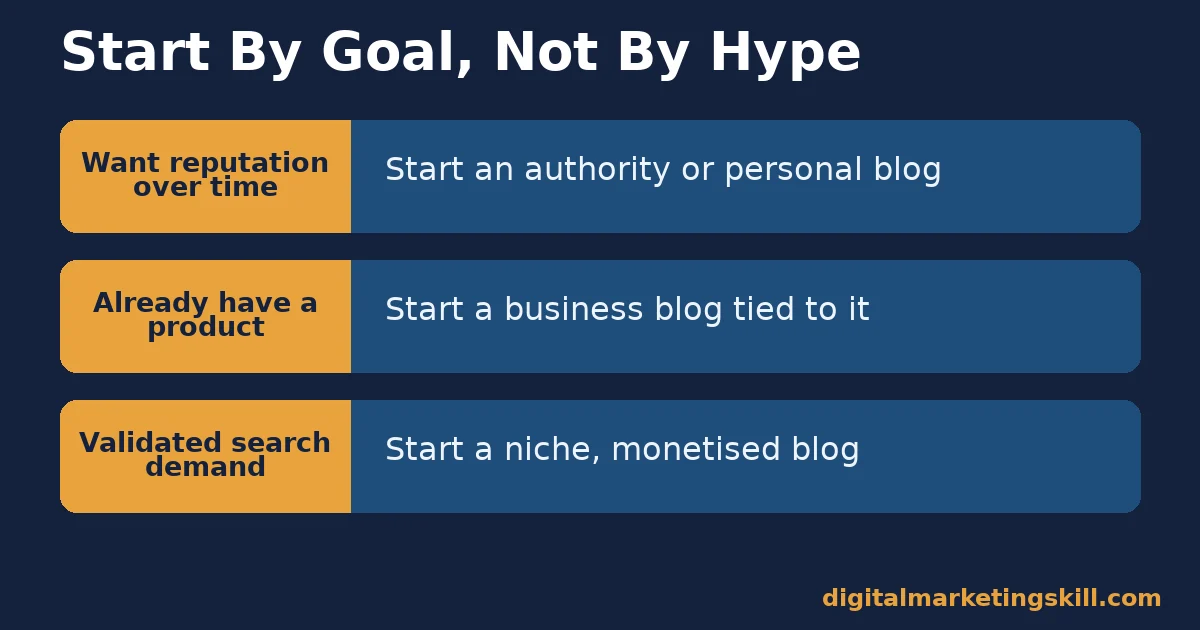
Start an authority or personal blog when your main goal is reputation, opportunities or a future audience. You need to accept months of unpaid effort before any of that materialises.
Start a business blog when you already have a product or service. The blog’s job is to bring qualified visitors toward that offer, not to stand alone as a destination.
Start a niche or monetised blog only once you have validated real search demand for the topic. Check the search volume and existing competition before you write the first word, because this model’s income depends entirely on traffic volume arriving.
A Worked Example
Illustrative, invented numbers: picture three new bloggers, each publishing one post a week for six months. That is about 26 posts each.
The authority blogger picks one narrow professional topic. By month six, a handful of posts rank well enough to bring a steady trickle of visitors. Two of those visitors become paying clients worth more than a year of blogging time combined.
The business blogger ties every post to one product line. Traffic stays modest, around 400 monthly visits by month six. But 3% of visitors join an email list, and that list eventually drives real sales.
The niche blogger picks a commercial topic with real search volume. Traffic is slow to start. But by month six it reaches 2,000 monthly visits, and small affiliate commissions begin to add up.
Who Should Start A Blog Right Now
Anyone with real knowledge of a narrow topic, and the discipline to publish on a schedule, is a reasonable candidate to start a blog. You do not need existing credentials or a large following to begin. You need a question worth answering, and the patience to keep answering related ones.
The people who should wait are those hoping for fast income with minimal time invested. Every model above pays off on a delay measured in months, not days. Starting a blog mainly to make quick money usually ends in disappointment before the slow payoff arrives.
Three Mistakes That Sink A New Blog Early
The first mistake is picking a topic too broad to rank for. “Marketing tips” competes against thousands of established sites. A narrower angle, aimed at one audience, has a real chance to rank within months instead of years.
The second mistake is judging results too soon. Search engines need time to trust a new site, and giving up at week six, before the rhythm has a chance to compound, wastes every post already written.
The third mistake is skipping the email signup entirely. A blog that only hopes readers return on their own loses most of them permanently. Even a simple signup box turns some of that traffic into an audience you can reach again.
A Real Case: Writing Became The Service Itself
Olajire Jacob, a graduate of Digital Marketing Skill Institute’s training programme, started by charging around $500 to set up email marketing automation and content for individual clients. Over time, by narrowing into that specific service for a specific type of client, that work grew into roughly $5,000 a month in recurring revenue, as described on the Institute’s own reviews page.
The limits of this case are real. It is one self-reported account, published by the training provider itself, not an independent audit, and results like this are not typical or guaranteed. See DMSI’s own earnings disclaimer before treating any single story as a benchmark for your own blog.
The pattern worth taking from the case is narrow focus, not writing skill alone. The growth came from specialising in one content service for one kind of client. That is the same “lead with a narrow topic” rule covered above for authority blogs.
Frequently Asked Questions About Starting A Blog
What platform should I use to start a blog?
Use a self-hosted platform you own, such as self-hosted WordPress, rather than a free hosted platform you do not control. W3Techs reports WordPress alone runs 39.7% of all websites. That scale also means far more themes, plugins and documentation are available if something goes wrong.
How long does it take for a new blog to get traffic?
Most new blogs see little to no organic traffic for the first three to six months, even with consistent publishing. Search engines need time and signals to trust a new site. Judging success before that window closes usually leads to quitting too early.
How often should I publish to start a blog successfully?
A schedule you can sustain for a year beats a faster one you abandon after two months. One well-researched post every one to two weeks, published consistently, generally outperforms a burst of ten posts followed by silence.
Do I need to be a great writer to start a blog?
No. Clear, useful writing that answers a real question outperforms stylish writing that does not, especially for search traffic. Skills improve with practice. Most successful bloggers’ early posts read very differently from their later ones.
How many words should a blog post be?
Length should match the question, not a fixed target. A quick factual question needs a short, direct answer. A complex topic may reasonably need two thousand words or more to actually help the reader. Padding a short answer to hit a word count usually hurts, not helps.
Can a blog make money before it has much traffic?
Yes, if the blog supports a service or product you already sell, rather than depending on ad or affiliate income, which both need volume first. A business blog can generate its first qualified lead from a single well-targeted post, long before traffic is large.
Should I start a blog on a subdomain of a free platform or my own domain?
Use your own domain from the start, even though a free subdomain feels easier at first. Moving a blog later means rebuilding search rankings from close to zero, which can erase months or years of progress overnight.
Is it too late to start a blog?
No. More content exists now than ever, but demand for genuinely useful, narrow, well-researched answers has not shrunk to match. A new blog competing on depth and specificity in an underserved topic can still rank, even in a crowded broader category.
Your Next Step To Start A Blog That Lasts
Whichever type of blog you start, the skills behind it, content, SEO, email and audience building, are exactly what Digital Marketing Skill Institute’s Master Diploma in Digital & AI Marketing teaches.
The programme runs four AI-powered tracks: AI-Powered Social Media Management and Advertising, AI-Powered Lead Generation and Email Automation, AI-Powered Google Specialist, and AI-Powered WordPress and SEO Specialist, with a Full Stack option covering all four. Every track includes unlimited one-on-one coaching and mentoring, plus a U.S. Project Internship that leads to a verified U.S. Work Reference Letter.
The diploma is dual accredited and recognised in more than 100 countries, and the whole programme runs 100% online, so you can start a blog and build these skills from anywhere in your country.
Learn more at digitalmarketingskill.com, see the full structure on the Master Diploma programme page, or browse more guides on the blog. When you are ready, you can apply here — wherever you live, the application process is the same. You can also simply visit https://digitalmarketingskill.com/ and explore the curriculum yourself.
Every figure in this guide was checked against its original source before publication. Figures marked as illustrative are invented examples, not real results.
![9 Amazing Digital Marketing Skills to Make Money Online [With Proof]](https://digitalmarketingskill.com/wp-content/uploads/2019/07/9-Amazing-Digital-Marketing-Skills-to-Make-Money-Online-With-Proof-17.png)






