
Most “why you should blog” advice skips the hard part. Blogging only compounds into traffic and leads once a site clears a minimum size. AI search answers now eat clicks that used to land on a blog post. Start blogging anyway. Just build toward that size on purpose, and measure leads, not only visits.
Key Takeaways
- Sites that blog generate 67% more leads than sites that do not. That is based on a HubSpot study of more than 760 companies (15 median leads versus 9).
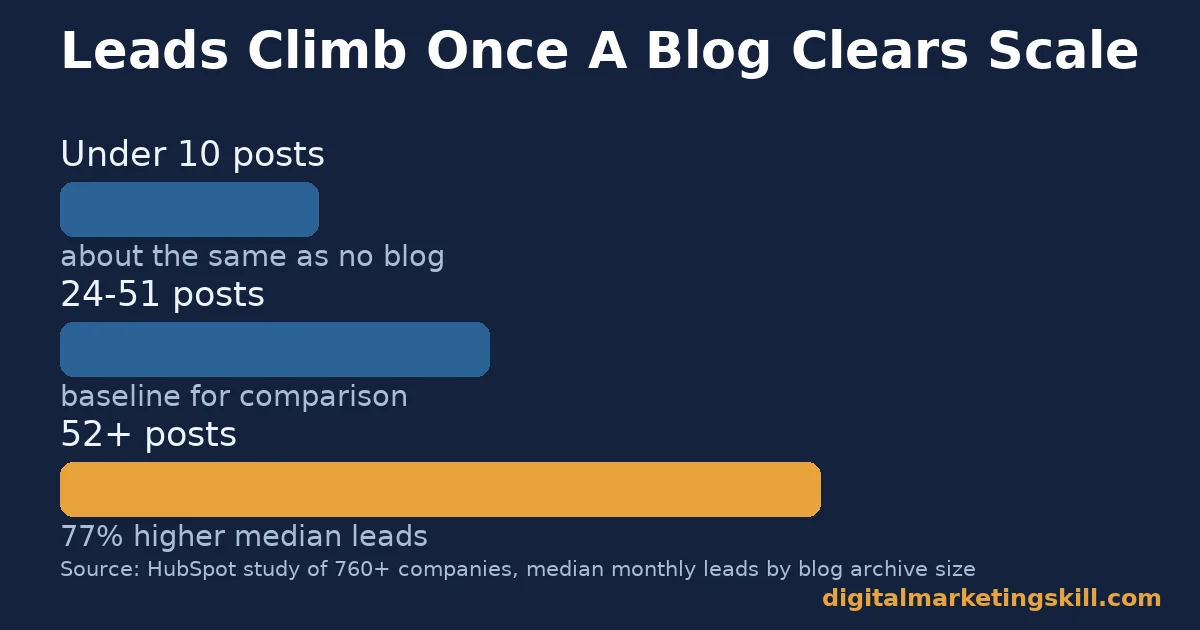
- Leads only start climbing once a blog reaches roughly 20 to 50 published articles. Blogs under 10 posts perform about the same as no blog at all, per the same HubSpot research.
- Companies with 52 or more articles generate 77% higher median leads than companies with 24 to 51 articles. The payoff keeps compounding past the first threshold.
- AI Overviews cut organic clicks by 58.6% on average. Informational queries see a 91.7% zero-click rate when an AI Overview appears, according to First Page Sage’s traffic-impact report.
- Only 13.9% of marketers say their blog delivers strong results. That is an all-time low in Orbit Media’s long-running annual blogger survey, even though 92.4% of bloggers now use AI tools.
In this guide
- What Most “Start Blogging” Advice Gets Wrong
- How Blogging Actually Builds Traffic And Leads
- What Changes Depending On Where Your Blog Stands Today
- How To Lead With Each Starting Point
- Common Mistakes That Stall A New Blog
- How To Measure Whether Blogging Is Working
- The One Decision Rule: Judge A Blog By Leads Per 20 Posts, Not By Any Single Post
- A Real Case: What Blogging Changed For Two Different Publishers
- Frequently Asked Questions About Starting A Blog
- Where To Start Blogging Properly, With Real Training
What Most “Start Blogging” Advice Gets Wrong
Most articles that tell you to start blogging stop at one idea: fresh content pleases Google. That was true for a long time. It is now an incomplete answer. Treating it as the whole story is why so many new blogs stall.
Two things changed. First, search results now answer plenty of questions directly. A chunk of the clicks a blog post used to earn simply never happen. Second, a blog does not compound on day one. It compounds once it passes a size threshold, and most people quit long before that point.
This guide treats both facts as ground rules, not footnotes. What follows is an informed read of the evidence, not a settled formula. The numbers are a snapshot, and they will keep moving as AI search changes.
Why Informational Posts Feel The AI Squeeze Hardest
The gap also runs deeper than clicks. Most searches split into three rough intents: informational (“what is X”), commercial (“best X for Y”), and transactional (“buy X”). AI Overviews answer the informational layer directly, which is exactly where most “why you should blog” advice tells beginners to start.
That does not make informational content worthless; it still builds the topical authority described below, and it is still a reason to start blogging on those questions too.
It does mean a blog aimed only at broad, factual questions will feel the AI-search gap hardest. Posts built around a specific decision, a comparison, or a named case tend to keep earning clicks, because an AI answer cannot fully substitute for them.
None of that means skip blogging. Content marketing as a whole still generates roughly three times the leads of outbound marketing, at a lower cost per lead. 82% of marketers now invest in it specifically to generate leads. So start blogging, but do it with a realistic model of when it pays off and what it pays off in.
How Blogging Actually Builds Traffic And Leads
A blog works through three linked mechanisms. Understanding each one changes how you plan posts.
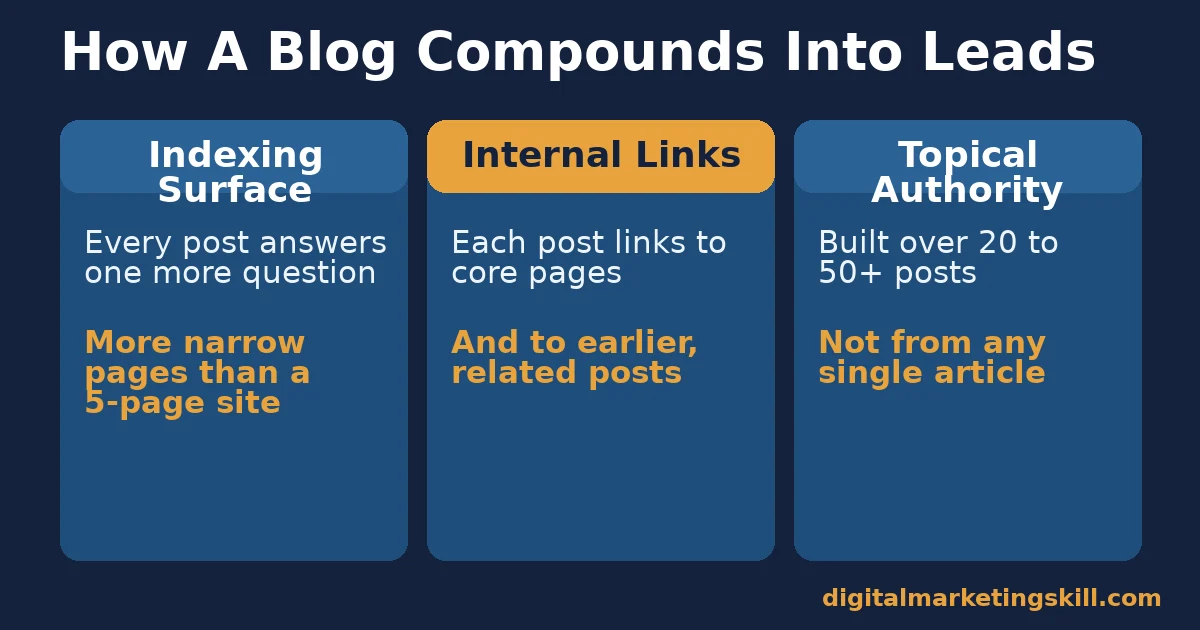
The first is indexing surface area. Every published post is a new page a search engine or an AI answer engine can match to a question. A five-page website can only answer five questions. A 60-post blog can answer dozens of narrow, specific ones. That is exactly the kind of query long-tail search traffic is built from, especially once you have done real keyword research instead of guessing at topics.
The second is internal linking. Each new post is a place to link back to your core service or product pages. It is also a place other posts can link to in return. That internal web turns a pile of articles into a structure search engines can crawl, and trust.
The third is topical authority. You build it over time by publishing on a connected set of subjects, not one post per topic, each one built around keywords chosen with intent in mind. This is also why the HubSpot research above found a threshold effect. A handful of posts cannot show authority on a topic the way 30 or 50 connected posts can.
Put together, a single blog post rarely moves the needle. A body of linked posts is what search engines and AI systems learn to treat as a trustworthy source on a subject.
A Quick Example: Two Sites, Same Writing Effort
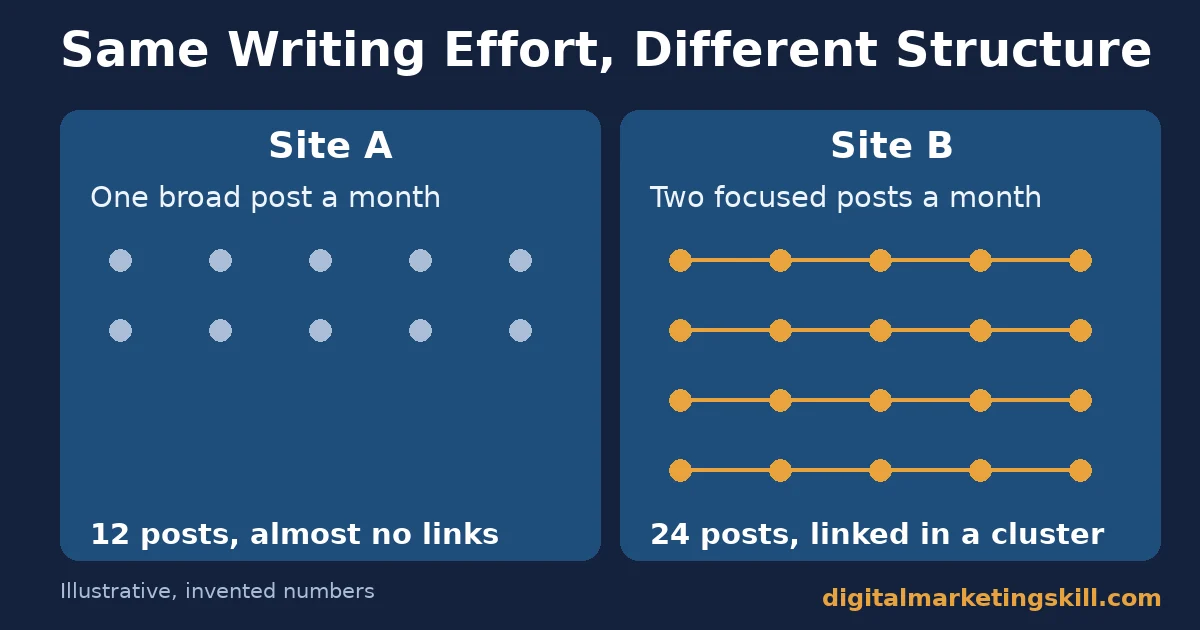
Illustrative, invented numbers: imagine two sites in the same niche. Site A publishes one broad post a month on a different topic each time. After a year it has 12 posts with almost no links between them.
Site B publishes two focused posts a month on the same connected set of customer questions, linking each new post to two earlier ones. After a year it has 24 posts forming a small, interlinked cluster.
Site B is far closer to the 20-to-50-article threshold where the HubSpot research found leads start climbing, and it has a crawlable structure Site A never built. Same writing output, very different outcome, because the posts were planned as a connected set rather than a list of unrelated ideas.
What Changes Depending On Where Your Blog Stands Today
The right first move is different for a blog with almost nothing published than for one with a real archive. Treating both the same way wastes effort either direction. Before you compare yourself to any benchmark in this guide, count your own published posts honestly, including thin ones you would not want a stranger to judge your brand on.
New Or Small Blogs: Start Blogging Expecting Patience, Not Instant Leads
If your blog has fewer than 10 posts, the HubSpot data above says plainly: expect it to perform about the same as having no blog, for now. That is not a reason to stop. It is a reason to plan for a minimum of 20 to 50 posts before you judge the channel, and to pick a narrow set of topics you can credibly cover that many times.
Established Blogs With A Real Archive: Built For Compounding Leads
Once a blog clears that early threshold, the math changes. Sites with 52 or more articles generate noticeably more leads than sites with 24 to 51. The return on each additional post keeps improving instead of flattening out.
An established blog’s best move is usually not starting new topics. It is strengthening and interlinking what already exists, which matters more the longer you have been publishing: a two-year-old blog with weak internal links is leaving easy gains on the table that a brand-new blog has not earned yet.
How To Lead With Each Starting Point
Once you know which situation you are in, the next 90 days of your plan to start blogging should look different.
New Or Small Blogs: Start Blogging With A Narrow Niche And A Cadence You Can Keep
Pick one audience problem you can write about from ten angles. Publish on a schedule you can sustain without burning out. Link every new post back to two or three earlier ones.
A good source of first-post angles is a running list of creative content ideas, not whatever comes to mind that week.
Research into publishing frequency found that companies posting 16 or more times a month saw roughly 3.5 times the traffic of companies posting under four times a month. A small team should still set a pace it can hold for months, not a number copied from an enterprise benchmark.
Established Blogs: Lead With Updates, Internal Links, And Pruning
Rewriting and relinking a strong older post is often cheaper than writing a new one, and it protects pages that already rank. Audit your archive for posts competing on the same topic.
Apply a working set of on-page SEO tips to the ones worth saving, then merge or redirect the weaker post. Add fresh internal links from any new post to your highest-value older ones. This is also the stage where measuring AI-answer citations starts to matter as much as clicks.
Common Mistakes That Stall A New Blog
Most blogs that never reach the lead-generating threshold fail for one of three avoidable reasons, not from a lack of writing talent. If you recognize your own blog in any of these, it is fixable without starting over.
Skipping Keyword Research
Only 23% of marketers say they “always” do keyword research before writing a post, and the same share, 23%, say they “never” do, according to Orbit Media’s survey. Marketers who research search demand before writing are consistently more likely to report strong results.
Skipping this step is one of the most common ways a new blog wastes effort on topics nobody searches for. Spend time checking search volume and intent with a free keyword-research tool before you write a single word. Start blogging from a short list of phrases you already know people are searching, not a guess.
Rushing Each Post
Time invested still predicts results. The same survey found bloggers who spend six or more hours per post have historically been far more likely to report strong results than those who spend one to two hours. Overall performance has softened across the board, but that gap between rushed and careful posts has not closed.
A rushed, generic post competes against AI-generated answers for the same query, and it rarely wins that fight. Depth, specific numbers, and a clear structure are what make a post worth citing instead of summarizing. A thin 500-word post answering the same question ten other thin posts already answer gives an AI system nothing new to cite.
Publishing Without Linking
A post with no internal links in or out is an island. It cannot pass authority to your core pages, and it gives search engines no signal about how it relates to the rest of your site.
Before you hit publish on any post, add at least two links back to earlier, related articles. Add at least one link forward from an older post to the new one too. This single habit is what turns separate posts into the connected structure the mechanism section above describes, and it costs a few minutes per post.
How To Measure Whether Blogging Is Working
Four metrics tell you most of what you need. Each one means something specific, and none of them is “pageviews” on its own, which looks impressive but tells you almost nothing about whether a post is paying for itself.
Organic sessions is the count of visits arriving from unpaid search results. Track it per post and in aggregate, since a handful of posts usually carry most of the traffic.
Leads per post is the number of newsletter signups, demo requests, or inquiries traced back to a specific article. This is the number that actually mattered in the HubSpot research above, not raw traffic.
Time to first ranking is how long a new post takes to reach a stable search position. That is typically weeks to a few months on an established site, and far longer on a brand-new one. Use it to set realistic expectations, not to judge a post in its first week.
AI citation rate is newer. It is how often your content gets named or linked inside an AI-generated answer. Check it by searching your own target questions and noting whether your domain is cited. Zero-click search behavior rose from 54.1% in a recent comparison period to 74.6% now, so this metric is becoming as important as click-through rate.
The One Decision Rule: Judge A Blog By Leads Per 20 Posts, Not By Any Single Post
Before you judge whether you were right to start blogging, commit to a block of at least 20 posts on a connected set of topics. Measure the leads that block generates as a whole, not any single article’s traffic.
Illustrative, invented numbers: a small services business publishes 20 posts over six months. It tracks 40 leads traced to the blog across that block, versus 9 leads in the same period with no blog at all.
That roughly matches the proportional gap the HubSpot study found between blogging and non-blogging companies. Judging after only the first 3 or 4 posts would have looked like a failure. Judging the full block shows the pattern the research predicts.
A Real Case: What Blogging Changed For Two Different Publishers
Buffer, the social media scheduling company, is a widely analyzed example of blogging’s SEO mechanics outside any single post’s content. An independent SEO case-study analysis of Buffer’s own site found that restructuring its blog onto a clearer URL path moved the domain’s organic sessions from roughly 415,000 to about 900,000 within weeks. No single new article was published to cause that jump.
That is a reminder that blogging’s return depends on technical structure and internal linking, not writing quality alone. It is a third-party analysis, not Buffer’s own published report. A migration effect like this does not represent ordinary month-to-month content growth.
At Digital Marketing Skill Institute, graduate Abimbola Fafiolu describes using the program’s search engine optimization module to build a website that ranks in Google. It is a small, checkable example of the same mechanism this guide covers: a site that structures content with SEO in mind becomes findable in ways an un-optimized site is not.
This is one student’s self-reported experience, not a guarantee, and it carries no income figure one way or the other.
Frequently Asked Questions About Starting A Blog
How many posts should I publish after I start blogging before judging results?
Plan for at least 20, and ideally closer to 50, before you judge the channel. The HubSpot research summarized above found blogs under 10 posts perform about the same as no blog. Leads climb clearly only past that range.
Does AI search mean I should stop blogging?
No, but it changes what you optimize for compared with when you might have started blogging in the past. Clicks on informational queries are down sharply where AI Overviews appear. A post also needs to be clear and well-sourced enough that an AI system would want to cite it, not only built to rank in a list of ten blue links.
What should my first blog post be about?
Pick the single question your potential customers ask most often before they buy. Answer it more specifically and more usefully than anything that already ranks. A narrow, well-answered question beats a broad, generic one for anyone who is about to start blogging with no authority yet.
How long does it take for a blog post to start ranking?
Weeks to a few months is typical on an established site. It is often longer on a brand-new domain with little authority. Treat the first few months of any new blog as a research and structure-building phase, not a results phase.
Can a blog really generate email subscribers, not just traffic?
Yes, but only if each post includes a clear, specific reason to subscribe tied to that post’s topic. A generic sidebar form will not do it. A blog with no subscribe path converts visits into nothing more than a bounce.
Is it worth updating old blog posts instead of writing new ones?
Often, yes, once your blog has a real archive. A post that already ranks or already has internal links pointing to it is usually cheaper to improve than a new post is to launch from zero. Updating it also protects the authority that post has already earned.
Is blogging the same thing as content marketing?
No. Blogging is one format inside the wider practice of content marketing, alongside video, podcasts, and guides.
Most people who ask this question are really asking whether to start blogging first or invest in video first, and for a limited budget, start blogging first because it is cheaper to test. A blog happens to be one of the easiest formats to start with, because it needs no special equipment and it slots directly into a website’s existing SEO structure.
Do I need to write every post myself, or can I use AI tools?
You can use AI tools to draft or research, but treat the output as a starting point, not a finished post. Orbit Media’s survey found that heavy AI use does not correlate with stronger results on its own; the posts that perform well still carry specific numbers, real examples, and a structure built around what the reader actually asked.
Where To Start Blogging Properly, With Real Training
Everything above applies whether you run a small services business, a solo consultancy, or an in-house marketing team. The mechanism does not change with company size; only the pace you can sustain does. Start blogging as one skill inside a broader digital and AI marketing skill set, not as an isolated task. Once the fundamentals click, explore how people make money from blogging as the archive grows.
Digital Marketing Skill Institute’s Master Diploma in Digital & AI Marketing runs four AI-powered tracks totalling ten courses. The AI-Powered WordPress and SEO Specialist track covers the structure, keyword research, and internal-linking mechanics this guide describes. The AI-Powered Lead Generation and Email Automation track covers turning blog readers into subscribers and leads. A Full Stack option lets you complete all four tracks.
What The Program Adds On Top Of Writing Skill
The program includes unlimited 1-on-1 coaching and mentoring, plus a U.S. Project Internship with a verified U.S. Work Reference Letter. It carries dual US and UK accreditation, recognised in more than 100 countries, and it runs 100% online, so you can study from anywhere in your country.
See the full program structure on the Master Diploma in Digital & AI Marketing page. Browse more guides like this one on the digital marketing blog, or read real outcomes on the student reviews page. Wherever you live, you can apply to the program here. Learn more at digitalmarketingskill.com, and come back to digitalmarketingskill.com any time you have a follow-up question.
Every figure in this guide was checked against its original source before publication. Figures marked as illustrative are invented examples, not real results.
![9 Amazing Digital Marketing Skills to Make Money Online [With Proof]](https://digitalmarketingskill.com/wp-content/uploads/2019/07/9-Amazing-Digital-Marketing-Skills-to-Make-Money-Online-With-Proof-17.png)






