
The types of advertising campaign that actually convert are not interchangeable with each other. Search ads catch people who already want to buy. Social ads introduce people who do not know you exist yet. Email campaigns work only on people who already gave you permission. Pick the type that matches where your audience stands, not the one that is easiest to launch.
Key Takeaways
- Search ads convert the best, but cost more per click. Google Search ads average an 8.18% conversion rate and a $5.42 cost per click across industries (LocalIQ/WordStream).
- Social ads cost less per click but convert less often. Meta ads built for leads average a $1.92 cost per click and a 7.72% conversion rate (WordStream).
- Email remains the highest-return type of advertising campaign. Litmus reports email marketing averages $36 back for every $1 spent, higher than any other channel.
- How you build the list changes the return. Litmus found single opt-in email programs return 80% more than double opt-in programs.
- Click-through rate is falling even as conversion rate climbs. LocalIQ’s latest data shows search ad CTR dipped slightly year over year while conversion rate rose about 8.78%.
In this guide
- What Most Advice on Types of Advertising Campaign Gets Wrong
- How an Advertising Campaign Actually Works
- What Differs by Type of Advertising Campaign
- How to Lead With Each Type of Advertising Campaign
- Combining Types of Advertising Campaign Across the Funnel
- Measuring Advertising Campaign Performance
- The One Rule: Match the Campaign Type to Where the Audience Already Stands
- A Real Finding: Why Opt-In Method Changes Email Campaign Results
- Frequently Asked Questions About Types of Advertising Campaign
- Turn These Campaign Types Into a Real Skill
What Most Advice on Types of Advertising Campaign Gets Wrong
Most lists of advertising campaign types just name the channels: search, social, email, display. They rarely say which one to actually run first. They rarely explain why the wrong choice wastes a budget, either, beyond a vague warning to “know your audience.”
This guide ranks each type of advertising campaign by its actual job, using named, dated benchmarks instead of guesswork. That keeps the comparison between types of advertising campaign grounded in numbers rather than opinion.
Treat the benchmark numbers as industry averages, not a guarantee for your account; every platform states this itself. Treat survey figures as self-reported, a useful signal rather than a lab result. A figure from one year is a snapshot, not a permanent ranking.
How an Advertising Campaign Actually Works
Every advertising campaign, whatever the channel, runs on the same five decisions: an objective, an audience, a message, a channel, and a budget. Change any one of those and the result changes with it. This holds true across every type of advertising campaign in this guide, from a single search ad to a full multi-channel push.
The Five Parts of Every Advertising Campaign
The objective sets what counts as success: awareness, leads, or sales. The audience defines who sees it. A specific promise sits inside the message itself. The channel decides where that message runs. Reach and frequency both depend on the budget.
Get the objective wrong and even a well-made ad fails, because you are measuring the wrong thing. Don’t judge an awareness campaign by its conversion rate. Don’t judge a conversion campaign by reach alone, either; the two goals need different scorecards. This is true of every type of advertising campaign, not just the newer digital ones, since the same five decisions shaped a newspaper ad long before the internet existed.
Why Channel Choice Decides the Outcome
Across every type of advertising campaign, the channel is not a cosmetic choice. It decides who sees your ad and in what mindset. Someone searching Google has already named their need. Someone scrolling a social feed has not. That single difference explains most of the performance gap between channels.
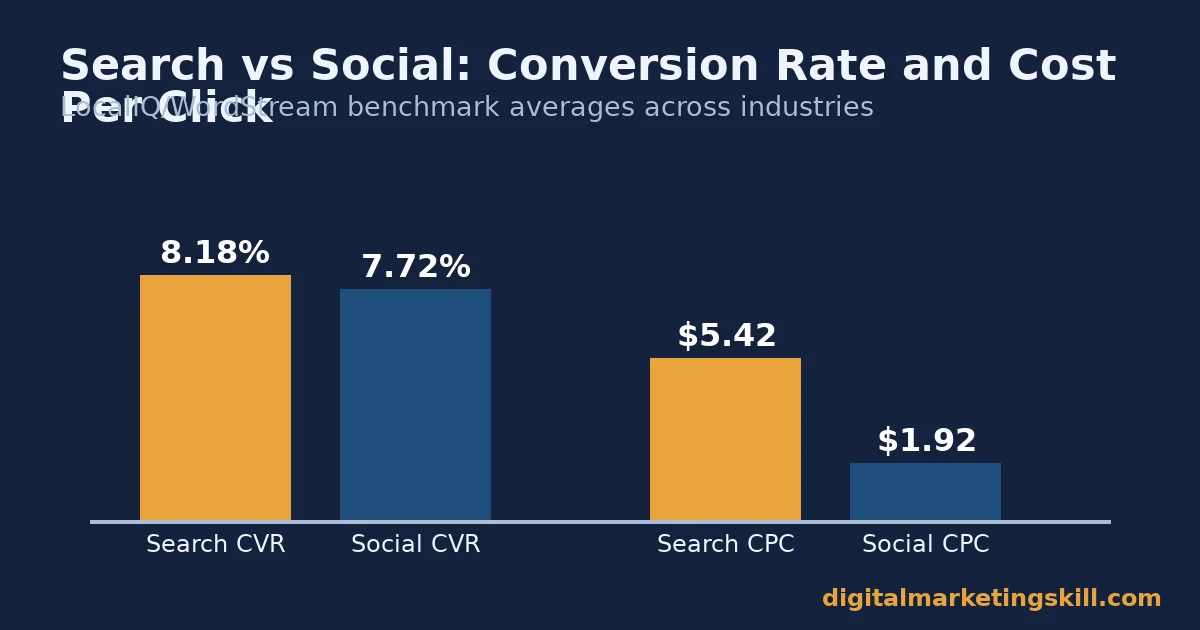
Google Search ads average an 8.18% conversion rate across industries, more than Meta’s 7.72% average for lead campaigns. The gap is intent, not creative quality. Google’s own guidance on choosing a campaign objective makes the same point: pick the goal before the format.
What Differs by Type of Advertising Campaign
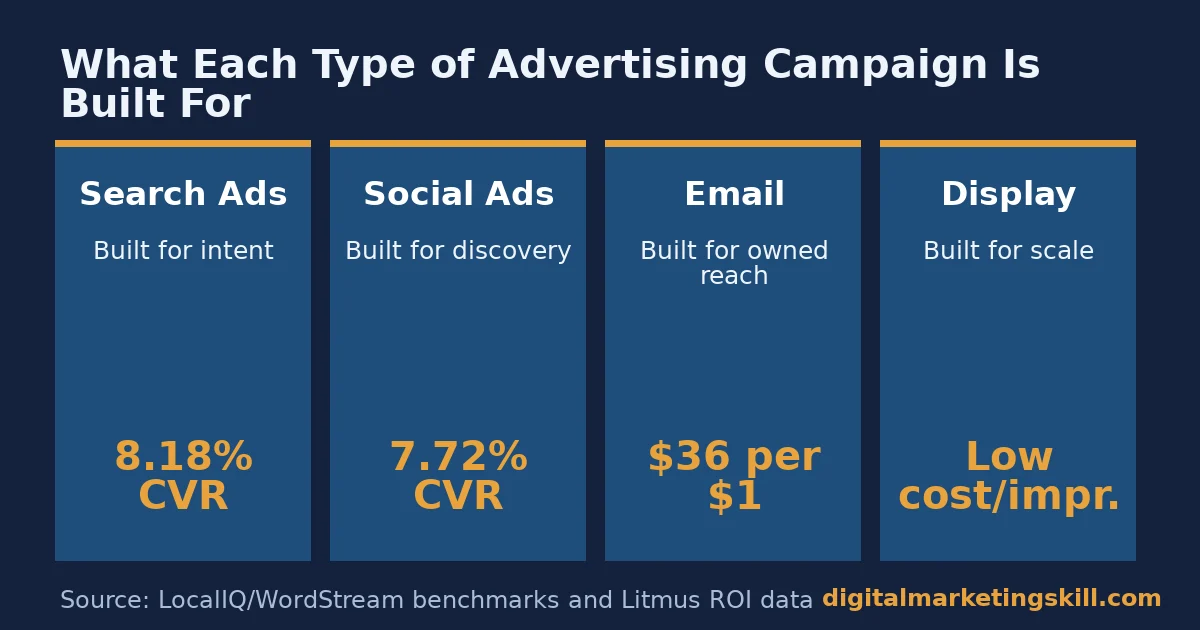
Each major type of advertising campaign does a different job: intent, discovery, owned reach, or scale. Picking the wrong one for your situation is the most common reason a campaign underperforms. The four sections below walk through each type of advertising campaign in the same order every time, so you can compare them side by side instead of jumping between unrelated frameworks.
Search Ads: Built for Ready-to-Buy Intent
Search ads show up when someone types the exact thing they want. LocalIQ’s benchmark report, built with WordStream, puts average search ad performance across industries at a 6.64% click-through rate, a $5.42 cost per click, and an 8.18% conversion rate.
Search earns its intent advantage because the person is already looking for a solution before the ad even appears. That single fact separates search from every other type of advertising campaign on this list. The trade-off is cost: competitive keywords push the cost per click higher than most other channels, because every advertiser chasing the same ready buyer bids against each other for the same slot.
Social Media Ads: Built for Discovery
Social ads interrupt a feed to introduce a product nobody searched for yet. WordStream’s data, reported via Enrich Labs, puts Meta’s lead-objective ads at a 2.59% click-through rate, a $1.92 cost per click, and a 7.72% conversion rate.
Social earns its discovery advantage because it reaches people before they have a need in mind, placing a brand in front of someone who was not shopping at all. The trade-off is a lower conversion rate than search, since the audience has not raised a hand yet, and this type of advertising campaign has to do the extra work of creating interest from nothing.
Email Campaigns: Built for Owned Reach
An email campaign reaches people who already said yes to hearing from you. Litmus reports that email marketing averages $36 back for every $1 spent, the highest return of any channel it tracks.
Email earns its owned-reach advantage because you are not renting attention from a platform algorithm that can change overnight. The trade-off is scale: an email list only reaches the people already on it, so this type of advertising campaign cannot introduce you to new buyers the way social advertising can.
Display and Programmatic Ads: Built for Scale
Display ads place a banner or video across thousands of sites at once, bought automatically through an exchange. Google’s own overview of the Display Network describes this reach as its main advantage over search. Display is the broadest type of advertising campaign, built to put a brand in front of large numbers of people cheaply.
Display earns its scale advantage because the inventory is vast and the cost per impression is low across that inventory. The trade-off is attention: banner ads are easy to scroll past, so this type of advertising campaign usually supports a larger push rather than closing a sale on its own.
How to Lead With Each Type of Advertising Campaign
Knowing what each type of advertising campaign is built for only matters once you know how to start it. Here is the first move for each.
Search Ads: Lead With High-Intent Keywords
Start with the exact phrases a ready buyer types, not broad category terms. A narrow, high-intent keyword list costs more per click. It also converts at a far higher rate than a broad one, which matches the pay-per-click advertising principle of paying only for qualified attention.
Social Media Ads: Lead With a Hook, Not a Pitch
Start with the first three seconds of the creative, not the offer. A scrolling feed punishes anything that looks like an ad before it earns attention. Save the pitch for the second half of the message, once the hook has done its job.
If you run paid social through Meta specifically, set this up correctly first in Facebook Ads Manager, since a misconfigured objective undoes a good creative before it is even tested. Choosing the wrong objective there is one of the most common reasons this type of advertising campaign underdelivers despite a strong hook.
Email Campaigns: Lead With Segmentation
Start by splitting your list by behaviour, not just demographics. A single opt-in signup, where someone confirms interest in one step, returns 80% more than a double opt-in process, per Litmus, so remove friction from the signup itself before you touch the message.
Display Ads: Lead With Frequency Caps
Start by capping how many times one person sees the same banner. Display’s biggest risk is waste: the same impression shown too often to the same person stops working and starts annoying. A frequency cap protects the budget more than any creative change.
Combining Types of Advertising Campaign Across the Funnel
Most businesses do not have to pick only one type of advertising campaign. The four types of advertising campaign in this guide cover different stages of the same buying journey, so a well-run budget usually spreads across more than one of them.
Top of Funnel: Introduce the Brand
Social and display ads do the heavy lifting here. The goal is simply to be seen by people who do not yet know your product exists. Judge this stage on reach and awareness, not on conversion rate, because conversion is not the job yet.
Bottom of Funnel: Close the Ready Buyer
Search ads and email campaigns earn their keep here. Both reach people who already raised a hand, either by searching or by opting in. Judge this stage on conversion rate and cost per acquisition, since those are the two numbers that tell you whether the spend turned into revenue.
A business running all four types of advertising campaign at once typically sees social and display feed new names into the funnel, while search and email convert the names already inside it. Cutting either half of that loop eventually starves the other, no matter how well each individual type of advertising campaign is run on its own.
Measuring Advertising Campaign Performance
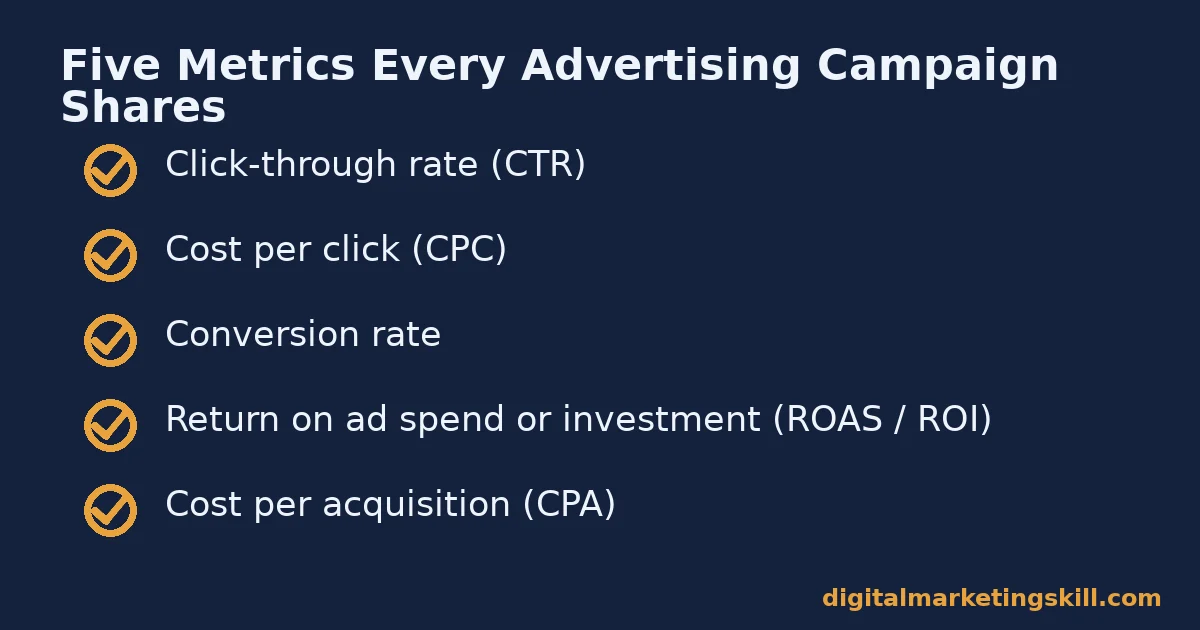
Every type of advertising campaign reports different headline numbers, but five metrics let you compare them fairly.
Five Metrics Every Campaign Shares
Click-through rate (CTR). The share of people who saw the ad and clicked it. It shows whether the message and audience match, not whether the campaign made money.
Cost per click (CPC). What you pay each time someone clicks. LocalIQ’s benchmark puts average search CPC at $5.42 and WordStream’s data puts average Meta lead CPC at $1.92, so comparing CPC across channels without context is misleading.
Conversion rate. The share of clicks that complete the goal action, like a purchase or signup. This is the number that tells you whether traffic actually became a result.
Return on ad spend (ROAS) or return on investment (ROI). Revenue divided by what you spent. Litmus’s $36-per-$1 figure for email is a ROI number, not a conversion rate, and the two should never be confused.
Cost per acquisition (CPA). The total cost divided by the number of results achieved. This is usually the number a budget decision should actually be based on.
How to Read These Numbers Together
A low CPC with a low conversion rate can cost more per result than a high CPC with a high conversion rate. Always divide back to CPA before comparing two types of advertising campaign against each other. Never compare CPC or CTR alone, since either number on its own hides the one figure that actually decides whether the spend was worth it.
If you need the tools to track these numbers without building your own dashboard, several are covered in a roundup of email marketing tools and in a wider look at paid media.
The One Rule: Match the Campaign Type to Where the Audience Already Stands
If you remember one rule from this guide, make it this: decide whether your audience already knows they want your product. Or decide whether you still need to create that want, before you choose between types of advertising campaign. Search and email suit the first group. Social and display suit the second.
As an illustrative, invented example: a plumber with emergency call-outs is better served by search ads, since the searcher already has a leaking pipe. A new skincare brand with no existing demand is better served by social ads, since nobody is searching for a product they have never heard of yet.
Here is the same idea with invented numbers. Say the plumber spends $500 on search ads at the 8.18% average conversion rate. That budget buys roughly 92 clicks at $5.42 each, producing about 8 qualified leads.
The same $500 spent on social ads for that searcher-driven service would reach far more people. It would convert a far smaller share of them, though, because almost nobody scrolling a social feed at that moment has a burst pipe right now. Match the spend to the moment the audience is actually in, not to whichever channel feels more exciting to run.
A Real Finding: Why Opt-In Method Changes Email Campaign Results
Litmus, an email testing and analytics company, measured a concrete difference inside one type of advertising campaign that is easy to overlook: how a subscriber joins the list in the first place. Its research found single opt-in email programs return 80% more than double opt-in programs.
A single opt-in signup adds someone to the list the moment they submit a form. A double opt-in signup asks for a second confirmation click in a follow-up email before anything else gets sent. The confirmation step filters out mistyped and uninterested addresses, but it also costs a share of real subscribers who never click the confirmation and simply drift away instead.
Treat this as one company’s measurement across its own customer base, not a universal law. Deliverability rules, regional consent law, and list quality all vary, so test both approaches against your own numbers before committing to one.
The finding matters beyond email, too. It is a reminder that small structural choices inside any type of advertising campaign, not just the creative or the channel, can move the result by a wide margin.
Frequently Asked Questions About Types of Advertising Campaign
What are the main types of advertising campaign?
The main types of advertising campaign are search ads, social media ads, email campaigns, and display or programmatic ads. Each type of advertising campaign does a different job: search and email suit people who already have intent or permission, while social and display suit introducing a brand to new audiences.
Which type of advertising campaign has the highest ROI?
Email marketing has the highest reported return of any channel Litmus tracks, averaging $36 back for every $1 spent. That figure is an average, so individual results vary by list quality, industry, and offer.
Which type of advertising campaign is cheapest to start?
Email campaigns usually cost the least to start among every type of advertising campaign, since you are messaging people who already opted in rather than paying a platform per click or impression. Search and social ads require an ongoing budget the moment they go live.
Should a small business use social ads or search ads first?
It depends on whether people are already searching for what the business sells. If search volume for the product exists, start with search ads to capture that demand. If the product is new or unfamiliar, social ads can build the awareness that search ads rely on. Search cannot capture demand that nobody has expressed yet.
How long should a type of advertising campaign run before judging results?
Most platforms need time to optimise delivery, so judging a campaign within the first few days usually measures noise, not performance. Let conversion data accumulate before comparing cost per acquisition across campaigns, whichever type of advertising campaign you are running.
Can one business run more than one type of advertising campaign at once?
Yes, and most effective marketing does exactly that. Search can capture people searching now. Email can nurture people who already converted once. Social can introduce the brand to people who have not heard of it yet. Each type of advertising campaign plays a different role in the same funnel.
Does a bigger budget always mean better results, and do small businesses need every type?
No to both. A larger budget spent on the wrong type of advertising campaign for the audience’s intent still underperforms a smaller budget matched correctly. Fix the channel-to-intent match before increasing spend.
For the same reason, a small business with a tight budget should pick just one or two types of advertising campaign. Match those to where its audience already stands, rather than spreading a small budget thinly across all four.
Do all types of advertising campaign need to disclose that they are ads?
Yes, in the US. The FTC’s endorsement guides require a clear, easy-to-see disclosure on any paid or sponsored promotion. That applies whether it runs as a search ad, a social post, or an email, and to every type of advertising campaign covered in this guide. Rules vary by country, so check local advertising law before launching any campaign.
Turn These Campaign Types Into a Real Skill
Understanding the types of advertising campaign is only the start. Running one well, on a real budget, with real measurement, is the harder skill, and it is the one the Master Diploma in Digital & AI Marketing at Digital Marketing Skill Institute is built to teach.
The program runs on four AI-powered tracks covering ten courses in total. Two are especially relevant here: the AI-Powered Social Media Management and Advertising track and the AI-Powered Lead Generation and Email Automation track. A Full Stack option exists if you want all four. Every track includes unlimited 1-on-1 coaching and mentoring, plus a U.S. Project Internship with a verified U.S. Work Reference Letter.
The program carries dual US and UK accreditation. It is recognised in more than 100 countries and runs 100% online. You can learn and run real types of advertising campaign wherever you live.
Explore the Master Diploma program, browse the digital marketing blog for more practical guides, or see real outcomes on the student reviews page before you apply. Learn more at Digital Marketing Skill Institute, and when you are ready, visit digitalmarketingskill.com to get started.
Every figure in this guide was checked against its original source before publication. Figures marked as illustrative are invented examples, not real results.
![9 Amazing Digital Marketing Skills to Make Money Online [With Proof]](https://digitalmarketingskill.com/wp-content/uploads/2019/07/9-Amazing-Digital-Marketing-Skills-to-Make-Money-Online-With-Proof-17.png)






