
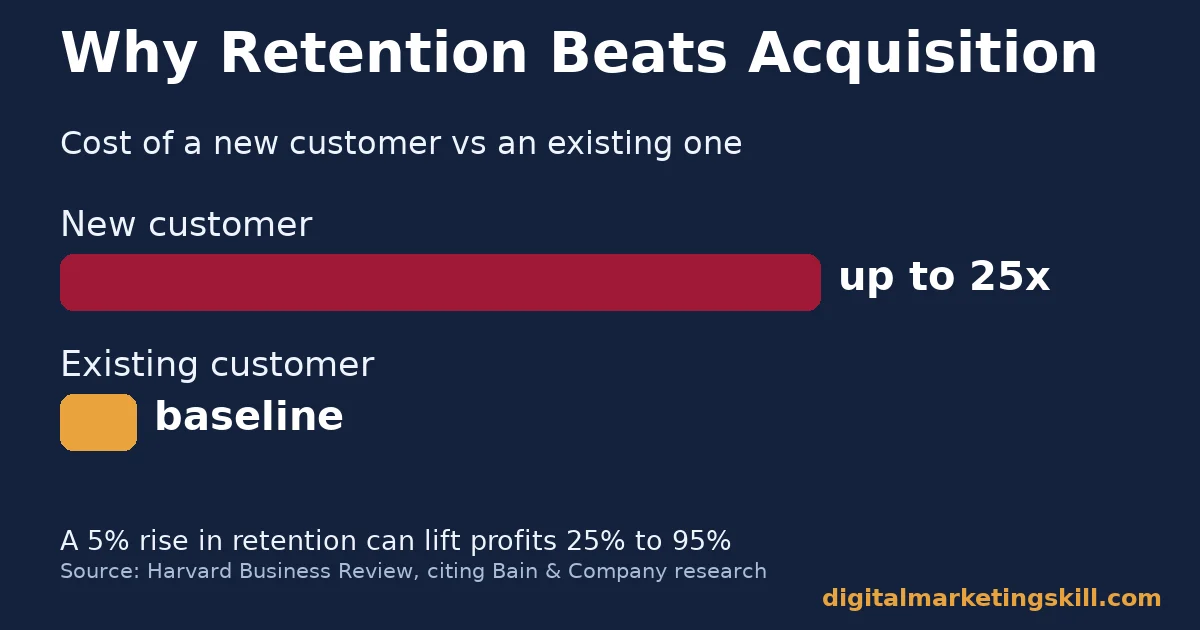
Post-purchase engagement is what happens after the sale closes. It decides whether a buyer comes back. A new customer can cost 5 to 25 times more than keeping one, says research cited by Harvard Business Review.
A 5% lift in retention can raise profits by 25% to 95%. This guide covers the moments that matter. It shows the metrics that prove it works, and one rule for choosing what to send.
Key Takeaways
- Keeping a customer is cheaper than winning one. Research reported by Harvard Business Review found a new customer costs 5 to 25 times more than an existing one.
- Small retention gains compound. The same research found a 5% increase in retention can raise profits by 25% to 95%, depending on the industry.
- Post-purchase emails already win attention. Klaviyo’s benchmark data found post-purchase emails average nearly 60% open rates, against a 49% average across all automated emails.
- Reviews move the next sale. Northwestern’s Spiegel Research Center found a product with five reviews is 270% more likely to be purchased than one with none, in a study of one retailer’s traffic.
- Sending less, better, can outperform sending more. River Island’s email program saw revenue per email rise 30.9% after cutting total send volume by 22.5% and targeting by engagement instead.
In this guide
- Why Post-Purchase Engagement Beats Chasing New Customers
- What Makes a Customer Decide to Come Back
- Two Moments That Shape Post-Purchase Engagement
- How To Lead With Each Moment
- Common Mistakes That Undo Post-Purchase Engagement
- How To Measure Post-Purchase Engagement
- The One Decision Rule: Match The Message To The Customer’s State
- A Real Case: How Sending Fewer, Better-Targeted Emails Lifted Revenue
- Frequently Asked Questions About Post-Purchase Engagement
- Build This Into Your Marketing
Why Post-Purchase Engagement Beats Chasing New Customers
Most advice on customer growth focuses on the sale. Get the click, get the cart, get the order. That misses the moment that actually builds a business: what happens next.
Harvard Business Review reported that a new customer costs 5 to 25 times more than keeping one. The research is attributed to Bain & Company’s Frederick Reichheld. A 5% rise in retention lifts profits by 25% to 95%, depending on the industry. Post-purchase engagement is the lever behind that number. Our guide to customer retention strategies covers the wider picture beyond the post-purchase window.
Here are the ground rules. Every statistic below is attributed to a source we opened directly. The real case describes one company’s result on its own traffic, not a guarantee. Any number that is only our own estimate is labelled illustrative.
What Makes a Customer Decide to Come Back
A customer decides to return based on two things. First, did the experience match or beat what they expected? Second, did you stay useful after the sale, instead of going quiet until the next promotion? A well-known Harvard Business Review study of over 75,000 customer interactions found that low effort, not delight, best predicted repurchase: 94% of customers with a low-effort experience said they would buy again.
The Window Where Post-Purchase Engagement Works Best
The period right after a purchase is when customers pay the most attention to you. Klaviyo’s benchmark data found post-purchase emails average nearly 60% open rates. That beats the 49% average across all automated email. The gap exists because the customer is still actively thinking about the purchase.
This window closes fast. Once a product arrives and becomes routine, attention drops. Post-purchase engagement has to start in the days around delivery, not weeks later when the moment has passed.
Why Silence After the Sale Costs You
Buyers often feel a flicker of doubt right after paying, wondering if they made the right call. Leaving that doubt unanswered is a missed chance, not a neutral choice. A plain shipping update does not fix it. A message that backs up the decision does. The same logic applies earlier in the customer relationship, where a well-timed message builds trust before the sale.
Silence also wastes your best-performing channel. An order confirmation already gets opened by nearly everyone who receives it. Sending it with no personality and no next step throws away attention most marketing emails never get. Baymard Institute’s research on order confirmation pages found shoppers often linger on this screen until the confirmation email arrives, which makes it one of the longest-held moments of attention in the whole buying journey.
Two Moments That Shape Post-Purchase Engagement
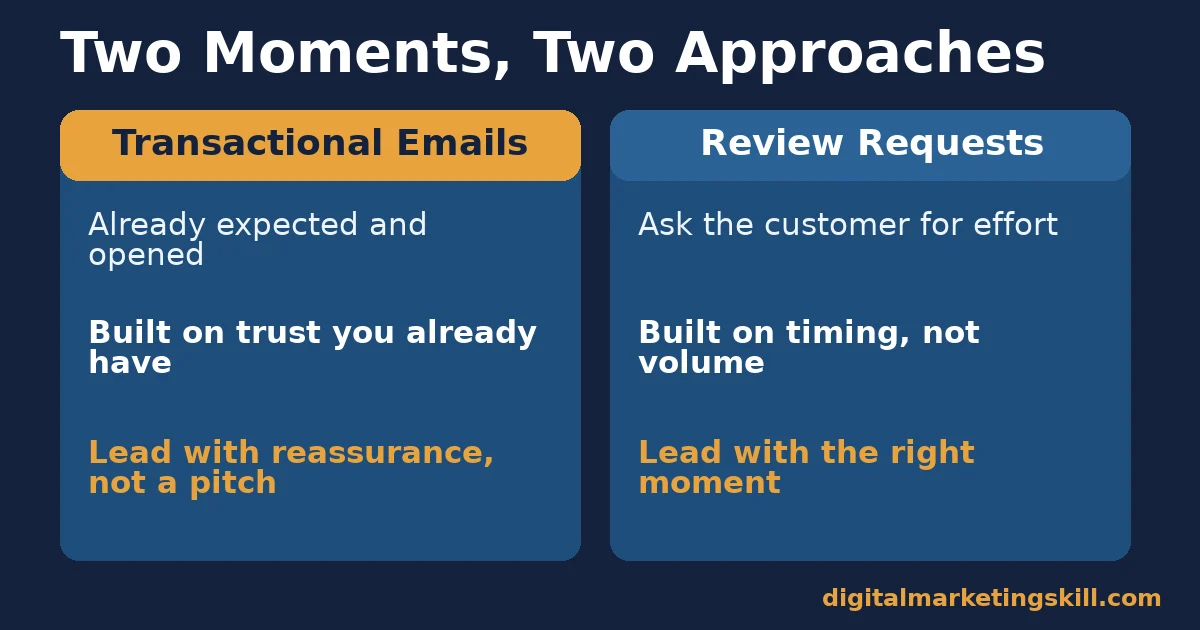
Two moments do most of the work. One is the transactional email every customer expects. The other is the review request, which asks something of them. Each needs a different approach, because the customer’s mindset differs in each one.
Transactional Emails: Built For Trust, Not Just Confirmation
A transactional email, such as an order or shipping confirmation, is not optional reading. The customer wants that information, so they open it. That makes it your highest-trust touchpoint, and also the easiest one to waste on a bare receipt.
Review Requests: Built On Timing, Not Volume
A review request asks the customer for effort, not just attention. It is built on a different kind of readiness. The customer needs to have formed an opinion about the product first. Sent too early, before they used the item, the request gets ignored or answered thinly.
How To Lead With Each Moment
The fix for each moment matches what made it different above. Start with your confirmation emails, since every customer already opens them.
Transactional Emails: Lead With Reassurance
Open with a clear, warm confirmation that the order succeeded. Then add one thing that builds confidence: a delivery estimate, a care tip, or a link to the order status. Keep your brand’s voice in it. A cold, templated receipt wastes the one email almost everyone reads.
Avoid turning every transactional email into a sales pitch. One soft next step, such as following your account or exploring a related guide, is enough. Too many offers crammed into a receipt reads as noise, not help.
Review Requests: Lead With The Right Moment
Time the request to when the customer has actually used the product, not to when the order shipped. A service works best requested within a day of delivery. A physical product usually needs a few days of use first. Test your own window rather than copying a single rule, since this varies by product type.
Once reviews start coming in, make them visible. Northwestern’s Spiegel Research Center studied one retailer’s traffic. Five reviews made a product 270% more likely to sell than one with none. That lift fell once more reviews piled up, so the first five count most. If review requests sit inside a wider email sequence, our guide to email marketing strategies covers how to sequence them.
Common Mistakes That Undo Post-Purchase Engagement
A few habits quietly waste the goodwill you just earned. Watch for these before you add another email.
- Treating every email as a sales pitch. A confirmation stuffed with offers reads as noise. Save the pitch for a separate, clearly marked message.
- Asking for a review too soon. A request sent before delivery gets ignored or rushed. Wait until the customer has actually used the product.
- Using a no-reply address for everything. It signals you do not want to hear back. A real reply path builds more trust than any one message.
- Copying the same sequence for every product. A high-consideration purchase needs more reassurance than a routine one. One sequence for everything ignores that difference.
- Going silent after the first sale. Post-purchase engagement is not one email. It is a short series that carries a new customer toward a second purchase.
How To Measure Post-Purchase Engagement
Raw revenue hides whether post-purchase engagement is actually working. Track the four metrics below together. For the same discipline applied to blog and content performance, see our guide to content marketing metrics.
Four Metrics That Show It Is Working
- Repeat purchase rate. The share of customers who buy a second time within a set window. This is the clearest sign that post-purchase engagement, not just the first sale, is doing its job.
- Post-purchase email engagement rate. Opens and clicks on your confirmation, shipping and follow-up emails. Track these separately from your marketing campaigns, since Klaviyo’s data shows they behave very differently. For the channels that bring in new contacts to feed this funnel, see our guide to growing your email list.
- Review response rate. The share of customers who leave a review after being asked. A falling rate often means your timing has drifted from when customers are actually ready.
- Time to second purchase. How long it takes an average customer to buy again. A shortening gap usually means your post-purchase engagement is building habit, not just goodwill.
Read these four together. Strong post-purchase email engagement with a flat repeat purchase rate tells a specific story. People read your emails but are not acting on them. That points at the offer, not the channel.
The One Decision Rule: Match The Message To The Customer’s State
Before you send anything after a purchase, ask what the customer is feeling at that moment. Send the one message that fits it, not your next scheduled campaign.
Here is an illustrative, invented example. A customer buys hiking boots. Minutes later, they feel mild doubt about the size. An email confirming the order and linking to a sizing guide meets that moment. A generic “check out our new arrivals” email, sent at the same time, ignores it entirely and reads as tone-deaf.
Apply the rule by mapping your own sequence against the customer’s likely state at each point. Right after paying, it is relief and mild doubt. While waiting for delivery, it is anticipation. Once the product arrives, it is judgment. Write one message for each state instead of one generic sequence for all of them.
A Simple First-30-Days Timeline
Mapping post-purchase engagement to a timeline makes it easier to build. Here is a simple version you can adapt to your own product.
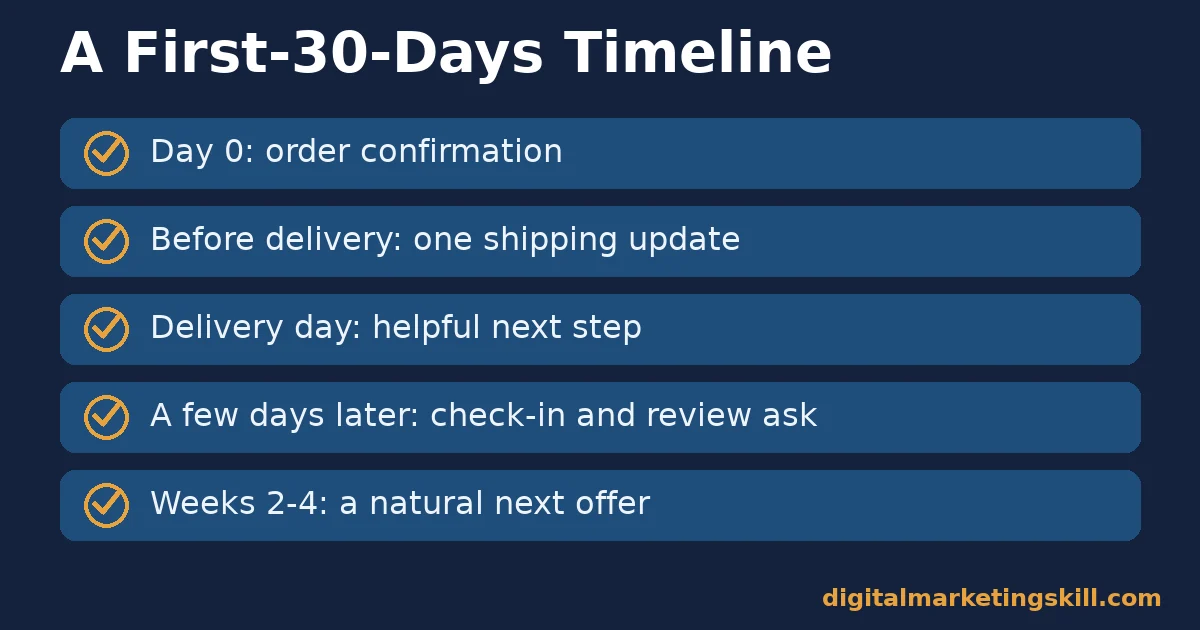
- Day 0. Send the order confirmation right away. Confirm the purchase and set a clear delivery expectation.
- Day 1 to delivery. Send one shipping update if the wait is longer than a couple of days. Keep it short and useful, not promotional.
- Delivery day. Send a delivery confirmation with one helpful next step, such as a setup guide or care tip relevant to the product.
- A few days after delivery. Ask how it is going, once the customer has had time to actually use the product. This is often the right moment for a review request too.
- Two to four weeks later. Introduce something that earns a second purchase naturally, such as a related product or a loyalty option, only if it fits what they bought.
Adjust the gaps for your own product. A fast-moving consumable needs a shorter cycle than a durable purchase someone uses for years.
A Real Case: How Sending Fewer, Better-Targeted Emails Lifted Revenue
River Island, the fashion retailer, ran a two-phase test on its email program with Bloomreach Engagement, built around sorting customers into groups by how engaged they already were. The company cut its total email send volume by 22.5%, sending fewer messages to people who were not opening them.
The result was not less revenue. Revenue per email rose 30.9%. Orders per email rose 30.7%, and open rate rose 26%, while unsubscribe rate fell 12.8%. Fewer, better-targeted messages, including post-purchase and lifecycle emails, beat sending more of the same message to everyone.
The limits matter here too. River Island published these results through its technology partner, over a stated test window of at least three weeks, without detailing sample size or a control group. Treat the direction as credible and the exact percentages as one company’s result, not a universal benchmark.
Frequently Asked Questions About Post-Purchase Engagement
How soon after a sale should post-purchase engagement start?
Start with the order confirmation, sent immediately. Follow with a shipping update, then a delivery check-in within a few days of the product arriving. Review requests usually come later, once the customer has had time to actually use what they bought.
Does post-purchase engagement work for services, not just products?
Yes. The timing shifts: a service review request tends to work best within a day. A physical product usually needs a few days of use first. The underlying rule is the same: ask once the customer has formed an opinion.
What is a good repeat purchase rate?
There is no single number that fits every industry, so judge your own rate against your own prior periods rather than an outside benchmark. A rate that climbs after you improve post-purchase engagement is the signal that matters, regardless of the starting point.
Should every post-purchase email include an offer?
No. Your confirmation and shipping emails already earn high attention because customers expect practical information, not a pitch. Save offers for a later, clearly separate message, so the high-trust emails keep their credibility.
How many reviews does a product actually need?
Northwestern’s Spiegel Research Center found the first five reviews carried the largest lift in purchase likelihood, with the benefit per additional review shrinking after that. Getting a product from zero reviews to a handful matters more than chasing a large total.
What should I do if a post-purchase email gets a low open rate?
Check the subject line and sender name first, since these emails normally outperform marketing campaigns by a wide margin. A low open rate on a transactional email usually signals a deliverability problem, not a content problem. Check your sending domain and inbox placement before you change the message.
Can post-purchase engagement reduce returns?
It can help, though no single study proves an exact percentage. A clear confirmation, a realistic delivery estimate and a quick way to ask questions all reduce the doubt that leads to a return. Treat this as a reasonable, informed inference rather than a settled number.
Who should own post-purchase engagement inside a small team?
Whoever owns email or lifecycle marketing is the natural fit, since most of the work happens through automated sequences. In a very small team, this often falls to whoever also handles customer support, because both roles depend on understanding what the customer is feeling after the sale.
Does post-purchase engagement matter for one-time purchases?
Yes, though the goal shifts. For a product someone buys once, aim for referrals and reviews instead of a second sale. A happy one-time buyer who leaves a review or tells a friend still grows the business, even without buying again.
How does post-purchase engagement differ for subscriptions?
Subscriptions add a new risk: cancellation, not just silence. Post-purchase engagement for a subscription should confirm the value the customer is getting on a regular basis, not only at the first sale. A customer who forgets why they subscribed is a customer close to cancelling.
Build This Into Your Marketing
Post-purchase engagement is a skill you can build and measure, not a one-off email you set and forget. The Digital Marketing Skill Institute’s Master Diploma in Digital & AI Marketing includes an AI-Powered Lead Generation and Email Automation track inside its ten-course, four-track program.
It comes with a Full Stack option for completing all four tracks, unlimited 1-on-1 coaching and mentoring, a U.S. Project Internship with a verified U.S. Work Reference Letter, and dual US and UK accreditation recognised in more than 100 countries. It runs 100% online, wherever in your country you happen to be.
Explore more practical guides on the Digital Marketing Skill Institute blog, read real outcomes on the reviews page, or go straight to the application page to start. Learn more about the Institute and its full course catalogue at digitalmarketingskill.com, any time, from anywhere.
Next step: look at your own order confirmation email right now. Decide whether it reassures a customer or just states a fact, then fix that one email before you touch anything else. Once it is in place, come back to digitalmarketingskill.com for the next guide on building post-purchase engagement further.
Every figure in this guide was checked against its original source before publication. Figures marked as illustrative are invented examples, not real results.
![9 Amazing Digital Marketing Skills to Make Money Online [With Proof]](https://digitalmarketingskill.com/wp-content/uploads/2019/07/9-Amazing-Digital-Marketing-Skills-to-Make-Money-Online-With-Proof-17.png)






