
Marketing for niche businesses works differently from mass-market advertising. Your audience is small but specific, and it is already searching for exactly what you sell. You win by showing up in the few places that audience looks, then proving trust fast, not by chasing broad reach. This guide covers the mechanism, a channel-by-channel plan, the right metrics and one decision rule that stops wasted budget.
Key Takeaways
- Your audience is already online. DataReportal’s global digital overview counts 6.12 billion internet users, 73.8% of the world’s population. A small, specific audience is still reachable almost everywhere.
- Trust decides the sale, not reach. BrightLocal’s Local Consumer Review Survey, a panel of 1,002 US adults, found that 97% read reviews before choosing a local or specialist business.
- Platform choice is not even across channels. Pew Research Center’s survey of 5,022 US adults found 84% use YouTube and 71% use Facebook, against 25% for LinkedIn. The right platform depends on your audience, not habit.
- Email still beats broad social reach per contact. Mailchimp’s own benchmark data puts the all-industry average email click rate at 2.62%, well above typical organic social click-through.
- Most marketing for niche businesses fails from spreading thin, not from a weak product. One channel done well outperforms five channels done half-heartedly. That is the decision rule this guide builds toward.
In this guide
- What Generic Small-Business Advice Misses About Niche Businesses
- Why Marketing for Niche Businesses Works Differently
- What Differs by Channel for a Niche Business
- How to Lead With Each Channel for a Niche Business
- How to Measure Marketing for Niche Businesses
- The Most Useful Rule for Marketing Niche Businesses
- Common Mistakes in Marketing for Niche Businesses
- A Real Case: One Focused Channel, a Measured Result
- Frequently Asked Questions About Marketing for Niche Businesses
- Start With One Channel, Prove It, Then Expand
What Generic Small-Business Advice Misses About Niche Businesses
Most small-business marketing guides assume a fairly broad local audience: a cafe, a salon, a general contractor. A niche business is different. It sells something specific that only a slice of the population wants. That could be a specialty craft, a particular animal breed, a technical repair skill or a narrow professional service. The audience is thinner. But it searches with real intent, and that changes the whole playbook for marketing niche businesses.
Here are the ground rules for this guide. Every figure below comes from a named survey or a platform’s own benchmark page, not from marketing folklore. Each one is reported with its scope and sample size. Social platform habits shift over time, so treat them as a snapshot of current behaviour, not a permanent ranking. Where a figure is self-reported by a vendor about its own product, that is stated plainly.
This guide applies to any seller whose product serves a specific, well-defined group rather than the general public. That covers specialty makers, breeders, technical repair trades, narrow professional services and small online stores built around one category. If your product already fits that description, marketing for niche businesses is the right lens, even if your current traffic looks small compared with a mass-market competitor.
Why Marketing for Niche Businesses Works Differently
A mass-market product can win on reach alone. Enough of a huge audience converts even with a generic message. A niche product cannot do that, because its total addressable audience is already small. Marketing for niche businesses has to raise the conversion rate within that small audience instead. Three things change as a result.
First, search intent carries more weight than search volume. A term with only a few hundred monthly searches can still be worth targeting, if almost everyone typing it is close to buying. Second, trust has to travel faster. A niche buyer usually cannot compare you against five familiar competitors, the way they could compare coffee shops. So they lean on reviews, cases and expertise signals instead.
Third, community and repeat contact matter more. A thin audience is expensive to keep re-acquiring from scratch, so email and returning visitors carry a larger share of revenue than they would for a mass-market brand.
Put together, the mechanism is simple to state. Find the specific place your narrow audience already looks. Answer their exact question better than anyone else there. Then keep the relationship alive through email or community, so you are not paying to find the same buyer twice.
This is the core loop behind every tactic in this guide. It is worth re-reading before you pick a channel, because marketing for niche businesses rewards this loop more than any single tactic.
What Differs by Channel for a Niche Business
The four channels below behave differently for a niche audience than they do for a mass-market one. Each section names what the channel is actually built for, so you can judge where your audience spends attention.
Search: Built for Buyers Who Already Know What They Want
Search traffic arrives with intent already formed. Someone typing a specific, technical query is usually closer to a decision than someone scrolling a feed. Google’s own guidance on helpful, people-first content asks whether a page leaves a reader “feeling they’ve learned enough” to reach their goal. That is exactly the bar a niche buyer applies before they trust you with their money.
The catch is volume. Niche search terms rarely show large numbers in a keyword tool. You are optimising for a smaller, higher-intent pool instead. That trade is worth making, because a visitor who typed your exact niche term converts far better than one who arrived through a broad, loosely matching term.
Social: Built for Discovery, Not Precision
Social platforms are where a niche audience is found, rather than searched for. Pew Research Center’s fact sheet on US adults found that 84% use YouTube, 71% use Facebook, 50% use Instagram, 32% use TikTok and 25% use LinkedIn. Those are general adult-usage numbers, not niche-audience numbers.
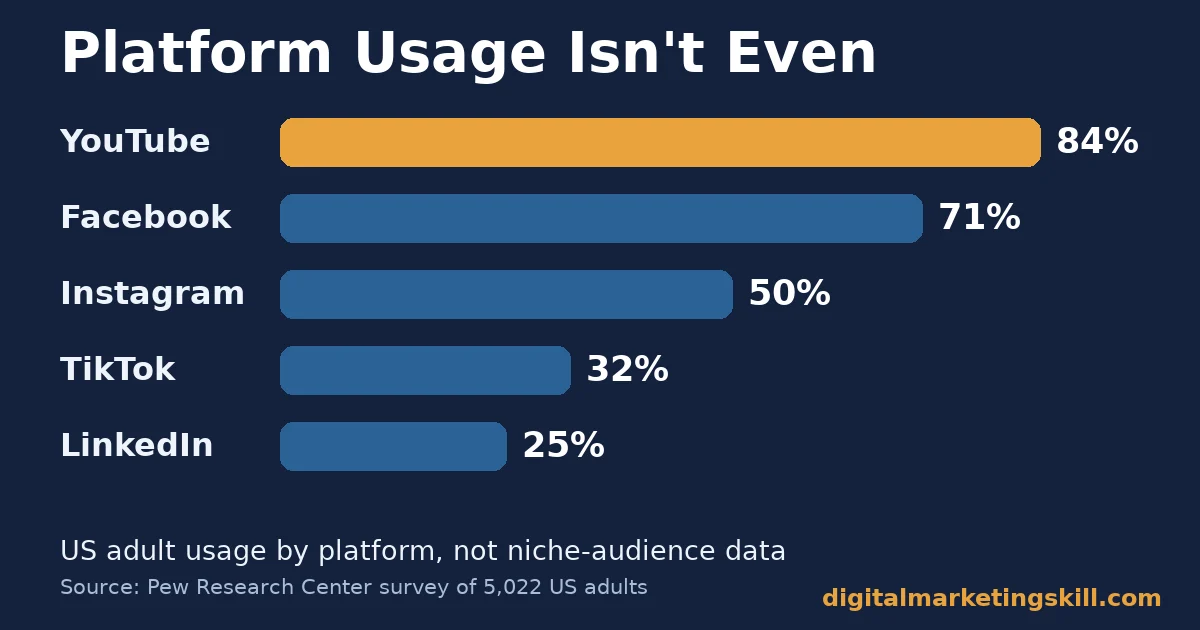
So the right platform for your audience may not be the most popular one overall. A technical B2B niche often does better on LinkedIn or YouTube than on a platform built for broad entertainment.
Social is also where a niche brand builds the community that keeps buyers coming back. A thin audience that feels part of something is worth far more than the same number of one-time visitors, because referrals inside that community cost nothing to earn.
Email: Built to Keep a Thin Audience Without Re-Buying It
Email is the channel least affected by an algorithm deciding who sees your message. Mailchimp’s benchmark data reports an all-industry average open rate of 35.63% and a click rate of 2.62%. For ecommerce specifically, those numbers fall to 29.81% and 1.74%. When your total audience is small, that reliability matters more than it would for a brand that can simply buy more reach.
Our guide on email marketing ROI and why segmentation changes it covers how to protect those numbers once your list grows past its first few hundred subscribers.
Reviews and Local Signals: Built to Replace Familiarity
A niche buyer rarely has five familiar competitors to compare against you. So they lean on proof instead of brand recognition. BrightLocal’s Local Consumer Review Survey, a panel of 1,002 US adults, found that 97% read reviews before choosing a local or specialist business. For a niche business, reviews do the job that brand familiarity does for a household name.
How to Lead With Each Channel for a Niche Business
Understanding a channel is not the same as using it well. The sections below mirror the four channels above. Each one turns understanding into a specific first move.
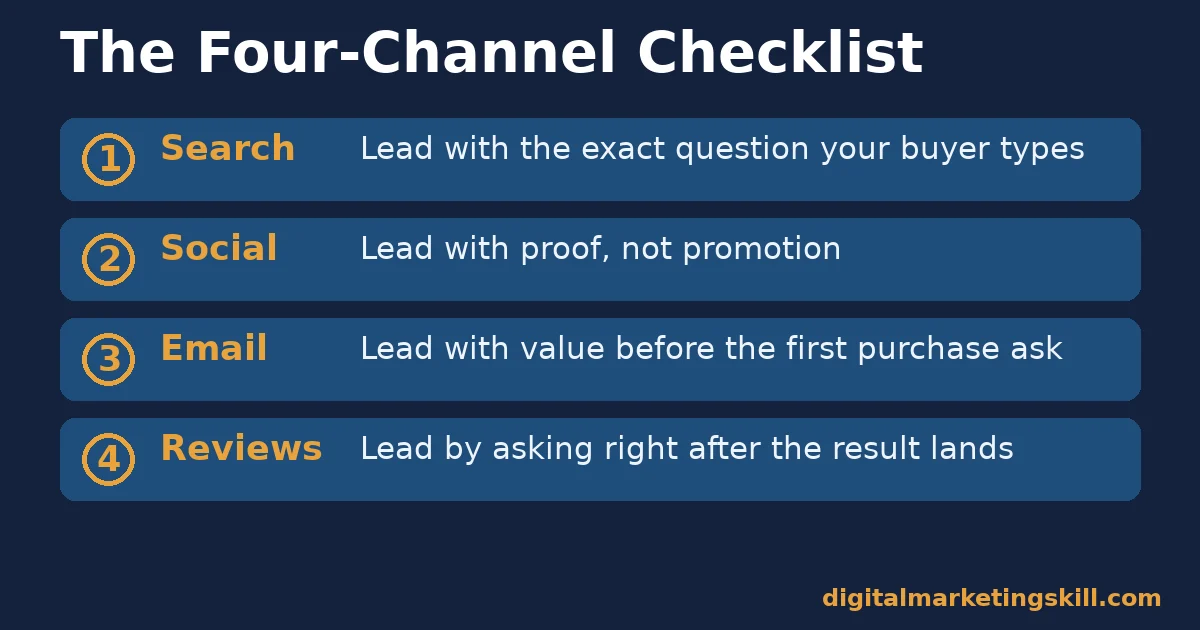
Search: Lead With the Exact Question Your Buyer Types
Write the page title and the opening paragraph around the exact phrase your buyer searches, not a broader category term. A page titled around “how to start a backyard mushroom farm” will out-convert one titled generically around “farming business ideas.” It gets fewer visitors, but every one of them already wants that exact thing.
Then answer the question in the first two sentences, before any background or story. Our on-page SEO checklist covers titles, headings and page structure in more depth.
Social: Lead With Proof, Not Promotion
Post the process, not just the finished product. A niche audience follows accounts that show real technique, real mistakes and real results. That is the proof a stranger needs before trusting a specialist seller. Save direct promotion for a small share of posts, and let demonstration carry the rest.
Pick the one or two platforms your audience actually uses, based on where your current customers already spend time. Our guide on social media campaign strategies for small businesses has a simple way to test that before you commit a full content calendar to one platform.
Email: Lead With a Reason to Join Before You Ask to Buy
Offer something useful before the first purchase ask. That could be a short guide, a checklist or an invitation to a small community. A thin niche audience joins a list for value, not discounts alone. That first useful email sets the open-rate habit for every one that follows.
Segment early. Even a small list splits usefully into “not yet bought” and “already a customer.” Those two groups need different emails, and segmentation is one of the simplest ways to protect your click rate as the list grows.
Reviews and Local Signals: Lead by Asking at the Right Moment
Ask for a review right after a buyer gets the result they wanted, not weeks later. Make the ask a direct link, not a general request. Every extra step loses a share of buyers who meant to leave feedback. Our guide on how to get good customer reviews covers wording that gets more of them answered.
If your niche business also serves a specific area, keep your Google Business Profile current. That listing is often the first proof a local searcher checks before anything else.
How to Measure Marketing for Niche Businesses
A thin audience makes raw traffic numbers misleading. Measure conversion and retention instead of volume alone. Each metric below is defined in one sentence, with a note on how to read it.
- Search-to-lead conversion rate. The share of search visitors who take a meaningful action, tracked in Google Analytics as a key event. For a niche business, this should run well above a generic site’s rate, because the traffic is more specific.
- Email click rate. The share of subscribers who click through on a send. Compare your own number against Mailchimp’s 2.62% all-industry average only as a rough guide. A genuinely engaged niche list often beats it.
- Review velocity. New reviews earned per month. A flat line means your ask process has broken somewhere between the sale and the request.
- Returning-visitor share. The percentage of visits from people who have been to your site before. Rising returns show the community and email work is paying off, not just the acquisition work.
- Cost per repeat customer. Total marketing spend divided by the number of customers who buy a second time. For a niche business, this figure matters more than cost per first sale, because the audience is too thin to keep re-acquiring profitably.
Reading the Numbers Together
Start with conversion rate, not traffic. If conversion is healthy but traffic is low, your channel choice and message are working. You simply need more of the right visitors. If traffic is fine but conversion is weak, the message does not match what your audience needs to hear, no matter how many people arrive.
Here is a worked example, with invented numbers for illustration. A specialist seller gets 400 visits a month to its main search page and converts 3% of them into leads, which is 12 leads. Email click rate sits at 4%, above the all-industry average, because the list is small and genuinely interested.
The owner reads these two numbers together and concludes the search page is doing its job. So the next fix is adding more pages that target closely related niche terms, not changing the page that already works.
The Most Useful Rule for Marketing Niche Businesses
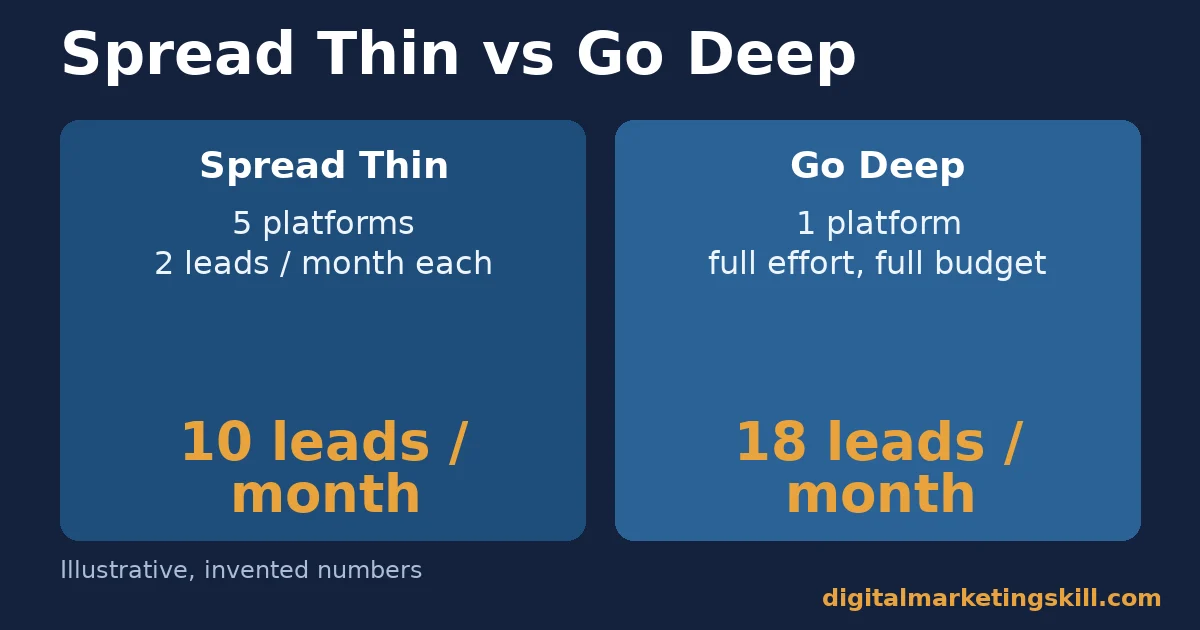
If you take one decision rule from this guide, make it this one. A niche business has less total budget and attention than a mass-market one. Spreading it across five channels usually means doing all five poorly. Pick the single channel where your audience already gathers. Run it properly for a sustained stretch. Only add a second channel once the first produces steady, measurable results.
Here is an illustrative example, with invented numbers. A specialty pet-breeding business splits its time evenly across five platforms. It earns roughly two qualified leads a month from each, ten total.
It then drops four platforms and puts all its effort into the one search term its buyers actually type. Within a few months, that single channel alone produces eighteen qualified leads a month, because the budget and the content quality both doubled on the channel that mattered.
Common Mistakes in Marketing for Niche Businesses
Three mistakes show up again and again when a specific, small-audience business tries to copy mass-market tactics. Each one wastes budget that a niche business cannot easily spare.
- Copying a broad keyword strategy. Chasing a popular, generic term instead of your exact niche phrase brings traffic that rarely converts. Marketing for niche businesses works better around the specific words your buyer actually types.
- Running every channel at half effort. A thin budget split six ways produces weak results everywhere. One channel run properly beats six channels run poorly, which is the core idea behind marketing for niche businesses done well.
- Treating reviews as an afterthought. Waiting until a customer complains, instead of asking happy buyers right away, starves a specialist seller of the proof a niche audience relies on most.
Fixing even one of these mistakes usually frees up enough budget to fund the single-channel focus this guide recommends. Review your own spend against this list once a quarter, because marketing for niche businesses rewards steady discipline more than any single clever tactic.
A Real Case: One Focused Channel, a Measured Result
Ayooluwa Osemi, a Digital Marketing Skill Institute graduate, published a result that shows this principle in a single small campaign. According to the student’s review on the institute’s reviews page, a $14 spend on Facebook and Instagram ads produced $878 in sales. That is marketing for niche businesses in miniature: one channel, tested with a small budget, instead of money split thin across several platforms at once.
Keep the limits of this case in mind. It is one published result from one seller, not a guaranteed return for any niche business, and spend-to-sales ratios vary widely by product, price point and audience. Past income results do not guarantee future ones; see the institute’s earnings disclaimer for the full context.
Frequently Asked Questions About Marketing for Niche Businesses
What makes marketing for niche businesses different from regular small-business marketing?
The audience is smaller but searches with more intent. Niche marketing wins through higher conversion within a thin audience, rather than reach across a broad one. Trust signals like reviews and demonstrated expertise matter more than they do for a familiar mass-market brand.
Which platform should a niche business use first?
Start with wherever your current customers already spend time, not the most popular platform overall. A technical or specialist niche often converts better on a platform like LinkedIn or YouTube than on a general entertainment platform, even with fewer total users.
Is search engine optimisation worth it for a low-search-volume niche?
Yes. A visitor who types your exact niche term is usually close to buying. Low search volume is not the same as low value. A smaller number of highly intentional visitors can convert better than a larger number of loosely matched ones.
How many reviews does a niche business need before they help?
There is no fixed number, but a steady flow matters more than a one-time push. BrightLocal’s research found that 97% of consumers read reviews before choosing a specialist or local business. Even a handful of recent, specific reviews outperforms none.
Should a niche business bother with email marketing?
Yes. Email is the one channel not controlled by an algorithm deciding who sees your message, which matters most when your total audience is already small. Segment early, so returning customers and new subscribers get different messages.
How do I know if I am spreading my marketing too thin?
If no single channel produces steady, measurable leads after a real effort, you are likely spread too thin. Consolidate into the channel with the best early signal, and give it a sustained run before you judge it.
Does a niche business need a bigger budget than a mass-market one?
Not necessarily. A niche business often needs less total spend, because it is not paying to reach people who will never buy. The budget works harder when it is concentrated on one channel that your specific audience already uses.
How long before marketing for niche businesses starts producing results?
Give one channel a real, sustained run, usually a few months, before judging it. Search and reviews build up gradually, while a paid test on social or search can show an early signal within weeks. Judge the channel on conversion, not on how fast traffic appears.
Start With One Channel, Prove It, Then Expand
Marketing for niche businesses works best when you stop trying to be everywhere. Start being unmistakably useful in the one place your audience already looks. Pick that channel, apply the lead-with tactic above, and measure conversion for a real stretch of time before you add anything else.
Revisit this plan every few months, because the channel that works best for marketing a niche business can shift as your audience and your list both grow.
If you want structured, hands-on practice, the Digital Marketing Skill Institute teaches these exact skills inside its Master Diploma in Digital & AI Marketing. The programme is built around four AI-powered tracks, including AI-Powered Social Media Management and Advertising and AI-Powered WordPress and SEO Specialist, across ten courses total, with a Full Stack option for completing all four. It comes with unlimited 1-on-1 coaching and mentoring, plus a U.S. Project Internship that leads to a verified U.S. Work Reference Letter. The diploma is dual US and UK accredited and recognised in more than 100 countries.
The programme is fully online, so you can study from anywhere in your country. Browse more guides on the Digital Marketing Skill Institute blog, check real outcomes on the reviews page, and when you are ready, apply for the Master Diploma or start from the Digital Marketing Skill Institute homepage.
Every figure in this guide was checked against its original source before publication. Figures marked as illustrative are invented examples, not real results.
![9 Amazing Digital Marketing Skills to Make Money Online [With Proof]](https://digitalmarketingskill.com/wp-content/uploads/2019/07/9-Amazing-Digital-Marketing-Skills-to-Make-Money-Online-With-Proof-17.png)






