
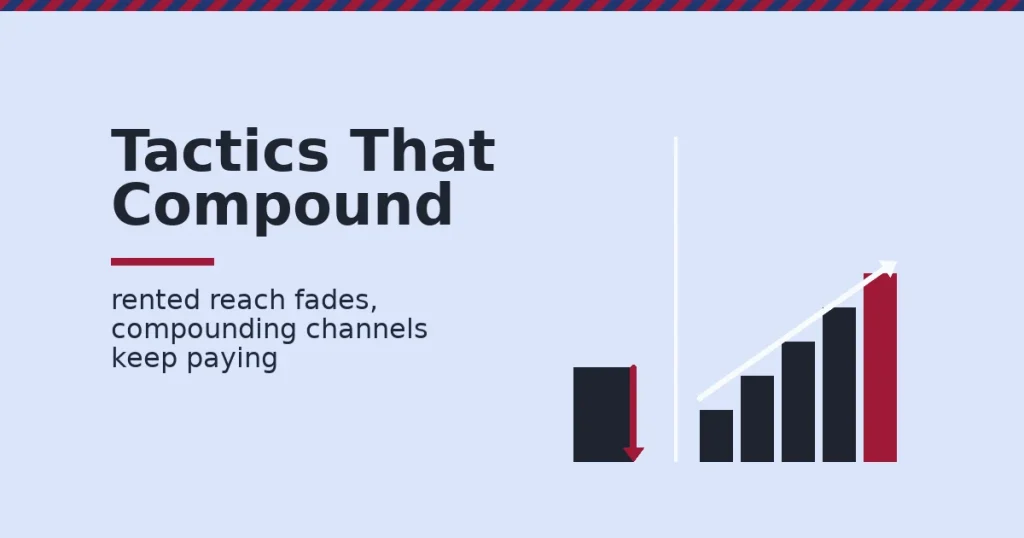
The best free website traffic tactics are not a twenty-item checklist. They are the three or four channels that keep paying off after you stop posting. This guide ranks the free website traffic tactics that compound over time against the ones that drain the moment you stop working, and shows how to tell the difference on your own site.
Key Takeaways
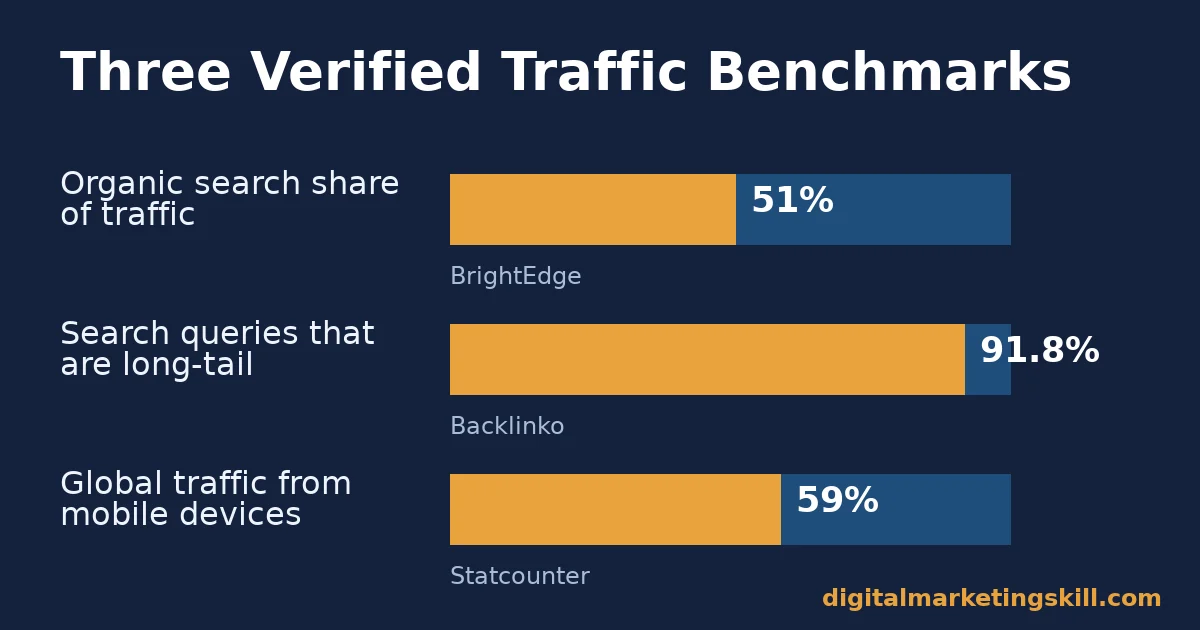
- Organic search is responsible for an estimated 51% of website traffic, according to BrightEdge’s own research, more than any other single channel.
- 91.8% of all Google search queries are long-tail keywords, per Backlinko’s analysis of 306 million keywords. Those queries together account for only 3.3% of total search volume.
- Mobile devices generate roughly 59% of global website traffic, per Statcounter. A mobile-broken page quietly caps every other tactic on this list.
- 35% of marketing leaders report $10–$36 back for every $1 spent on email, according to Litmus’s State of Email survey of around 500 marketing professionals.
- G2’s Learning Hub grew from roughly 3,000–5,000 monthly organic sessions to just under 1 million organic sessions in about two years, using topic clustering, keyword research and a dedicated link-building team, per G2’s own published case study.
In this guide
- Why Most Free Website Traffic Tactics Lists Fail
- The Mechanism Behind Compounding Traffic
- What Differs By Channel
- How To Lead With Each Free Website Traffic Tactic
- How To Measure Free Website Traffic Tactics
- The One Decision Rule For Choosing A Free Website Traffic Tactic
- A Real Case: G2’s Organic Traffic Growth
- Frequently Asked Questions About Free Website Traffic Tactics
- Turn These Free Website Traffic Tactics Into A Repeatable Skill
Why Most Free Website Traffic Tactics Lists Fail
Search for ways to drive traffic and you will find twenty or thirty tactics. But most lists give you no sense of which three actually move the needle for your site. That is the real gap. It is not a shortage of tactics. It is a shortage of guidance on which free website traffic tactics compound, and which ones expire the day you stop.
Two ground rules first. Channel benchmarks below are averages across many sites and industries. Your numbers will vary by niche, site age, and competition, so treat every figure as a snapshot, not a guarantee. Nothing here promises a specific amount of traffic by a specific date. Free tactics still take real, sustained work. Anyone promising guaranteed numbers on a fixed date is not being straight with you.
One more ground rule: this guide is written for a worldwide audience. The channel mechanics below work the same way for a business anywhere in your country, even though your audience’s preferred platforms may differ by region.
With those ground rules in place, the rest of this guide walks through the free website traffic tactics themselves — what makes each one different, how to lead with it, and how to tell whether it is actually working for your specific site.
The Mechanism Behind Compounding Traffic
Every traffic source falls into one of two buckets. Compounding sources keep working after you stop promoting them: organic search, an indexed content archive, an email list, and backlinks all fall here, because a search engine, an inbox, or a link on someone else’s page still exists tomorrow.
Understanding this split is the single most useful thing to take from this guide.
Rented sources stop producing traffic almost the moment you stop paying or posting. A single social post, a paid ad, or a one-off share all decay fast, because the feed algorithm buries yesterday’s post under today’s.
This split explains why organic search still drives roughly half of all trackable traffic, years after social platforms became dominant. A page that ranks for a search term keeps earning visits for as long as it ranks, at no repeat cost.
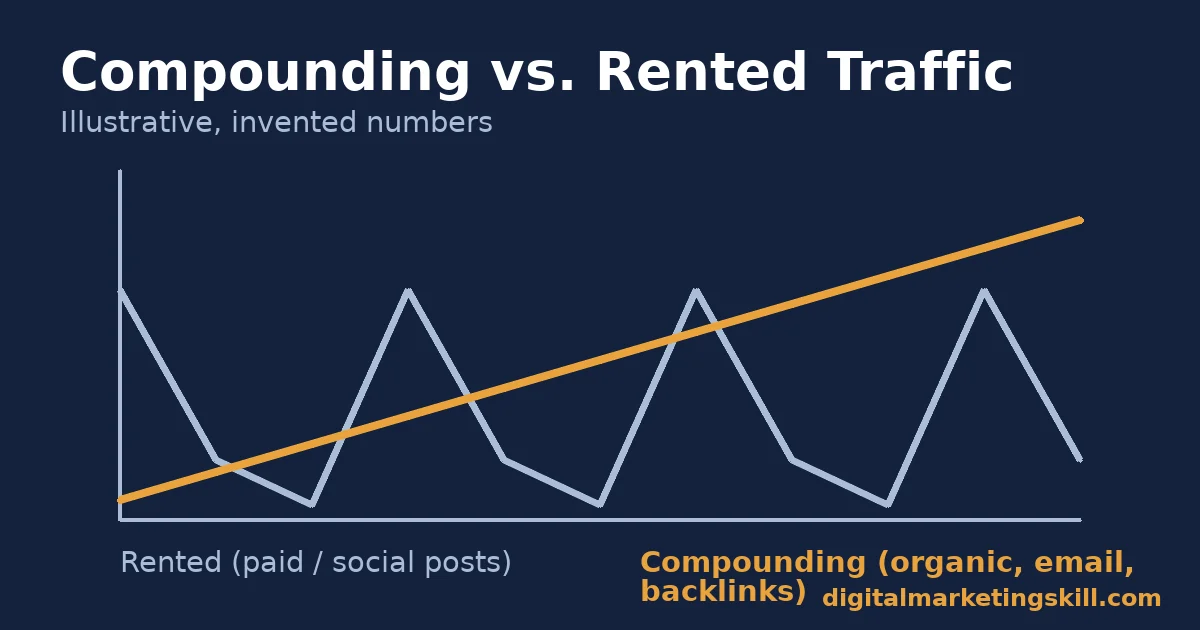
The practical lesson is sequencing: use rented traffic first to get an early signal on what resonates. Then invest the real effort into the compounding version of that same idea — a ranking page, an email sequence, or a backlink-worthy resource.
A rented post reaches its full audience once, then decays toward zero within days. A compounding page reaches a small audience at first, then a larger one each month, as it climbs in rankings.
Ten compounding pages are worth more than ten months of rented traffic — closer to ten growing curves stacked together. Consistent publishers tend to out-earn newer, more polished sites with less history behind them.
What Differs By Channel
Organic Search: Built For Compounding, Slow To Start
Organic search is the only major channel where one page, written once, keeps earning visits for years. There is no repeat cost. The tradeoff is time. A new page typically needs weeks to months to earn trust and ranking signals, and the first page of competitive results is crowded.
Long-tail, specific phrases are the practical way in. Backlinko’s study of 306 million keywords found that 91.8% of all search queries are long-tail. Most of what people actually type is specific, not the generic one- or two-word term everyone fights over. For a deeper walkthrough of ranking fundamentals, see our complete guide to search engine optimization.
Paid Reach And Social Posts: Fast But Rented
A paid ad or a social post can reach people within hours. That is exactly what organic search cannot do early on. The tradeoff: the moment the budget or the posting stops, the traffic stops too. You are renting attention inside somebody else’s feed and algorithm, not building an asset you control.
People spend a large daily average of time inside social feeds worldwide, per DataReportal’s global digital research. That is why social feels like a safe primary channel. But your post competes with everything else in that feed for a sliver of that time, and the platform decides how much you get, not you.
Email And Community: Owned Reach That Survives Algorithm Changes
An email list or a community you host is the one channel a platform change cannot take away overnight. You hold the contact detail, not a borrowed feed position. The tradeoff: building the list takes a genuinely useful reason for someone to hand over their email address. A sloppy, overly salesy list will unsubscribe faster than it grows.
Backlinks And Digital PR: Slow Trust, Hard To Fake
Pages that other sites link to tend to rank higher. A recent Ahrefs study of roughly 1 million keywords found referring domains and backlink counts positively correlate with top-20 rankings. Backlinko’s analysis of 11.8 million results found the average #1 result has roughly 3x more referring domains than results in positions 2 through 10. Our guide to earning quality backlinks without buying links goes deeper on outreach tactics.
The tradeoff: earning links takes genuinely link-worthy content and real outreach. Buying or trading links that pass ranking credit violates Google’s own spam policies. That risks a penalty instead of a boost. Of all the free website traffic tactics in this guide, backlinks are the slowest to build and the hardest to fake, which is exactly why they carry so much weight with search engines.
How To Lead With Each Free Website Traffic Tactic
Organic Search: Lead With Search Intent
Skip the one broad page competing for a crowded two-word term. Write a cluster of narrower pages instead. Each should answer one specific, long-tail question your audience actually searches, with a clear next step at the end.
Use each page’s title, first 100 words, and at least one subheading to state the specific phrase naturally, never stuffed. Link the cluster together so search engines understand the pages are related.
Write for the person who typed that exact question, not for the search engine. Answer it directly in the first few sentences. Then go deeper than the next ten results on the same topic. A page that only repeats what already ranks has no reason to outrank it.
Paid And Social: Lead With Retargeting, Not Cold Reach
Spend the smallest share of a paid or social budget on cold reach to strangers. Spend the largest share on retargeting people who already visited your site or opened an email. Warm audiences convert at a noticeably higher rate than cold ones, so the same budget buys more qualified traffic when aimed at people who already showed interest.
A practical split many small budgets use: roughly a fifth on cold reach to test new audiences, and the rest on retargeting the people who already engaged. Review that split every month using the engagement numbers from your analytics tool, and shift more budget toward whichever audience segment is converting, rather than leaving the split fixed forever.
Email And Community: Lead With One High-Value Resource
Skip the generic newsletter signup. Offer one specific, genuinely useful resource instead — a checklist, a template, or a short course that solves one real problem. Build the follow-up sequence around getting that resource used, not around selling immediately.
A list built this way opens and clicks at a far higher rate than one grown through pop-ups alone. That is a large part of why email still returns $10 or more for every $1 spent, for over a third of marketers surveyed by Litmus.
Keep the welcome sequence short — three or four messages, each delivering one small win — rather than a long drip campaign that asks for a sale before it has delivered any value. Our guide to building an email list that converts covers the welcome sequence in more detail. Of all the free website traffic tactics covered here, this is the one most founders delay the longest, usually to their own cost.
Backlinks And Digital PR: Lead With Something Worth Citing
Build one genuinely citable asset per quarter. An original survey, a free tool, a detailed comparison, or a well-sourced data roundup all work. Do not simply ask for links to ordinary blog posts — our content marketing strategy framework can help you plan which asset to build first.
Backlinko and Pitchbox’s analysis of 12 million outreach emails found only about 8.5% get a response. Personalizing the subject line lifted response rates by roughly 30%. Pitch a small, relevant list of sites, with a specific reason that page should link to your specific asset.
How To Measure Free Website Traffic Tactics
Free website traffic tactics are only as good as the numbers you track against them. Pick a small number of KPIs per channel. Check them monthly, not daily, since free-tactic results move slowly.
Checking daily tends to produce noise-driven decisions, like abandoning a page after one slow week, instead of trend-driven ones. Pull the same five numbers on the same date each month. Only change course when a trend holds for two or three months running.
- Organic sessions: visits from unpaid search results, tracked in your analytics tool. This is your core compounding-traffic number.
- Click-through rate (CTR): the share of people who see your page in search results and click it. A low CTR at a good ranking position usually means the title needs work, not the content.
- Engagement rate / bounce rate: the share of visits that stay and interact, versus leave immediately. A high bounce rate on mobile often points to slow load time, not weak content, since mobile drives roughly 59% of global traffic — our mobile SEO guide covers the fixes.
- Email open and click rate: the share of your list that opens a message, and the share that clicks a link inside it. Falling open rates usually mean the list needs cleaning, or the subject lines need work.
- Referring domains: the number of distinct sites linking to you, tracked in a backlink tool. This is the slowest-moving number, and the hardest to fake, which is exactly why it correlates with ranking.
The One Decision Rule For Choosing A Free Website Traffic Tactic
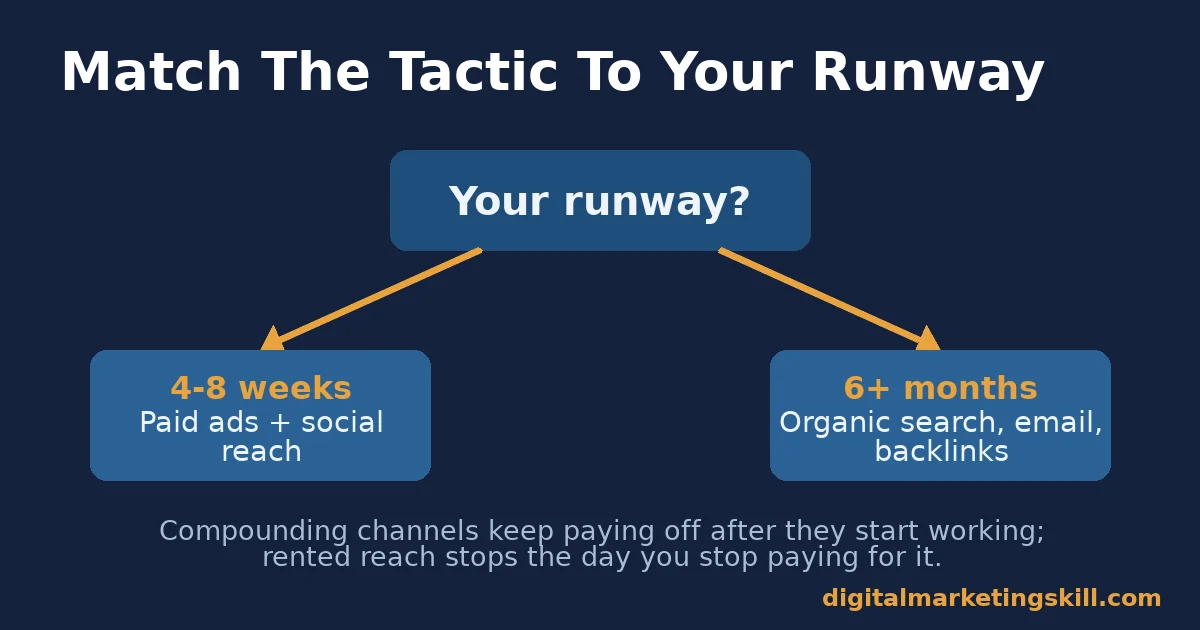
If you need traffic within 4–8 weeks because of a launch or a deadline, prioritize paid and social reach. It is the only channel here that can produce visits that quickly.
If you have 6 months or more of runway, prioritize organic search, email, and backlink-worthy content instead. That is roughly the timeframe compounding channels need to start paying off, and once they do, they keep paying off at no repeat cost. See our related breakdown of which traffic channels actually compound for a closer look at this tradeoff.
Illustrative, invented numbers: imagine two sites each publish 12 long-tail pages. Site A runs paid ads to the same pages for the first month, to see which topics get clicks. Then it stops paid spend and leans on the organic rankings those pages build over the following months.
Site B keeps paying for ads the whole time, and never earns organic rankings for the same pages. A year later, Site A’s traffic from those 12 pages is still growing at no extra cost, while Site B’s traffic stops the day its ad budget stops.
These numbers are invented to illustrate the mechanism, not a guarantee of your results. The rule holds regardless of niche: match the tactic to how much runway you actually have, not to which one sounds most impressive.
A Real Case: G2’s Organic Traffic Growth
G2’s Learning Hub published its own account of growing blog organic traffic. It went from roughly 3,000 to 5,000 monthly sessions, to just under 1 million organic sessions, in about two years. The team’s write-up credits four specific habits.
First, keyword research with SEO software, to find real search volume before writing. Second, organizing 20 to 40 articles into single-topic clusters, instead of scattered subjects. Third, a dedicated outreach team built specifically for backlinks. Fourth, consistent on-page SEO basics — headers, alt text, meta descriptions — applied to every single post.
Limits worth naming: this is one company’s self-reported case study, not an independent audit. G2 is a large B2B platform with a seven-person link-building team and years of runway. A smaller site will not match these exact numbers on the same timeline. But the four habits themselves scale down to a single-person blog running the same free website traffic tactics on a much smaller budget.
Frequently Asked Questions About Free Website Traffic Tactics
How long do free website traffic tactics take to show results?
Organic search and backlink-based tactics typically need weeks to months before a new page gains meaningful ranking. A search engine has to crawl, index, and build trust in a page over time. Email and community tactics can produce visits faster once a list exists, but building that list still takes sustained effort. No fixed timeline applies to every site, so treat any specific day-count promise with caution.
Which free website traffic tactics work best for a brand-new website?
A brand-new site usually has no backlinks, no email list, and no ranking history. The fastest realistic starting point is a small number of narrow, long-tail pages that answer specific questions with little competition. Pair that with direct outreach to a handful of relevant sites or communities where your audience already gathers.
Avoid spreading thin across every channel at once. A new site with limited time is usually better served by doing one or two free website traffic tactics thoroughly than all of them half-heartedly.
Is social media traffic free or paid?
Organic posting is free in the sense that you are not paying for reach. But it behaves like rented traffic, because a platform’s algorithm decides how many people see each post. That reach can change or shrink without notice. Paid social ads are the explicitly paid version of the same channel.
How many backlinks does a page need to rank well?
There is no fixed number. Research shows a positive correlation between referring domains and ranking position. Top results tend to have noticeably more referring domains than lower-ranked pages, but link quality and relevance matter more than raw count.
A handful of relevant, earned links from respected sites usually outweighs a large pile of low-quality ones. Chasing a specific link count is the wrong goal; chasing a specific number of genuinely relevant sites in your field is the right one. Content Marketing Institute’s B2B research similarly finds organic search is the largest single revenue channel for B2B marketers who use it consistently.
Do I need to post on every social platform to drive traffic?
No. Posting consistently on one or two platforms where your audience spends time tends to outperform scattered posting everywhere. Most platform algorithms reward accounts that post predictably, over accounts that post everywhere occasionally.
Can I combine paid and free traffic tactics?
Yes, and the data above suggests you should. Use a small, time-limited paid or social push to find out which topics and pages get clicks. Then invest ongoing effort into the organic, email, and backlink versions of whichever topics proved interesting. Those are the free website traffic tactics that keep producing traffic with no repeat cost.
Why is my traffic growing but my sales aren’t?
This usually means the traffic and the offer are mismatched. You may be attracting visitors for a broad or loosely related search term, rather than the specific question your actual buyers ask. Or the page itself may not make the next step obvious.
Check the bounce rate on your highest-traffic pages. A very high bounce rate usually means the page answers a different question than the one your offer solves. The fix is a sharper topic or a clearer next step, not more traffic.
Turn These Free Website Traffic Tactics Into A Repeatable Skill
Search-intent content, retargeted paid reach, a genuinely useful lead magnet, and outreach for backlinks are all skills. They get faster and more effective with structured practice, not a one-time checklist.
The Digital Marketing Skill Institute’s Master Diploma in Digital & AI Marketing is built around four AI-powered tracks. AI-Powered Google Specialist and AI-Powered WordPress and SEO Specialist cover the organic-search and on-page side of this guide. AI-Powered Social Media Management and Advertising and AI-Powered Lead Generation and Email Automation cover the paid, social, and email side.
The four tracks total ten courses, with a Full Stack option for anyone who wants all four. The program includes unlimited 1-on-1 coaching and mentoring, a U.S. Project Internship with a verified U.S. Work Reference Letter, and dual US and UK accreditation recognised in more than 100 countries.
It is 100% online, so you can apply these tactics to a real project from wherever you are in your country.
See real course outcomes on our reviews page, read the full program breakdown on the Master Diploma page, and browse more guides like this on the digital marketing blog. When you’re ready, apply here. Whether you are starting out or scaling an existing site, wherever you live, Digital Marketing Skill Institute is built to meet you there. Learn more at digitalmarketingskill.com.
Every figure in this guide was checked against its original source before publication. Figures marked as illustrative are invented examples, not real results.
![9 Amazing Digital Marketing Skills to Make Money Online [With Proof]](https://digitalmarketingskill.com/wp-content/uploads/2019/07/9-Amazing-Digital-Marketing-Skills-to-Make-Money-Online-With-Proof-17.png)






