
Product Marketing is the work of bringing a product to market and helping it succeed, by deciding who it is for, what makes it different and how to tell that story. It sits between the product team, the sales team and the wider marketing team. As a result, it shapes how buyers first understand a product. It also gives sales and marketing the words and tools they need to win customers.
Key Takeaways
- Product marketing connects what a product does with what buyers need.
- Its core jobs are market research, positioning, messaging, launches and sales enablement.
- Product managers build the product, while product marketers take it to market.
- Good product marketing makes every other channel work harder, from ads to sales calls.
- The work continues after launch, as the product, market and buyers change.
What Is Product Marketing?
Product marketing is the part of marketing that focuses on a specific product. In practice, it answers three simple questions. Who is this for? Why should they care? And how do we reach them?
The Product Marketing Alliance puts it this way: “At its core, product marketing is the process of bringing a product to market and overseeing its ongoing success.” It adds that “It is the intersection of product, sales, and marketing.” So the role is a bridge. It takes what the builders know and turns it into something buyers understand.
Think of a new phone case that is very hard to break. At first, the engineers might talk about materials and drop tests. However, a buyer just wants to know their phone will survive a fall. So a product marketer finds that message, tests it and makes sure the website, ads and sales team all say it the same way.
Also, product marketing is not only for tech companies. For example, a food brand launching a new snack, a bank launching a new account or a gym launching a new class all need it. In fact, wherever there is a product to sell, someone has to decide how to position it.
Why It Matters
Without product marketing, teams often describe a product in their own words, not the buyer’s. As a result, ads miss the mark and sales calls run long. On the other hand, clear positioning gives every team one story to tell. Then ads, landing pages, emails and demos all point in the same direction. In short, product marketing helps the rest of marketing work better.
It also saves money. For instance, a sharp message can lift ad results without a bigger budget. Likewise, good sales tools can shorten the time it takes to close a deal. Above all, product marketing keeps the customer’s voice inside the company, so the product and the story improve together.
How Product Marketing Works
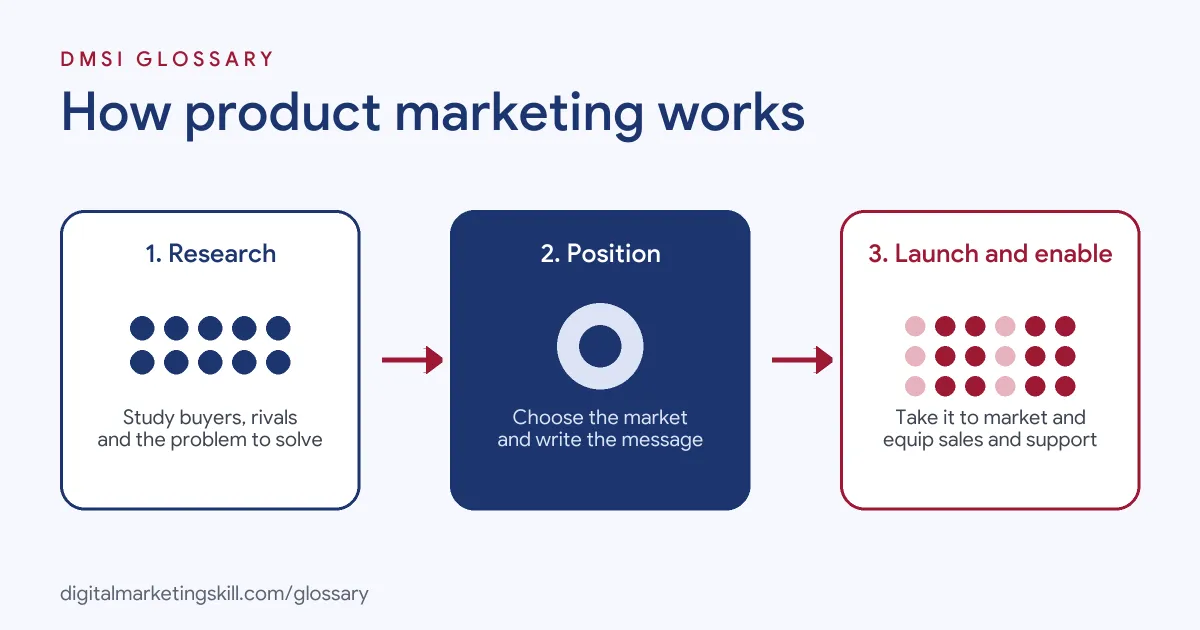
Product marketing works as a cycle. First you learn about the market. Then you decide how to position the product. Next you launch it and equip the teams who sell it. Finally you measure the results and start again.
Market and Customer Research
First, everything starts with research. Product marketers talk to customers, study rivals and look at sales and usage data. For instance, they may run interviews or surveys with recent buyers. They also do competitor analysis to see how other brands describe similar products. The aim is a clear picture of the buyer persona and the problem they want solved.
Positioning and Messaging
Next comes positioning. In simple terms, this means choosing the market you compete in and the reason you win. It builds on brand positioning but focuses on one product. Then messaging turns that position into words. For example, you write a short value proposition, key benefits and proof points. After that, every team uses the same core message.
Launches and Go-to-Market
Then the product marketer plans the launch. This includes timing, channels, pricing input and launch content. Usually, this forms part of a wider go-to-market strategy. Coursera notes that the role includes “undertaking market research, positioning (and differentiating) the product.” In practice, a launch can be a big event or a quiet update to existing customers.
Sales Enablement and Ongoing Success
Finally, product marketers help sales teams sell. For example, they write battle cards, demo scripts, pitch decks and case study content. In addition, they track win rates, feedback and product usage. So if buyers keep raising the same doubt, the message changes. That way, the cycle keeps running long after launch day.
Examples of Product Marketing
- A software company adding a new feature. The product marketer interviews early users and finds they value saved time most. So the launch email, help article and in-app message all lead with that benefit.
- A skincare brand launching a new serum. The team studies reviews of rival products. Then it positions the serum for sensitive skin and gives creators a short, clear message to share.
- A business bank launching an account for freelancers. First, the team maps the freelancer’s main pain points. Next, it writes a landing page, a comparison sheet for advisers and a short FAQ for the support team.
Product Marketing vs Product Management vs Brand Marketing
| Point | Product Marketing | Product Management | Brand Marketing |
|---|---|---|---|
| Main question | How do we take this product to market? | What should we build next? | What does the company stand for? |
| Focus | One product or feature | The product itself | The whole brand |
| Typical outputs | Positioning, messaging, launches, sales tools | Roadmaps, requirements, releases | Brand story, campaigns, guidelines |
| Works most with | Product, sales, marketing | Engineering, design, data | Creative, PR, social |
| Key measures | Win rate, adoption, launch results | Usage, retention, delivery | Awareness, preference, sentiment |
Why the Split Matters
These roles overlap, so confusion is common. However, each one has a clear centre. For example, a product manager might spend the day with engineers on a new release. Meanwhile, the product marketer works out who will buy it and why. At the same time, the brand team keeps the company’s overall voice consistent. As a result, the three roles work best as partners, not rivals. In small companies, one person may even do all three jobs.
Pragmatic Institute sums up the split: “Product managers are responsible for using market data to create products,” while “product marketing managers are responsible for promoting those products to their target markets.”
How to Do Product Marketing
- Talk to real customers. Ask why they bought, what nearly stopped them and what they compared.
- Map the competition. List the main rivals and the claims each one makes.
- Pick your best-fit buyer. Then choose the group that gains the most from the product.
- Write a positioning statement. State who it is for, what it does and why it beats the alternatives.
- Build a message house. Add three key benefits, each with proof such as data, quotes or demos.
- Plan the launch. Choose channels, dates, owners and the content each team needs.
- Enable sales and support. Then train them, share the tools and collect their questions.
- Measure and refine. After launch, track adoption and win rates, and update the message when needed.
Best Practices for Product Marketing
- Use the buyer’s words. Lift phrases straight from interviews and reviews.
- Lead with the problem. First show the pain, then the product that solves it.
- Prove every claim. Back benefits with real data, customer quotes or a live demo.
- Keep one source of truth. Then store positioning and messaging in a shared document that every team can find.
- Stay close to sales. Join sales calls often, so you hear objections first-hand.
- Review after each launch. Note what worked and what didn’t, and use it next time.
Common Mistakes to Avoid
- Listing features, not benefits. In the end, buyers care about results, not specs.
- Targeting everyone. In reality, a message for everybody usually lands with nobody.
- Skipping research. Otherwise, guessing what buyers want leads to weak positioning.
- Treating launch as the finish line. Adoption and growth need work after launch day too.
- Forgetting internal teams. If sales and support don’t know the message, buyers won’t hear it.
- Never updating the message. Markets and rivals change, so positioning must change too.
Where You’ll Use Product Marketing at Work
Indeed, product marketing is a career path in its own right, especially in software and B2B firms. For example, real remote job listings say:
- “We are seeking a Product Marketing Manager to own the positioning, messaging, and market-facing enablement” (Product Marketing Manager).
- “Product Marketing is a highly cross-functional role at Stripe, partnering closely with Product and Engineering, Sales, Partnerships, Demand Generation, and Campaigns” (Product Marketing Manager, Market Intelligence).
- “Own product marketing roadmap.” (Lead Product Marketer / Head of Product Marketing).
Learn It in the Full Stack Track
You can build the research, positioning and launch skills behind product marketing in the Full Stack programme, which covers all four tracks. Every track includes a U.S. Project Internship from day one, with unlimited 1-on-1 mentoring.
Frequently Asked Questions
What does a product marketer do day to day?
First, they research buyers and rivals, write positioning and messaging, plan launches and create sales tools. They also gather feedback and update the story as the market changes.
Is product marketing the same as product management?
No. Product managers decide what to build. By contrast, product marketers decide how to position and launch it.
Do I need a technical background?
Not always. However, you need to understand the product well enough to explain it simply and answer buyer questions.
Which skills matter most?
In most roles, clear writing, customer research and strategic thinking matter most. Also, you need to work well with many different teams.
How do you measure product marketing?
Usually, common measures include launch results, product adoption, sales win rates and how often sales use your materials.
Sources: Product Marketing Alliance: What is Product Marketing?; Pragmatic Institute: What Does a Product Marketing Manager Do?; Coursera: What Is Product Marketing?; remote job listings on Himalayas, Himalayas and Himalayas.