Digital marketing skills decide who gets hired. They also decide who gets scrolled past. Recruiters and hiring systems now screen for named, provable abilities, not a single job title. LinkedIn data shows recruiters still struggle to fill roles that need search advertising and link building. This guide names the skills worth building and how to prove each one.
Key Takeaways
- Generic no longer sells. LinkedIn data reported by Social Media Today shows recruiters struggle to find marketers with digital strategy, search advertising, link building and off-page SEO skills. “Digital marketing” is still one of the most listed headline skills on profiles.
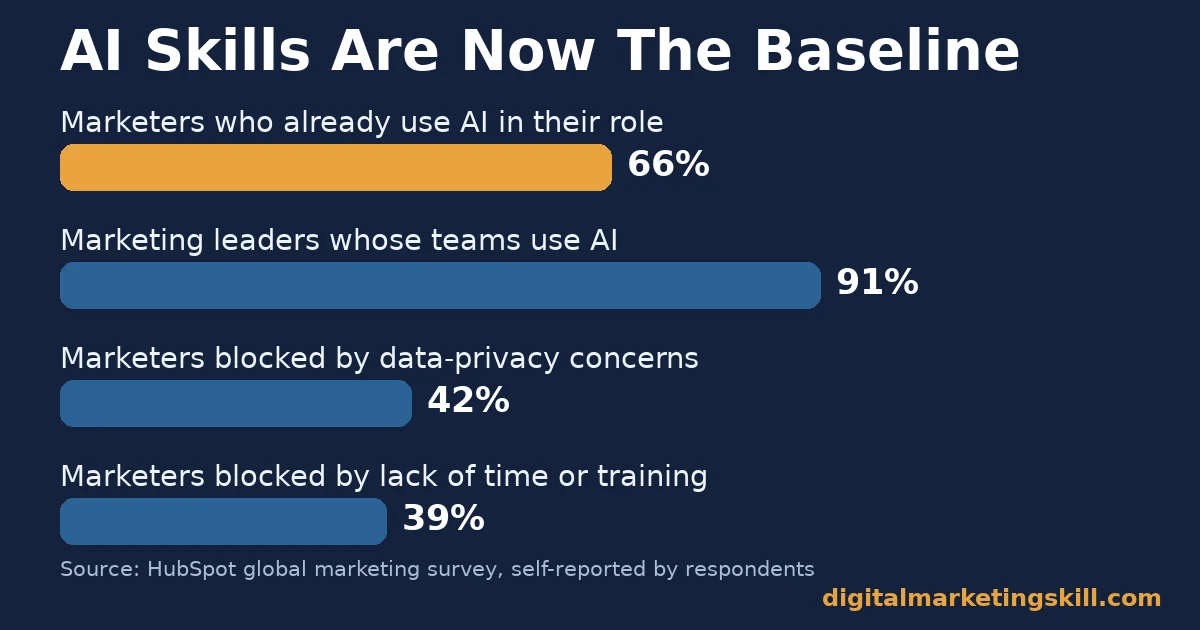
- AI literacy is now a baseline skill. HubSpot’s global marketing survey found 66% of marketers already use AI in their role. 91% of marketing leaders say their teams use it too.
- Adoption still outpaces confidence. The same HubSpot research found 42% of marketers cite data-privacy concerns. 39% cite a lack of time or training as a barrier to using AI tools fully.
- Analytical roles keep growing. The U.S. Bureau of Labor Statistics projects market research analyst jobs, the closest official occupation to marketing analytics, to grow 7% over the next decade. That is far faster than the average occupation.
- The tool count explains the gap. The marketing technology landscape tracked by chiefmartec grew from roughly 150 tools to over 15,000. No one can master every tool, so employers now hire for transferable digital marketing skills instead.
In this guide
- The Digital Marketing Skills Gap Nobody Talks About
- How Employers Actually Screen For Digital Marketing Skills
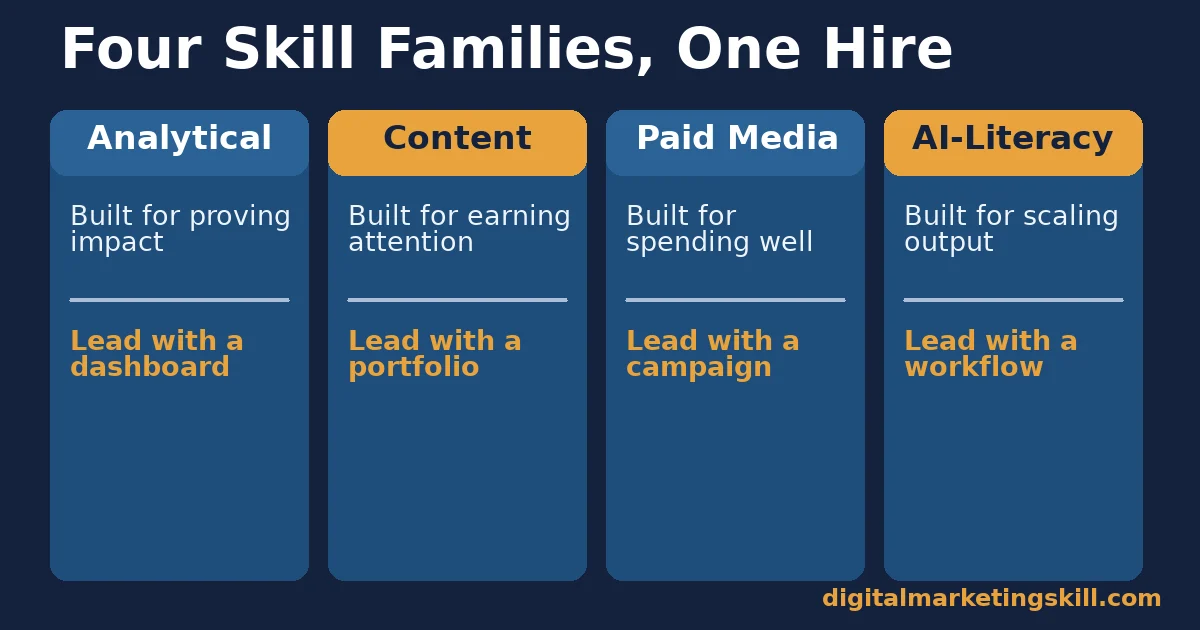
- The Four Skill Families Behind Every Marketing Hire
- How To Turn Each Skill Into Evidence Employers Trust
- Measuring Whether Your Skill Set Is Market-Ready
- Common Mistakes When Listing Digital Marketing Skills
- The One Decision Rule: Depth Beats Breadth
- A Real Case: One Proven Skill, Not A Long List
- Frequently Asked Questions About Digital Marketing Skills
- Where To Build These Skills, Wherever You Live
The Digital Marketing Skills Gap Nobody Talks About
Most “top skills” lists repeat the same ten words: SEO, content, social, email, analytics, paid ads. None of that is wrong. But it skips the real problem. Job seekers list these skills freely on a resume or profile. Employers cannot easily tell which claims are real.
Here are the ground rules for this guide. The hiring and AI-adoption figures below come from named surveys and labor data. Each is attributed to the organization that ran it, not to this site. LinkedIn’s hiring data and HubSpot’s marketing survey are self-reported by the platform and its own respondent pool. So treat them as a snapshot of the current market, not a permanent ranking. Government labor projections cover related job titles, not “digital marketer” as one occupation, because that exact title does not exist in official statistics.
A quick, honest check before you read further: open your own resume or portfolio and count how many listed skills have a real example attached. Most people find the number is lower than they expected. That gap, between the digital marketing skills people claim and the ones they can actually show, is the subject of this guide.
How Employers Actually Screen For Digital Marketing Skills
A hiring manager rarely reads a full resume first. An applicant-tracking system scans for keywords that match the job post. A recruiter then skims the shortlist for proof, such as portfolio links, numbers and named tools. Only after that does a conversation happen.
That sequence is stricter than most job seekers realize. Harvard Business School and Accenture studied hiring screening in a joint report, covered by HR Dive. Surveyed employers admitted that applicant-tracking systems rejected qualified, high-skilled candidates outright when a resume did not exactly match the listed criteria, in 88% of cases. A skill that only exists as a word on a resume can look identical to a skill that was never learned, to software built to match text.
LinkedIn data reported by Social Media Today adds the other half of the picture. Recruiters say they cannot find enough marketers with skills in digital strategy, search advertising, link building and off-page SEO. Thousands of profiles still list digital marketing as a single headline skill. The mismatch is not a shortage of people. It is a shortage of proof that survives the first filter.
So the real question is not which digital marketing skills to learn. It is which skills you can demonstrate with a real, checkable result inside a reasonable timeframe. The rest of this guide answers that question one skill family at a time.
The Four Skill Families Behind Every Marketing Hire
Almost every digital marketing role draws from four skill families. Knowing which family a skill belongs to makes it easier to decide what to learn next. It also makes it easier to prove once you have it. Most job posts blend two or three families into one title, which is part of why a single generic skill rarely stands out on its own.
Analytical Skills: Built For Proving Impact
Analytical skills turn activity into evidence. They cover tracking setup, campaign reporting, simple testing and translating numbers into a decision. Employers lean on this family hardest. It answers the one question every budget owner asks: did this actually work? The Bureau of Labor Statistics projects market research analyst roles, the nearest official occupation to marketing analytics, to grow 7% over the next decade, with a median annual wage above $78,000. Watch out for the common mistake here: reporting a vanity number, like impressions, instead of a number tied to a business outcome, like cost per qualified lead.
Content Skills: Built For Earning Attention
Content skills cover writing, scripting, design and video that earns attention without paid spend. The work itself judges this family almost completely. A certificate rarely matters, because a published piece is its own proof. This family rewards range. A marketer who can write a post, a short script and a few social captions is more hireable than one who can only do a single format well. For a deeper breakdown of this family, see our guide to content marketing.
Paid Media Skills: Built For Spending Efficiently
Paid media skills cover setting up, running and optimizing ad campaigns across search and social platforms. Employers trust this family only when numbers come attached to it. A paid campaign that looks good but loses money is worse than no campaign at all. This skill connects closely with lead generation. Well-targeted ads only pay off if the leads they produce get managed and followed up well.
AI-Literacy Skills: Built For Scaling Output
AI-literacy skills cover prompting, reviewing AI output for accuracy and building simple automated workflows. This family grew faster than the other three in a short time. HubSpot’s global marketer survey found that 66% of marketers already use AI in their role, and 91% of marketing leaders say their teams use it. This skill has moved from a bonus to a baseline expectation almost everywhere, and LinkedIn’s own skills research lists it among the fastest-rising marketing competencies.
How To Turn Each Skill Into Evidence Employers Trust
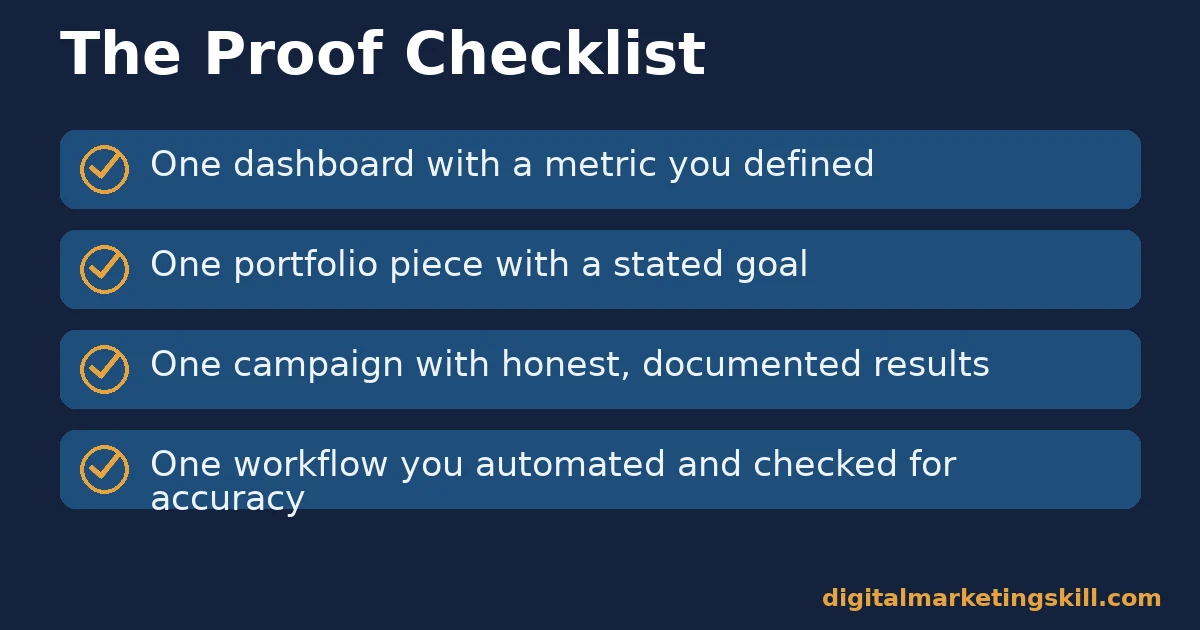
Listing a skill costs nothing. On its own, it proves nothing. Each of the four skill families has one piece of evidence that is genuinely hard to fake. That evidence belongs on a resume or portfolio instead of a bare word. By the end of this section, you should be able to point at one or two digital marketing skills and say exactly how you would prove them to a stranger within 60 days.
Analytical Skills: Lead With A Dashboard, Not A Certificate
A certificate shows you sat through a course. A dashboard, even one built for a personal or volunteer project, shows something different: that you can define a metric, track it and explain what changed. Build one for any website or account you have access to. Then be ready to explain a single decision it led to, in plain language.
Content Skills: Lead With A Published Portfolio
A portfolio of three to five published pieces beats a long list of content types you claim to know. Add a short note to each piece on the goal and the result. Range matters less than finishing. One well-measured post or video outperforms five unfinished drafts sitting in a folder.
Paid Media Skills: Lead With A Documented Campaign
Run one small, real campaign, even on a modest personal budget. Document the goal, the spend, the result and what you would change next time. That single documented campaign carries more weight than a stack of platform certificates with no results attached, as long as you include the parts that underperformed, not just the wins.
AI-Literacy Skills: Lead With An Automated Workflow
Pick one repetitive task, such as drafting social captions or sorting leads. Automate part of it with an AI tool, then document what the task used to take and what it takes now. The accuracy check matters most here. HubSpot’s survey found only 46% of marketers feel confident they would catch inaccurate AI output, so showing you actively verify your own work sets you apart from someone who just runs the prompt.
Measuring Whether Your Skill Set Is Market-Ready
Four simple numbers show whether a skill set is ready for the job market, well before an employer says so out loud.
- Application-to-interview ratio. The share of applications that lead to a first interview. A ratio under roughly one in twenty usually means the proof attached to your skills needs work, not the skills themselves.
- Portfolio click-through. The share of resume viewers who open your portfolio or case-study link. A low rate often means the link is buried, not that the underlying work is weak.
- Time-to-first-interview. How many days pass between applying and hearing back. Track this across applications, then compare, to see which version of your resume or portfolio performs better.
- Skill-to-listing match. The share of a job post’s listed requirements you can back with a real example rather than a course name. Aim to cover at least two-thirds of a post’s named skills with a concrete example before you apply.
None of these numbers needs special software. A simple spreadsheet, updated after every application, reveals the pattern within a few weeks.
Common Mistakes When Listing Digital Marketing Skills
Four mistakes show up again and again in resumes and portfolios built around digital marketing skills. Each one is easy to fix once you can see it.
- Listing the tool, not the outcome. “Experienced with Google Ads” says nothing. “Cut cost per lead by documenting and adjusting one search campaign” says everything a recruiter needs.
- Treating every skill as equal. Ten shallow skills read worse than three deep ones. Pick the two or three digital marketing skills you can prove right now, and let the rest wait.
- Hiding the proof behind a vague claim. A line that says “strong analytical skills” with no link or number gets skipped. A line with a dashboard link gets opened.
- Copying someone else’s skill list. A skill list copied from a job post description matches keywords but not reality. A mismatch surfaces fast in an interview, and it costs more trust than a shorter, honest list ever would.
Fixing even one of these mistakes usually moves the application-to-interview ratio described above more than adding another course certificate does. Picture two candidates with the same digital marketing skills on paper. One sends thirty applications and gets one interview, a proof problem. The other sends twelve and gets three, a sign the proof is already working, so the better move for that person is simply to apply more, not to learn something new.
The One Decision Rule: Depth Beats Breadth
When choosing which digital marketing skill to build next, pick one rule: choose the skill that is both hard to find and provable within 60 days, rather than the one with the most job postings attached to it.
Illustrative, invented numbers show why. Imagine two options. Option A, general content writing, appears in 40% of job posts, but most applicants already claim it. It barely moves an application-to-interview ratio. Option B, documented paid-search campaigns, appears in only 15% of job posts. Recruiters report it as hard to find, and you can prove it with one small, honestly reported campaign inside a month. Option B is the better use of the next 60 days. It looks smaller on paper, but scarcity plus provability beats raw frequency.
A Real Case: One Proven Skill, Not A Long List
Olajire Jacob graduated from the Digital Marketing Skill Institute. His story is published on the Institute’s reviews page. He did not launch a wide range of services at once. He focused on one skill family, email marketing automation, and documented the work for real clients.
As published, he started by charging an average of $500 to set up email marketing flows for clients in the US, UK and Canada. He then expanded his services and scaled to $5,000 a month. The case shows one family of digital marketing skills, proven and repeated, instead of ten skills listed at once with no evidence behind them. Results like this are not guaranteed; they depend on effort, market and client acquisition. See the Institute’s earnings disclaimer for the limits on any income figure quoted here.
What makes this case useful is not the dollar figure. It is the sequence. One skill, proved on real client work, created the evidence needed to charge for a second project, then a third, until the work itself became the portfolio. Anyone building digital marketing skills from scratch can copy that sequence with a different starting skill and a smaller budget.
Frequently Asked Questions About Digital Marketing Skills
What are the most important digital marketing skills to learn first?
Start with one analytical skill, such as basic campaign reporting, paired with one creative or paid-media skill. Analytical skills make every other skill provable. Learning to track and report results first makes every skill you add afterward easier to demonstrate with real numbers.
Do I need a degree to build digital marketing skills?
No single degree is required. Employers screen for proof of a skill, such as a dashboard, a published portfolio or a documented campaign, more than for the credential that produced it. A structured course can speed up learning, but the proof still has to exist separately from the certificate itself.
How long does it take to become skilled at digital marketing?
Basic competence in one skill family usually takes a few weeks of focused practice, enough to produce one real example. Becoming hireable across two or three families, each with documented proof, more commonly takes a few months. Every family needs its own real example, not just study time.
Can AI tools replace the need for digital marketing skills?
No. AI tools change which tasks take a human versus a machine, but they have not removed the need for judgment. Most marketers already use AI, according to HubSpot’s survey, yet fewer than half feel confident catching inaccurate AI output. Reviewing and directing AI work is now part of the job, not a replacement for it.
Which digital marketing skill pays the most?
Pay varies by region, industry and seniority, so no single skill has a universal top rate. Skills that combine analytics with a specific channel, such as paid-search reporting or lifecycle-email analytics, tend to command a premium. They are rarer than single-channel skills, and their results are the easiest to prove to an employer.
How do I prove digital marketing skills without paid work experience?
Use a personal project, a volunteer campaign for a local organization or a small account you manage for free. The proof an employer wants is a real result you can explain honestly. That does not require a paid job. It requires a real audience, even a small one, and an honest account of what happened, including what did not work.
How many digital marketing skills should I list on my resume?
Fewer than you think. A resume listing fifteen skills with no evidence reads as padding to a recruiter trained to spot it. Four or five skills, each tied to a dashboard, a portfolio piece or a documented campaign, carry more weight than a long, unproven list.
What is the cheapest way to practice digital marketing skills before applying for jobs?
Offer to run one small, honest project for a local business, a club or a friend’s side project, for free or a token fee. Real constraints, a real audience and a real deadline teach more in a month than a course alone, because a course rarely forces you to handle a result you did not expect.
Where To Build These Skills, Wherever You Live
If you want to build these skill families with structured practice rather than piecing them together alone, consider the Master Diploma in Digital & AI Marketing from the Digital Marketing Skill Institute. It is organized around four AI-powered tracks: AI-Powered Social Media Management and Advertising, AI-Powered Lead Generation and Email Automation, AI-Powered Google Specialist, and AI-Powered WordPress and SEO Specialist. The program covers ten courses in total, with a Full Stack option for completing all four tracks.
The program is built around hands-on practice. It is designed to produce the dashboards, portfolios and documented campaigns this guide recommends, not just a certificate. You get unlimited one-on-one coaching and mentoring, a U.S. Project Internship with a verified U.S. Work Reference Letter, and dual US and UK accreditation recognized in more than 100 countries. Everything runs 100% online, so you can build these skills anywhere in your country.
Start at Digital Marketing Skill Institute. Browse the blog for more skill breakdowns. Read real outcomes on the reviews page, and when you are ready, apply here. Wherever you live, the skills in this guide are the ones worth proving first.
Every figure in this guide was checked against its original source before publication. Figures marked as illustrative are invented examples, not real results.