
Affiliate marketing income ranges from zero to a full-time living. The gap between those outcomes comes down to one choice: which payment model you build around. This guide breaks down how commissions get calculated, what each model pays in practice, and the one rule that predicts your first payout.
Key Takeaways
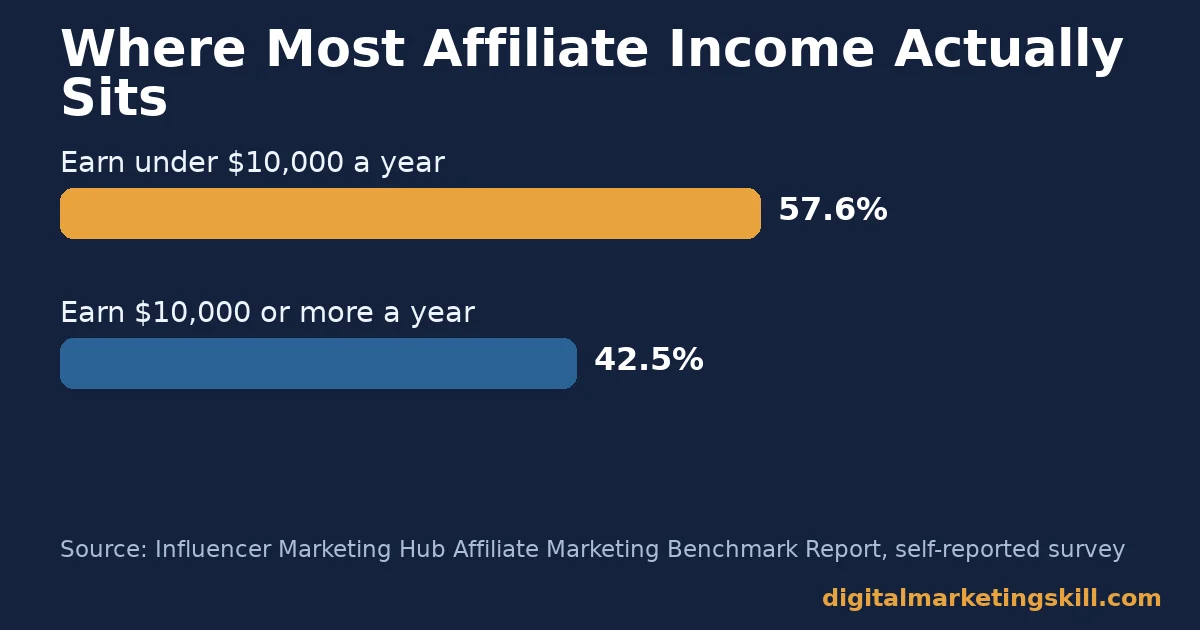
- Most affiliate income still clusters at the bottom. In the Influencer Marketing Hub Affiliate Marketing Benchmark Report, 57.55% of surveyed affiliates earned under $10,000 a year. Treat early months as testing, not income.
- 80% of advertisers now run an affiliate program, according to Rakuten Advertising. The bottleneck for most beginners is picking the right program, not finding one.
- Affiliate-driven customers carry real weight. An Awin and Forrester analysis found they had 21% higher average order values and repurchased at a 21% higher rate than customers from other channels.
- Affiliate campaigns return about 12:1 on ad spend on average, per the Performance Marketing Association’s Industry Study across seven networks and sixteen publishers. That is why brands keep paying commissions even in tight budget years.
- 97% of consumers read reviews before buying from a business they haven’t tried, per BrightLocal’s US survey. That is why honest, specific reviews out-earn generic “best of” roundups.
In this guide
- The Income Gap Nobody’s Calculator Shows You
- How Affiliate Marketing Income Is Actually Calculated
- What Differs by Payment Model
- How to Lead With Each Model
- Measuring Your Affiliate Income
- The One Decision Rule That Predicts Your First Payout
- A Real Case: What Steady Growth Looks Like
- Frequently Asked Questions About Affiliate Marketing Income
- Where to Build the Skills Behind Affiliate Marketing Income
The Income Gap Nobody’s Calculator Shows You
Search for “affiliate marketing income” and you’ll find screenshots of five-figure months. You’ll also find warnings that most people earn nothing. Both are true, which is the real problem. The Influencer Marketing Hub Affiliate Marketing Benchmark Report found that 57.55% of surveyed affiliates earned under $10,000 in a year. A visible minority earn far more.
That spread is not random luck. It is the predictable result of payment model, niche, and traffic source compounding over time. This guide breaks down that mechanism as an informed explanation, not a guarantee. Commission rates, cookie windows, and payout thresholds change by program. Treat every number here as a snapshot, not a fixed promise. Where a figure is US-only or self-reported, that is stated clearly so you can weigh it properly.
Niche choice alone can swing affiliate marketing income by a wide margin before you write a single word. A niche with a high average order value, like outdoor equipment or software, pays more per sale than a niche built on low-cost impulse buys, even at the same commission percentage and the same traffic level. A niche with recurring subscriptions, like web hosting or project management tools, keeps paying you every renewal cycle instead of once.
Picking a niche purely because “everyone says it’s profitable” skips this math entirely. It is the single most common reason a beginner’s first few months produce clicks but almost no income. A second trap sits right next to it: picking a niche you have no real knowledge of. Specific, accurate detail is what makes a review or tutorial convert. You cannot write it convincingly about a product category you have never actually used.
How Affiliate Marketing Income Is Actually Calculated
Affiliate income is a chain of four numbers multiplied together: traffic, click-through rate, conversion rate on the merchant’s site, and commission per sale. Miss one link and the whole chain produces near-zero income. That is why “just get more traffic” advice fails so many beginners whose real problem is a broken conversion step.
A cookie, or increasingly a server-side tracking pixel, records that a visitor came from your link. If that visitor buys inside the cookie window, you get credited with the sale. Cookie windows commonly run from 24 hours to 30 days, depending on the merchant. 80% of advertisers now run some form of affiliate program, according to Rakuten Advertising’s own research. The mechanism itself is mainstream. What varies wildly is the commission rate, the cookie length, and whether the program pays on repeat purchases too.
That last detail matters more than beginners expect. The Awin and Forrester analysis of affiliate-referred customers found their average order values ran 21% higher than customers from other channels. Those customers also repurchased at a 21% higher rate. A program that pays only on the first transaction leaves that repeat value on the table. A program with recurring or lifetime commissions captures it instead. Two programs with similar headline rates can pay very differently over a year because of this one difference. If you haven’t picked a program yet, see our affiliate marketing guide for how to shortlist one that matches your content.
What Differs by Payment Model
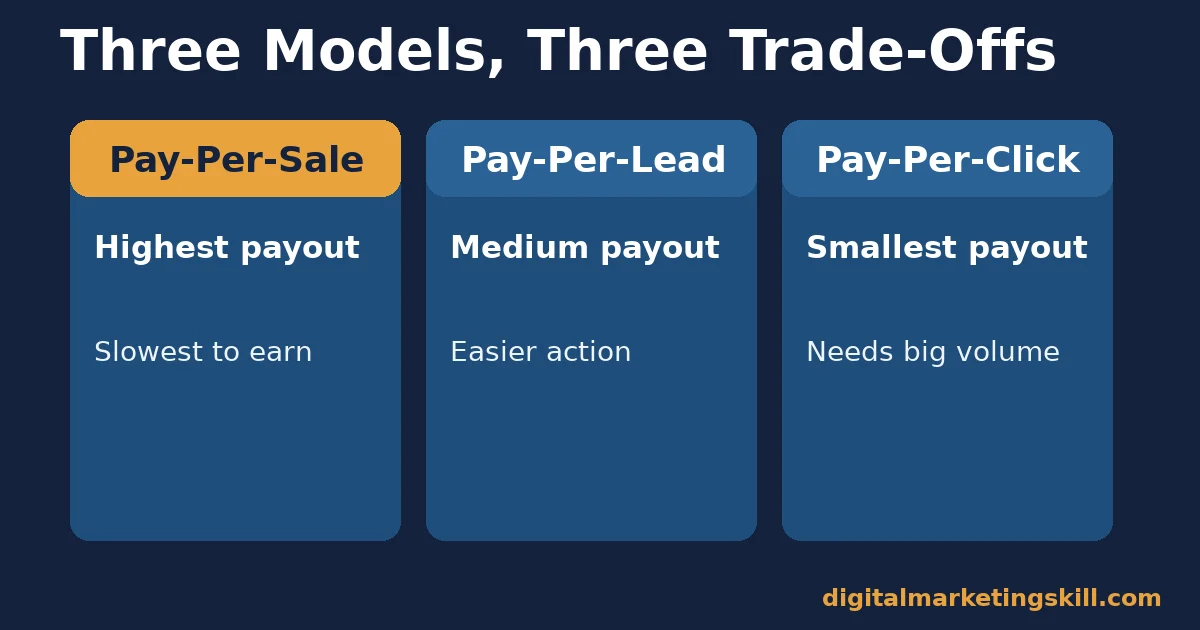
Every affiliate program pays through one of three core models. Each one rewards a different skill set. Picking a model that fits the content you’re actually willing to produce, rather than the one with the highest headline number, is the biggest lever beginners skip.
Pay-Per-Sale: Built For Patience, Not Speed
Pay-per-sale pays a percentage of the order once a customer checks out. It is the most common model and usually pays the highest commission per sale. It also has the longest delay between traffic and income, because the visitor has to trust you enough to buy, not just click.
It rewards specific, comparison-led content over generic promotion. A buyer researching a purchase decision converts at a far higher rate than someone casually scrolling. This is also the model where the 21% average-order-value lift from the Awin and Forrester data compounds the most, since a higher-value cart means a higher commission for the same conversion rate. Most of the affiliate marketing income earned across the industry flows through this exact model, which is why learning to write an honest, specific review is the highest-leverage skill in this entire guide.
Pay-Per-Lead: Built For Volume, Not Big Checks
Pay-per-lead pays a fixed amount when a visitor completes an action: usually a signup, a free trial, or a form fill. It pays out regardless of whether the visitor ever pays the merchant. The payout per lead is almost always smaller than a pay-per-sale commission, but the action is easier to get, so volume can offset the lower price.
This model rewards tools, calculators, and lead magnets that lower the friction of signing up. You are optimizing for a much smaller commitment than a purchase decision. Software and finance programs use this model most. A free trial signup is a meaningful lead for the merchant, even before any money changes hands. The merchant’s own sales team then takes over the job of converting that lead into a paying customer.
Pay-Per-Click: Built For Traffic, Not Trust
Pay-per-click pays for qualified clicks sent to the merchant, whether or not a sale or lead ever happens. It is rare today outside display and comparison-shopping networks. It is the easiest model for a merchant to overpay for when traffic quality is poor, so most programs have shifted toward pay-per-sale or pay-per-lead instead.
Where it still exists, it rewards raw traffic volume and placement on high-intent comparison pages. The merchant is paying for the click itself, not what happens after it. Because payment does not depend on a sale, per-click rates stay small, usually a few cents to a couple of dollars. This model only makes sense at genuinely high volume. A single-author blog rarely has the traffic to make pay-per-click worth building content around on its own.
How to Lead With Each Model
Understanding a model is not the same as earning from it. Here is the content format that actually converts for each one, matched against the model it serves. None of this depends on where you or your audience live. Payment processors like Payoneer, Wise, and PayPal settle affiliate commissions in most major currencies, so a creator building an audience anywhere in your country can join the same programs as a creator anywhere else; the only real constraint is whether a specific merchant’s program accepts affiliates from your region, which is worth checking before you invest weeks of content into one brand.
Pay-Per-Sale: Lead With Reviews and Comparisons
Write the review as if you were the buyer, not the seller. Name a real drawback alongside the benefit. 97% of consumers read reviews before buying from a business they haven’t tried, per BrightLocal’s survey of 1,002 US adults. A review with zero criticism reads as sponsored copy to that audience. Put the buy link at both the top and bottom of the page. State your recommendation in one direct sentence instead of hedging. Our guide on how to promote affiliate products covers the channel-by-channel version of this tactic in more depth.
Pay-Per-Lead: Lead With Tools and Lead Magnets
Build or borrow a free calculator, checklist, or short course that solves one narrow problem. Then gate the next step behind an email signup, which is the fastest way to turn a one-time visitor into a source of repeat affiliate marketing income instead of a single click you never see again. Email still earns its keep here. In Litmus’s State of Email survey of nearly 500 marketing professionals, 35% of leaders report $10 to $36 back for every $1 spent on email. Nurturing a lead list before pitching a paid affiliate offer beats pitching cold traffic every time. If your email funnel isn’t built yet, start with our beginner’s guide to email marketing.
Pay-Per-Click: Lead With High-Intent Content
If you do work with a pay-per-click program, place the links only on pages where the visitor has already decided what they want. A “best X for Y” roundup works. Low-intent placement, like a banner on an unrelated blog post, generates clicks that convert at close to zero for the merchant. Programs tend to drop that traffic source first. Most networks track click quality, not just click volume. If a merchant notices your clicks rarely convert to anything, even under pay-per-click terms, expect the commission rate or your program access to shrink at renewal.
Measuring Your Affiliate Income
Four numbers tell you whether an affiliate program or a piece of content is working. Each one isolates a different part of the chain described above.
- Earnings per click (EPC): total commission divided by total clicks sent to the merchant. This is the single best number for comparing two programs in the same niche, because it already bakes in both conversion rate and commission size. Most networks publish each program’s EPC, so you can compare programs before you send a single click.
- Conversion rate: the share of your clicks that become a sale or lead. A low conversion rate with high traffic usually means a mismatch between your content and the offer, not a traffic problem.
- Average order value (AOV): the average dollar size of a completed sale. Since affiliate-referred AOV runs 21% higher than other channels in the Awin and Forrester data, a program with a modest commission percentage can still out-earn a higher-percentage program with a smaller AOV.
- Cookie-adjusted conversion lag: how long, on average, between the click and the credited sale. A 30-day cookie window shows income weeks after the traffic spike that caused it, so judge new content on a full cookie cycle, not the first 48 hours.
The One Decision Rule That Predicts Your First Payout
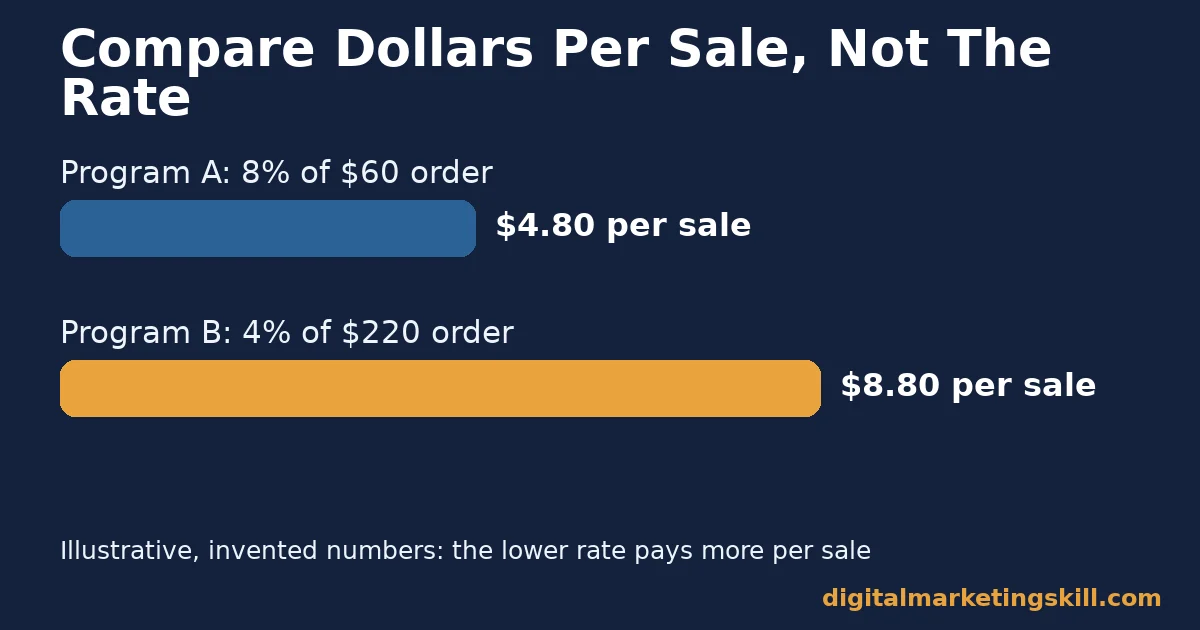
Before joining a program, multiply its average order value by its commission rate. Compare that dollar figure against a competing program with a lower rate but a higher AOV. A 5% commission on a $200 order pays the same $10 as a 10% commission on a $100 order. The headline percentage alone is a poor predictor of what you’ll actually earn.
Illustrative, invented numbers: picture two kitchen-equipment programs. Program A pays 8% commission on a $60 average order, for $4.80 per sale. Program B pays 4% commission on a $220 average order, for $8.80 per sale. A beginner comparing only the percentage would pick Program A. With identical traffic, they would earn roughly 45% less affiliate marketing income per sale than Program B earns. Always calculate the dollar commission per sale before joining a program. Never trust the advertised rate alone. The same math applies to recurring programs. A 20% recurring commission on a $15 monthly subscription pays $3 every renewal. That can out-earn a 40% one-time commission on a $20 product within four months. The recurring payout keeps compounding, while the one-time payout stops after the first sale.
A Real Case: What Steady Growth Looks Like
Illustrative, invented numbers, not a real result: picture a new affiliate site publishing one honest comparison review a week. Each review cites a named source for every claim. The site might see its first commission in month two, once its first reviews start ranking. Then comes a slow climb. The cookie window on earlier content keeps crediting new sales months after publication. That compounding lag is the real pattern behind affiliate marketing income, not a sudden spike. Content published early keeps paying out long after it stops being “new.” This is why beginners who quit a review three weeks after publishing usually quit too soon. The content simply hadn’t finished ranking yet.
Frequently Asked Questions About Affiliate Marketing Income
How much can a beginner realistically earn from affiliate marketing in the first year?
Most surveyed affiliates, including experienced ones, earn under $10,000 a year according to the Influencer Marketing Hub benchmark report. A realistic first-year target is proving the mechanism works with a handful of monthly commissions, not hitting a specific income figure. Income tends to accelerate in year two, once a backlog of ranking content keeps earning without needing fresh traffic each month. That backlog effect is the main reason consistency beats intensity: ten reviews published steadily over ten months will usually out-earn ten reviews published in one frantic week and then abandoned.
Do I need a website to earn affiliate marketing income?
No. Many affiliates earn entirely through social platforms or video, using a link in a profile or video description. A website gives you more control over SEO traffic and cookie placement, but it is not required to get your first commission.
Why did my affiliate link get clicks but no commission?
Check three things in order: whether the merchant’s cookie window expired before the buyer purchased, whether the buyer landed on a low-intent page, and whether another affiliate’s link overwrote your cookie later in that session. All three are common. None of them mean the content failed. Clicks without commissions after a few hundred visits usually point to an intent mismatch, not a tracking error. Re-read the content with the merchant’s actual buyer in mind before assuming the program is broken. Often the fix is as simple as moving the link earlier in the page, where a reader who has already decided to buy actually sees it.
How long does an affiliate cookie usually last?
Cookie windows commonly run from 24 hours to 30 days, depending on the merchant and category. Some subscription and software programs extend further for recurring commissions. Always check the specific program’s terms. This one setting changes how fast content can realistically produce affiliate marketing income. If you’re still deciding whether to build a dedicated affiliate site or work as an affiliate marketer across social platforms instead, that comparison is worth reading first.
Is a high commission percentage always the better program?
No. A lower percentage on a program with a higher average order value can pay more in absolute dollars per sale. That is the decision rule covered above. Compare dollar commission per sale, not the advertised percentage alone, and recheck that math whenever a program changes its rate, since a rate cut on a high-AOV program can still beat a rate increase on a low-AOV one.
Do I have to disclose affiliate links?
Yes. The FTC’s Endorsement Guides under 16 CFR Part 255 require a clear and conspicuous disclosure of any material connection, including affiliate commissions. Place it in or near the content itself, not hidden in a bio or footer. This applies wherever your audience lives, since most major platforms and advertisers now enforce similar disclosure terms globally. For the full setup process, see our guide to starting affiliate marketing.
Can affiliate marketing income replace a full-time salary?
For a minority of affiliates, yes, but the Influencer Marketing Hub benchmark data above shows most surveyed affiliates stay well under $10,000 a year, so it is not typical in year one. Treat replacing a salary as a multi-year goal built on compounding content, not a short-term plan. Keep your existing income while you test whether a niche converts.
Where to Build the Skills Behind Affiliate Marketing Income
Affiliate marketing income rewards the same underlying skills as the rest of digital marketing. You need content that ranks, an email list that converts, and the discipline to read the numbers above instead of guessing. The Digital Marketing Skill Institute’s Master Diploma in Digital & AI Marketing teaches those skills directly. Its AI-Powered Lead Generation and Email Automation track and its AI-Powered WordPress and SEO Specialist track cover them, or you can combine both through the Full Stack option, which covers all four AI-powered tracks and ten courses.
Every track includes unlimited 1-on-1 coaching and mentoring. Every track also includes a U.S. Project Internship with a verified U.S. Work Reference Letter. The diploma is dual US and UK accredited, recognised in more than 100 countries, and studied 100% online from wherever you live in your country. If you want a structured path instead of piecing together affiliate marketing income skills from scattered guides, apply to the Master Diploma program. You can also review the full program structure, browse more guides on the digital marketing blog, or read real outcomes on the reviews page. Learn more at digitalmarketingskill.com, or start your application at digitalmarketingskill.com today.
Every figure in this guide was checked against its original source before publication. Figures marked as illustrative are invented examples, not real results.
![9 Amazing Digital Marketing Skills to Make Money Online [With Proof]](https://digitalmarketingskill.com/wp-content/uploads/2019/07/9-Amazing-Digital-Marketing-Skills-to-Make-Money-Online-With-Proof-17.png)






