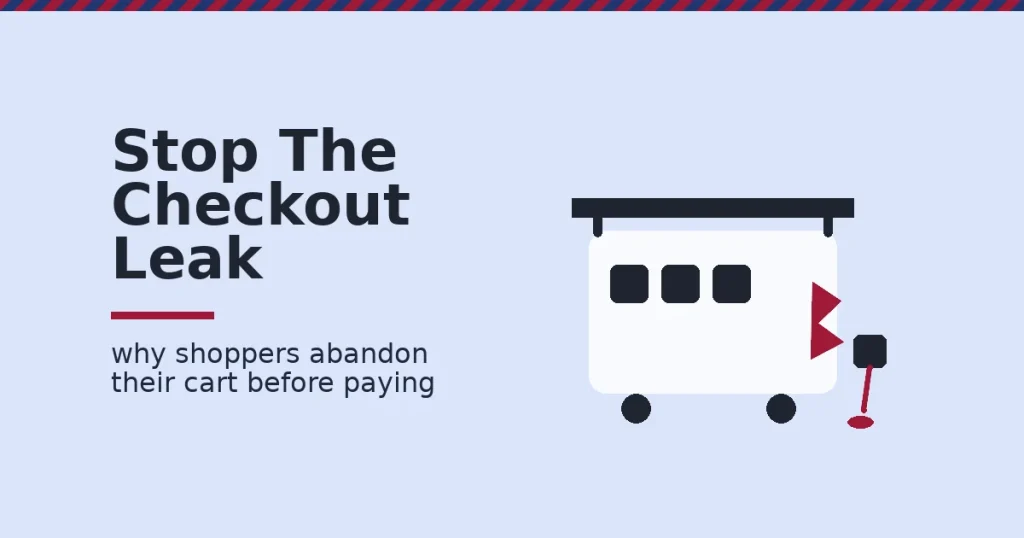
Cart abandonment happens when a shopper adds an item to their cart, starts checkout, then leaves before paying. Baymard Institute puts the average rate at 70.19% across 49 studies. Most stores lose most of the shoppers who reach checkout. The fix is rarely a discount; it is removing the specific friction that made this shopper stop.
Key Takeaways
- Most carts never become orders. Baymard Institute’s 14-year tracking of 49 studies puts average cart abandonment at 70.19%.
- Cost surprises are the top cause. In Baymard’s quantitative study, 40% of shoppers who abandoned blamed extra costs that appeared only at checkout.
- Forced sign-up pushes shoppers away. 18% of abandoners left because the store forced them to create an account before they could pay.
- Checkout forms carry more fields than they need. The average checkout now asks for 11.3 form fields across 344 benchmarked sites, against Baymard’s recommended 8.
- Speed changes the outcome measurably. Google and Deloitte found that mobile pages 0.1 seconds faster saw retail conversions rise 8.4%.
In this guide
- What Most Cart Abandonment Advice Gets Backwards
- Why Shoppers Abandon a Cart
- Cart Abandonment Differs By What You Sell
- How to Fix Cart Abandonment For Each Store Type
- How to Measure Cart Abandonment
- The One Decision Rule: Fix the Biggest Named Reason First
- A Real Case: How Baymard Tracks Abandonment Across 344 Stores
- Frequently Asked Questions About Cart Abandonment
- Start With Your Checkout, Not a New Discount
What Most Cart Abandonment Advice Gets Backwards
Most advice on cart abandonment starts with a discount code or an exit pop-up. Those can help, but they treat the symptom. They do not explain why the shopper decided to leave in the first place, so the same leak reopens as soon as the promotion ends.
A shopper who left because a checkout field asked for information they did not want to give will not be won back by ten percent off. They will just hesitate again at the same field next time. The discount changes the price, not the doubt that caused the exit.
This guide works the other way round. It names the specific, measured reasons shoppers abandon a cart. It shows how those reasons differ for a low-price impulse purchase against a high-ticket considered one, then gives a decision rule for which fix to make first.
A ground rule before the numbers: Baymard’s figures come from its own benchmark of large and mid-sized stores, mostly in the US and Europe. A very small or very new store may see different proportions. Treat every percentage below as a snapshot of stores Baymard studied, not a guarantee for yours.
Why Shoppers Abandon a Cart
A cart is not really abandoned at one moment. It is a chain of small doubts that build up until the shopper decides the purchase is not worth finishing right now. Each doubt on its own might not be enough to stop them. Stacked together across a slow page, an unexpected fee and a confusing form, they usually are.
The Decision Moment at Checkout
Checkout is where a shopper commits real money. Hesitation peaks right there. Baymard’s own benchmark of checkout form fields, drawn from 344 leading ecommerce sites, found the average checkout flow runs 5.1 steps and asks for 11.3 form fields. Its guideline is that most stores need no more than 8.
Every extra field is another chance for the shopper to stop and reconsider. A field asking for information that feels unnecessary reads as a reason to pause, not a formality. A second phone number, or a company name on a personal order, are common examples. Each field should earn its place by making shipping, billing or fraud checks work, nothing else.
The Extra-Cost Trap
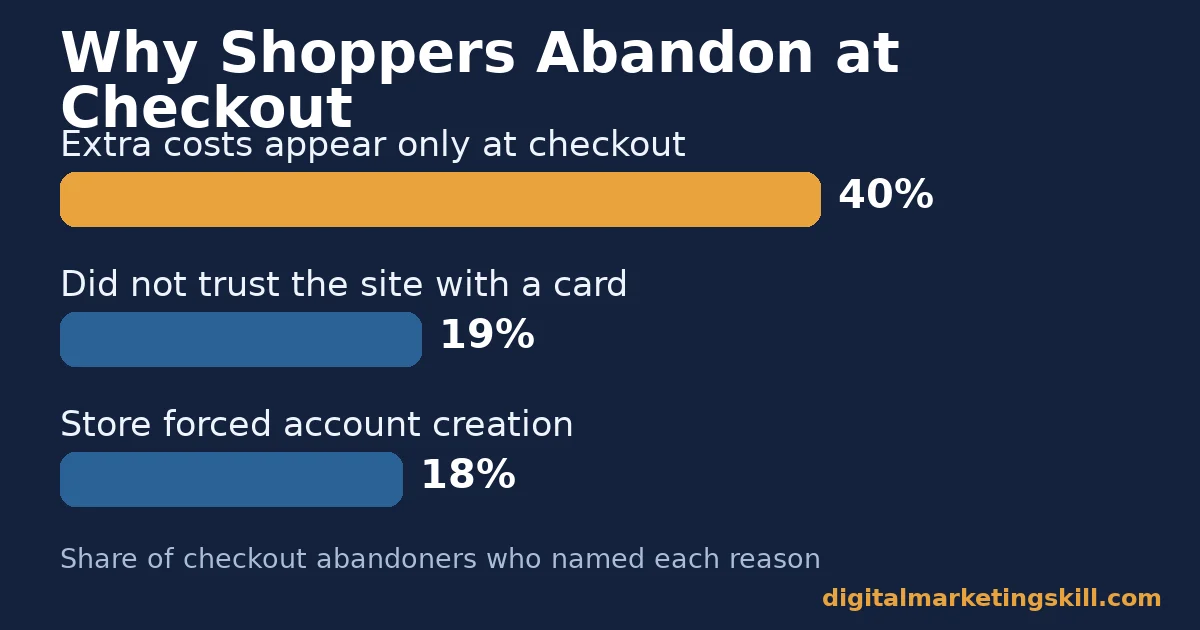
The single biggest named reason is cost, not design. Baymard’s own list of cart abandonment reasons puts extra costs, such as shipping, tax or fees that only appear at checkout, at 40% of named reasons. Not trusting the site with a card comes next, at 19%. Forced account creation is close behind, at 18%.
Those three reasons share a pattern. None of them is about the product. All three are about what the shopper learns, or is asked to do, in the final steps before payment. A shopper can love everything about an item and still walk away once checkout surprises them.
That is why fixing cart abandonment usually means changing checkout, not the product page. A store can have a great product and still lose most of its checkouts for reasons that have nothing to do with the product at all. The checkout itself is the thing to audit first.
Cart Abandonment Differs By What You Sell
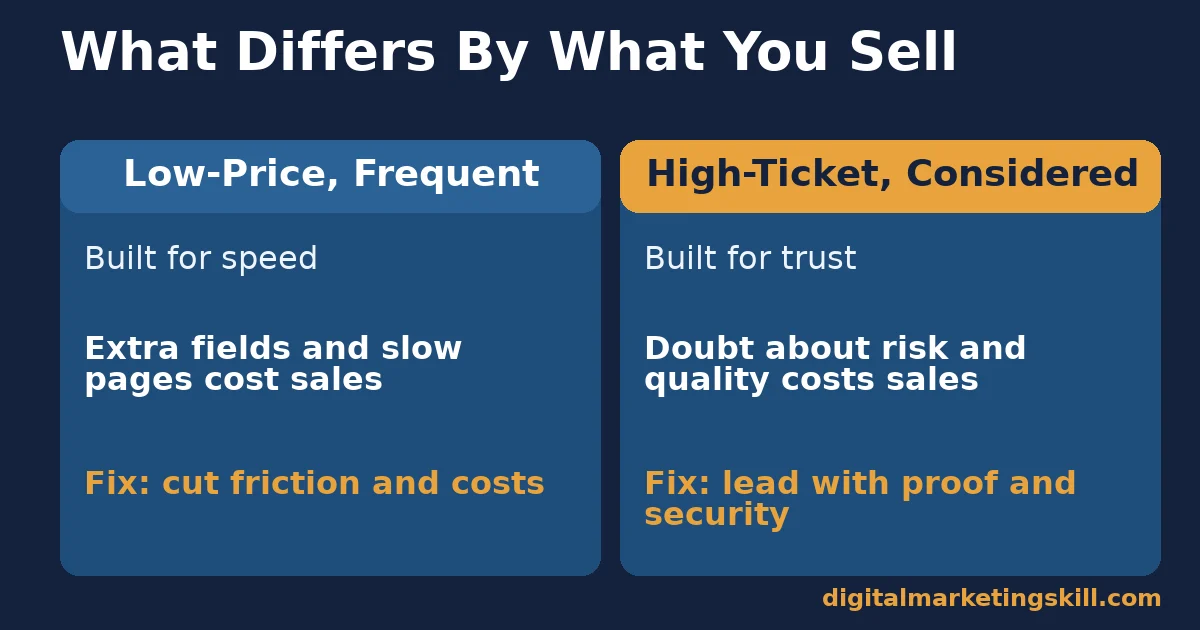
The checkout research above is an average across many kinds of stores. In practice, what drives abandonment differs by how much the item costs and how often a shopper buys it. A $15 phone case and a $1,500 sofa are both abandoned at checkout. They are rarely abandoned for the same reason, so a single fix list for both will under-serve at least one of them.
Low-Price, High-Frequency Stores: Built For Speed
A shopper buying a $25 item they already know they want is not weighing much risk. Their patience is short. A slow page, a surprise shipping fee or an extra form field feels disproportionate to the size of the decision, so they leave.
For this shopper, Baymard’s form-field and extra-cost findings matter most. A faster, shorter checkout keeps pace with how little thought they expected to give the purchase. Anything that slows them down works against the impulse that brought them to the cart in the first place.
High-Ticket, Considered Stores: Built For Trust
A shopper paying several hundred dollars for an item they researched for days is weighing real risk. They want proof the product performs, proof other buyers were satisfied, and proof the site will protect their payment details.
For this shopper, the 19% of abandoners who did not trust the site with their card matters more than a single extra field. Reviews, a visible returns policy and clear security cues carry more weight than shaving a few seconds off checkout. A few extra seconds spent reading a clear policy page is a small price for this shopper, next to the risk of an expensive mistake.
How to Fix Cart Abandonment For Each Store Type
The fixes below mirror the two store types above. Start with whichever one matches most of your orders, then layer in the other if you sell a mix of cheap and expensive items. Few stores are purely one type, so most will use ideas from both lists rather than only one.
Low-Price Stores: Cut Friction and Surprise Costs
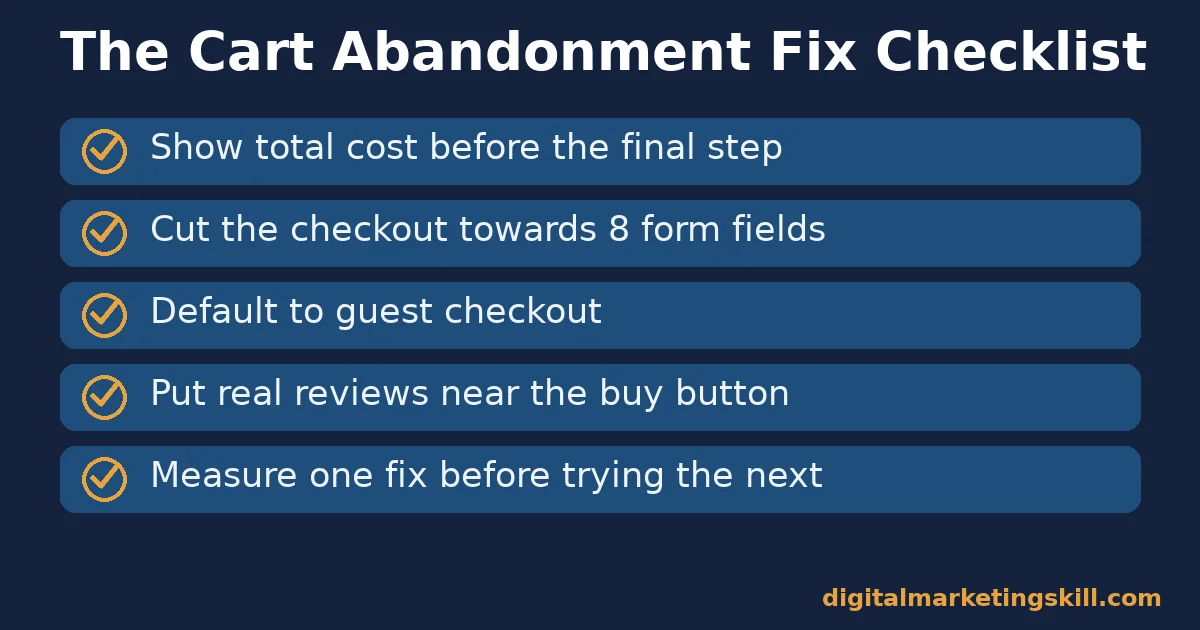
Show total cost, including shipping, before the final checkout step. Put it on the product or cart page. That one change addresses the single largest named reason for abandonment. Next, cut the checkout form down towards Baymard’s benchmark of 8 fields. Remove anything not needed to ship and bill the order.
- Show the full price early. Shipping and tax should appear on the cart page, not only at the final step.
- Trim the form. Delete fields that do not change how the order is shipped, billed or verified.
- Default to guest checkout. Offer account creation afterwards, as an option, not a requirement.
- Test real-phone speed. Measure load time on a mid-range phone, not only on a fast office laptop.
Speed is worth the effort it takes. Google and Deloitte’s joint “Milliseconds Make Millions” analysis studied 37 retail, travel and lead-generation brands over four weeks. It found that mobile sites 0.1 seconds faster saw retail conversions rise 8.4% and travel conversions rise 10.1%.
High-Ticket Stores: Lead With Proof and Security
Put genuine customer reviews near the price and the add-to-cart button. Do not bury them in a separate tab. Northwestern’s Spiegel Research Center analysed purchase behaviour across many product categories. It found that purchase likelihood for a product with five reviews was 270% greater than for the same product with none. The effect was larger for higher-priced products than cheaper ones in its data.
- Surface real reviews near the buy button. A shopper should not have to search for proof.
- State the returns policy before checkout. Plain language removes the “what if I need to send it back” doubt.
- Show recognisable security cues at the card field. Place them where the doubt actually appears, not only in the footer.
- Keep promises consistent. A delivery estimate or stock claim that turns out wrong at checkout undoes the trust the reviews built.
These steps answer the “can I trust this site with my card” doubt directly. That is better than hoping a shopper assumes the best on their own.
How to Measure Cart Abandonment
Treat cart abandonment as a funnel with named stages, not one number. A single abandonment rate hides where the problem actually sits. Each metric below is defined in one sentence, with a note on how to read it. Together they sit alongside the sales totals you already track.
Five Metrics That Show the Real Picture
- Cart abandonment rate. The share of shoppers who added an item to their cart but never completed the order. Track it monthly; a sudden jump usually points to a new checkout bug or a new cost that appeared late.
- Checkout abandonment rate. The narrower share who started checkout, meaning they entered at least one checkout field, but still did not pay. A gap between this and the cart rate points at the product or cart page rather than checkout itself.
- Step-by-step drop-off. The share of shoppers who leave at each individual checkout step. This pinpoints exactly which field or page is losing people, instead of guessing.
- Average engagement time on checkout. How long shoppers spend actively on the checkout page, available in Google Analytics. A time far longer than the form should take suggests confusion, not consideration.
- Recovery rate. The share of abandoned carts that convert after a follow-up email or reminder. Compare it against your own past campaigns rather than another store’s, since list quality varies widely.
None of these numbers replaces simple revenue and order counts. They sit alongside those totals, explaining why the order count moved rather than only that it did.
How to Read These Numbers Together
Read step-by-step drop-off first. If one step loses far more shoppers than the others, that step is the problem, whether it is a cost reveal, a mandatory account field or a payment error. Fix that before touching anything else.
If drop-off is spread evenly across every step, the issue is more likely overall trust or price than a single field. That points towards reviews, security cues and clear policies rather than a form redesign. Check recovery rate last, after the checkout itself is in reasonable shape, since a recovery email cannot make up for a step that was losing most shoppers before they ever gave an email address.
The One Decision Rule: Fix the Biggest Named Reason First
If you remember one rule from this guide, make it this one: fix the single largest named reason for abandonment on your own site before you test anything else. Guessing at ten small tweaks at once makes it impossible to know which one worked.
Here is an illustrative example, with invented numbers. A small homeware store finds that 45% of its checkout abandoners leave on the shipping-cost step, more than double any other step. It moves the shipping estimate to the cart page, before checkout even starts. Over the next month, checkout abandonment drops from 68% to 54%, with no other change to the site.
The store did not fix cart abandonment in general. It fixed the one step its own data pointed to, then measured whether that specific fix worked before moving to the next one. It kept the old checkout version’s numbers written down, so it had a clear before-and-after to compare, rather than a vague sense that things felt better.
The same approach works in reverse. If the store had instead added a live chat widget and a new discount banner in the same month, it would have no way to tell which change, if any, caused the improvement. One change, measured against a known baseline, is what turns a guess into evidence.
A Real Case: How Baymard Tracks Abandonment Across 344 Stores
Baymard Institute built its checkout abandonment benchmark because surveys asking shoppers why they left are easy to run but easy to get wrong. People do not always remember, or admit, their real reason for leaving. So its research combines large-scale usability testing with site benchmarking rather than relying on self-report alone, watching what shoppers actually do at each step rather than only asking them afterward.
According to Baymard’s own description of its checkout usability research, the programme includes 25 rounds of qualitative usability testing with more than 4,400 test sessions, 54 rounds of manual benchmarking across 344 leading ecommerce sites, and 12 quantitative studies covering more than 20,000 participants in total.
The limit is worth stating plainly: this benchmark leans towards larger, established ecommerce sites that can afford to be studied and copied, so a very small store’s checkout may differ in ways the benchmark does not capture.
A newly launched store with one product and a simple checkout may already sit close to the 8-field target the benchmark recommends. That can happen simply because it never grew the extra fields larger catalogues tend to collect over time. Treat the benchmark as the best available map of common failure points, not a perfect model of every store.
Frequently Asked Questions About Cart Abandonment
What is a normal cart abandonment rate?
Baymard Institute’s long-running benchmark puts the average at 70.19% across many studies and store types. Your own rate matters more than this average. Compare it against your own past months rather than chasing a single target number, since your mix of products, prices and traffic sources will never match the benchmark exactly.
What is the single biggest cause of cart abandonment?
In Baymard’s quantitative study of checkout abandonment, extra costs that appear only at checkout, such as shipping and tax, were the reason most shoppers named, at 40%.
Does requiring an account increase cart abandonment?
Yes. Baymard’s research found that 18% of abandoners left specifically because a store forced account creation before they could pay. Offering guest checkout, with account creation optional afterwards, removes that specific reason.
How many form fields should a checkout have?
Baymard’s benchmark of 344 ecommerce sites found the average checkout has 11.3 form fields, while its own recommendation is around 8. Removing fields that are not needed to ship and bill the order is a low-risk place to start. List every field on your current checkout, then ask what shipping, billing or fraud check actually needs each one before you decide to keep it.
Do customer reviews actually reduce cart abandonment?
Evidence points that way for considered purchases. Northwestern’s Spiegel Research Center found purchase likelihood for a product with five reviews was 270% greater than for the same product with none, with a stronger effect for higher-priced items. Treat that figure as a comparison of five reviews against zero, not a promise that every review you collect adds an equal amount of extra sales.
Does page speed really affect whether shoppers finish an order?
Yes, measurably. Google and Deloitte’s analysis of 37 brands found that mobile pages 0.1 seconds faster saw retail conversions rise 8.4%. Separate Google research, “The Need for Mobile Speed”, found the probability of a visitor leaving rises as load time grows from one second to three, and that a majority of mobile visits are abandoned once a page passes the three-second mark.
Should I use an abandoned-cart email?
Yes, as a second line of defence once checkout itself is fixed. A well-timed reminder can recover some lost orders after the fact, especially for shoppers who were simply interrupted. But no email sequence will fix a checkout step that loses most shoppers before they ever reach the point of leaving an email address, so treat it as a safety net, not the main repair.
Is a high cart abandonment rate always a bad sign, and should every store aim for the same number?
Not on its own, and no. Some shoppers use a cart to save items, compare prices or wait for payday, with no plan to leave for good. A store selling a $20 impulse item and a store selling custom furniture will likely never share the same rate either, because the decisions their shoppers make are not the same size.
Watch the trend and the named reasons on your own store instead of chasing a single industry-wide target. A rate that climbs sharply, or one checkout step losing far more shoppers than the rest, is the real warning sign worth investigating.
Start With Your Checkout, Not a New Discount
Cart abandonment usually has a specific, named cause in your own checkout data: a surprise cost, a forced account or a slow mobile page. Pull your step-by-step drop-off numbers, find the biggest leak, and fix that one thing before reaching for a discount code.
Our guide on converting website traffic into leads covers the stages before checkout. Our guide to landing page conversion covers the page a shopper lands on first.
Measuring the result matters as much as the fix. Our guide to Google Analytics traffic sources shows where abandoning shoppers came from. Our guide to conversion rate optimization ROI shows how to prove a checkout fix paid for itself, and our guide on customer retention strategies covers keeping the customers you convert.
If you want guided practice applying fixes like these, Digital Marketing Skill Institute teaches these skills hands-on. The Master Diploma in Digital & AI Marketing includes nine practical courses, among them AI-powered Google Analytics, with unlimited 1-on-1 coaching and real project work inside a U.S. company. It is dual US and UK accredited, recognised in more than 100 countries.
The programme is fully online, so you can study from anywhere in your country. Find more guides on the Digital Marketing Skill Institute blog, and when you are ready, apply for the Master Diploma or start from the Digital Marketing Skill Institute homepage.
Every figure in this guide was checked against its original source before publication. Figures marked as illustrative are invented examples, not real results.
![9 Amazing Digital Marketing Skills to Make Money Online [With Proof]](https://digitalmarketingskill.com/wp-content/uploads/2019/07/9-Amazing-Digital-Marketing-Skills-to-Make-Money-Online-With-Proof-17.png)