
toc items: 17
Facebook lead ads let someone hand over their contact details without ever leaving the app. No landing page. No slow mobile form. This guide covers how to set up Facebook lead ads, which fields actually convert, and the one follow-up step most campaigns skip.
Key Takeaways
- 5.66 billion social media user identities exist worldwide, 68.7% of the global population. The audience for Facebook lead ads is still growing (DataReportal).
- 56.9% of online adults aged 16 and over report using Facebook within the past 30 days, based on GWI survey data (DataReportal).
- Meta says lead ads can verify prospects with tools like a phone number sent by SMS passcode, or a work email. This raises lead quality before a sales team spends time on the contact (Meta for Business).
- Meta cites that 64% of online shoppers use its platforms to discover products. 45% have used them to help with a purchase (Meta for Business).
- The FTC’s CAN-SPAM rules apply the moment a lead ad hands you an email address. A truthful subject line, a physical address, and an opt-out honoured within 10 business days are required for every follow-up email after that (FTC).
In this guide
- Why Lead Ads Get Mishandled
- How Facebook Lead Ads Actually Work
- What Differs By Form Type
- How To Fix The Most Common Lead Ad Mistakes
- How To Measure Lead Ad Performance
- The One Rule For Choosing Your Form Type
- A Worked Example: Launching A First Lead Campaign
- Targeting Options For Facebook Lead Ads
- Budget and Schedule for a First Campaign
- Setting Up Your First Facebook Lead Ads Campaign
- What To Do After A Facebook Lead Ads Submission
- Frequently Asked Questions About Facebook Lead Ads
- Where to Go From Here
Why Lead Ads Get Mishandled
A Facebook lead ad is easy to launch. That is exactly the problem. The form takes two minutes to build. Because of that, many advertisers skip the planning that separates a form full of real buyers from a form full of junk entries.
This is not a guaranteed formula. Results vary by industry, offer, and audience size. Treat every benchmark below as a starting point for testing, not a promise.
Two ground rules come before the steps. First, nothing here claims a fixed cost per lead. Meta does not publish one, and any number you see elsewhere is an average across very different accounts.
Second, every legal note here is general information, not legal advice for your specific business. Check your own obligations with a professional before you launch at scale.
How Facebook Lead Ads Actually Work
A lead ad looks like a normal Facebook or Instagram post. The difference is the call-to-action button. Instead of sending someone to your website, it opens an in-app form. That form is already partly filled in with the name and email Facebook has on file for that account.
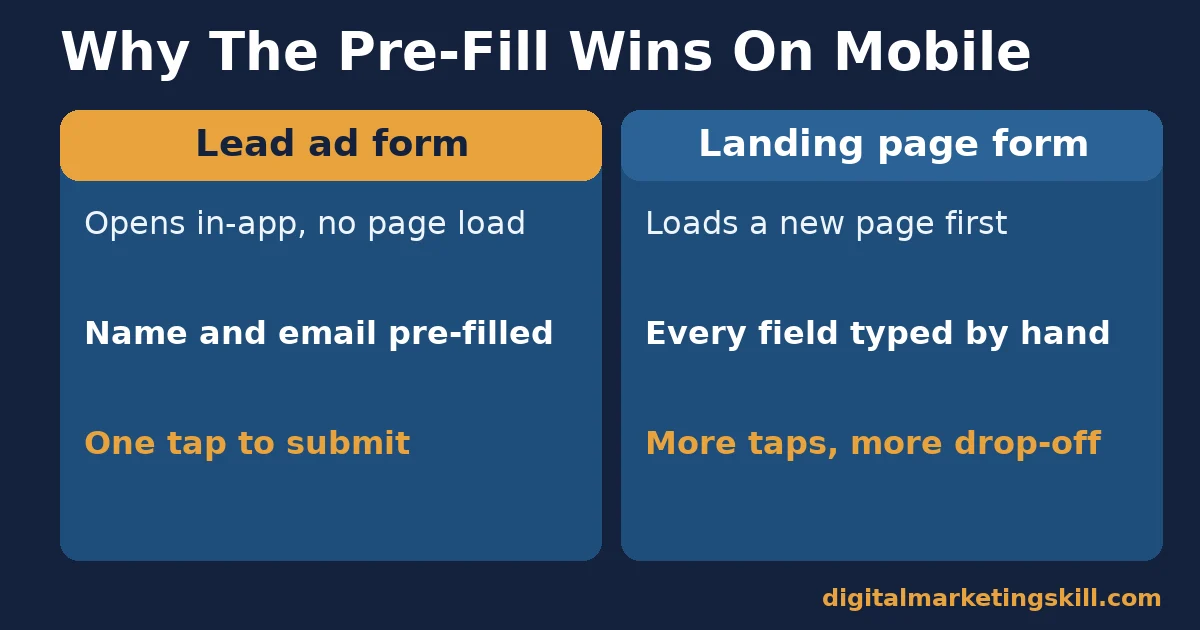
That pre-fill is the entire reason lead ads convert better than a cold landing page on mobile. The person taps submit instead of typing on a small keyboard.
Meta’s own guidance frames this as reaching “higher-intent prospects at scale.” It offers verification add-ons for the same reason: a phone number confirmed by SMS passcode, or a work email field. An easy form also invites low-effort, low-quality entries, and these tools push back against that.
Once someone submits, the lead lands in Meta’s own Leads Centre, or in a CRM you connect through an integration. Nothing forces you to check it daily. Many campaigns lose their best prospects simply because nobody looked at the form results for a week.
What Differs By Form Type
Meta gives you two real choices for a lead ad form: a More Volume form, or a Higher Intent form. They are built for opposite goals. Picking the wrong one for your offer is the single most common setup mistake.
More Volume Forms: Built For Speed
A More Volume form takes one tap to submit, because the fields are already filled in from the person’s Facebook profile. It produces the highest number of leads for the lowest cost per lead. The trade-off is quality. Some of those leads are people who tapped without reading the offer closely.
Higher Intent Forms: Built For Quality
A Higher Intent form adds a review screen before submission. The person sees their answers once more and has to confirm. It produces fewer leads, but a noticeably higher share of them are ready to talk to a salesperson, because the extra tap filters out casual taps.
How To Fix The Most Common Lead Ad Mistakes
These two form types fail in different ways later in the funnel. Match the fix to the form you chose.
More Volume Forms: Lead With Fast Filtering
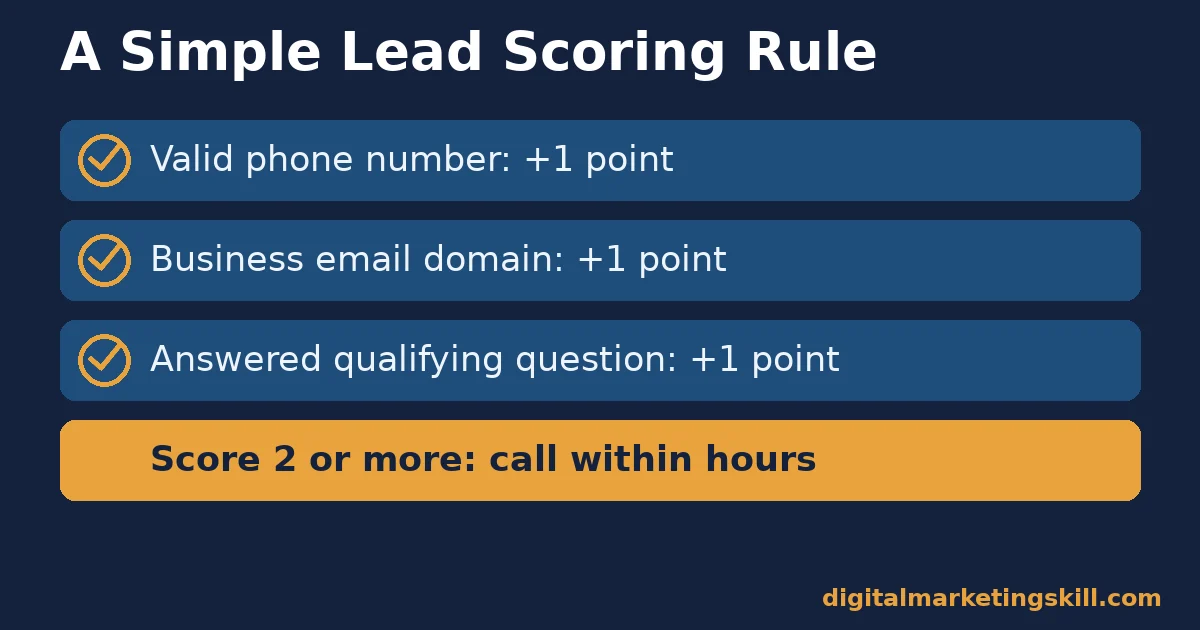
More Volume forms accept almost every tap. Build a simple scoring rule into your CRM or spreadsheet before the campaign launches. Give one point for a valid phone number, one for a business email domain, and one for answering an optional qualifying question.
Call or email the highest scorers first. Do it within hours, not days; a warm lead cools fast.
Higher Intent Forms: Lead With One Sharp Question
A Higher Intent form already filters for attention. Add exactly one qualifying question on top of it, such as budget range, timeline, or company size. Two or more extra questions push drop-off up fast. One well-chosen question keeps the form short while still separating real buyers from browsers.
How To Measure Lead Ad Performance
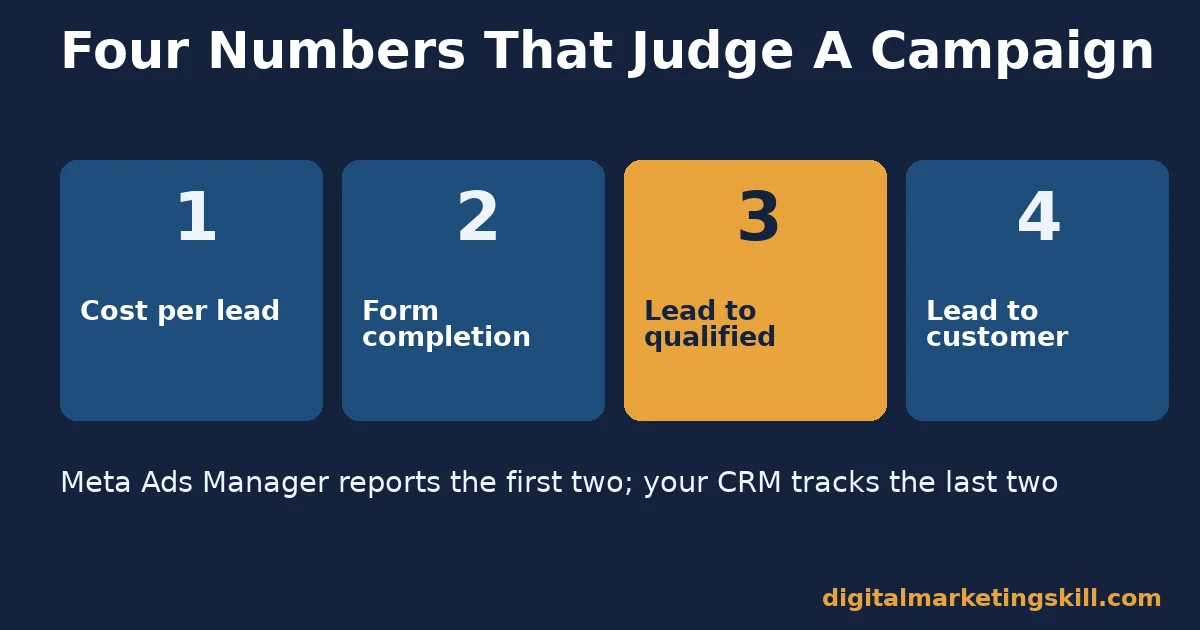
Four numbers tell you whether a lead ad campaign is actually working, not just generating entries.
- Cost per lead (CPL): total spend divided by number of form completions. Compare it against your own past campaigns, since CPL varies enormously by industry and offer.
- Form completion rate: the share of people who open the form and finish it. A low rate usually means too many fields, not a bad audience.
- Lead-to-qualified-lead rate: the share of submitted leads that pass your scoring rule or sales team’s first call. This is the number that actually reflects form quality.
- Lead-to-customer rate: the share of qualified leads that eventually buy. Track this over weeks, not days, since most buying decisions take longer than a single ad click.
None of these four numbers needs special software. Meta Ads Manager reports the first two directly. The last two live in whatever CRM or spreadsheet tracks your sales pipeline.
The One Rule For Choosing Your Form Type
Decision rule: if your offer is free, low-commitment, or top-of-funnel, use a More Volume form and filter afterward. If your offer involves a sales conversation, a quote, or a meaningful purchase, use a Higher Intent form with one qualifying question.
Illustrative, invented numbers: imagine two campaigns with the same $500 budget. A More Volume form might generate 100 leads at $5 each, with 20 turning out to be sales-ready after filtering.
A Higher Intent form on the same budget might generate 40 leads at $12.50 each, with 22 sales-ready. In this illustrative comparison, the Higher Intent form produces more usable leads for the same spend, because fewer of them need filtering out by hand.
A Worked Example: Launching A First Lead Campaign
Illustrative, invented numbers: this is a step-by-step walkthrough, not a real company’s results. A small business owner wants quotes for a service. They pick a Higher Intent form, add one qualifying question about project timeline, and connect the form to a CRM through Meta’s integration options.
Before launch, they write a scoring rule. Any lead who answers “within 30 days” to the timeline question gets called first. They also draft the first follow-up email in advance. It carries a truthful subject line, their business address, and a working unsubscribe link, to meet CAN-SPAM requirements from the first message onward.
In this illustrative walkthrough, the setup, from form build to a ready CRM connection and a compliant follow-up email, takes under two hours. Most of that time goes into writing the one qualifying question and the follow-up message, not into the ad itself.
Targeting Options For Facebook Lead Ads
Three targeting layers sit behind every Facebook lead ads campaign. Most of the wasted budget in a first campaign comes from skipping the first two in favour of the third.
Core audiences use interests, demographics, and location that Meta already tracks. They are the fastest to set up, and the easiest to get wrong. Broad interest targeting pulls in a wide mix of people who may never buy.
Custom audiences use data you already own: an email list, website visitors, or people who engaged with a previous post or video. For a business with any existing customer list, this is usually the strongest starting point for a new lead ad campaign. The audience has already shown some form of relationship with the brand.
Lookalike audiences, covered above, extend a custom audience outward to new people who share similar traits. Meta’s documentation recommends a source list of at least a few hundred people for lookalike audiences to perform reliably. Smaller lists tend to produce less consistent results.
Budget allocation follows the same logic as the form choice above. A narrow, warm audience with a Higher Intent form usually needs a smaller daily budget to find enough qualified people.
A broad, cold audience with a More Volume form can absorb a larger budget. It still needs the scoring and filtering habits covered earlier, to turn volume into something a sales team can actually use.
Budget and Schedule for a First Campaign
Most hosts of a first Facebook lead ads campaign ask the same question: how much to spend, and for how long. Meta’s delivery system needs enough events to learn from before it can optimize well, so a campaign that runs for only a day or two rarely gathers enough data to judge fairly.
A practical minimum is a run of five to seven days, with daily spend high enough to generate at least a handful of form completions each day. A campaign producing zero or one lead a day for a week is not a failed audience yet; it may simply need more budget or a longer run before the delivery system has enough signal.
Avoid the common mistake of changing the audience, form, or creative every day while a campaign is still in its early learning period. Frequent changes reset that learning process and make it harder to tell whether a result reflects the audience or just restarted optimization.
A simple weekly review works better than daily tinkering. Check cost per lead, completion rate, and the quality of leads once a week. Make one deliberate change if something needs fixing, then leave it alone until the next review.
Setting Up Your First Facebook Lead Ads Campaign
Four practical steps sit between an idea and a live campaign. Skipping any of them is where most new advertisers waste budget.
First, choose the campaign objective built for this format inside Meta Ads Manager, rather than a generic traffic or engagement objective. The dedicated objective optimizes delivery toward people more likely to submit a form, not just click.
Second, build the form itself. Keep it to three or four fields beyond name and email. Every additional field after that measurably lowers the completion rate, even on a pre-filled mobile form.
Third, write the privacy policy link into the form before you submit it for review. Meta requires this link. A missing one is one of the most common reasons a lead ad gets rejected or delayed.
Fourth, connect the destination for your leads, whether that is Meta’s own Leads Centre, a CRM, or a spreadsheet export, before the campaign goes live, not after the first leads start arriving.
What To Do After A Facebook Lead Ads Submission
A submitted form is not a sale. It is a warm, time-limited window. Three habits turn Facebook lead ads submissions into an actual pipeline instead of a spreadsheet nobody opens.
First, automate the first response. A simple confirmation email or text, sent within minutes, keeps the person engaged while they still remember clicking submit. It does not need to be a sales pitch; a short thank-you with a clear next step works better than silence.
Second, build a lookalike audience from your best Facebook lead ads submissions once you have at least a few hundred qualified leads. Meta’s own documentation on custom and lookalike audiences explains how uploading a list of existing customers lets its system find new people who share similar signals. This generally improves targeting over a cold interest-based audience.
Third, retire the leads that never convert. A contact who has not responded after a defined number of attempts, typically three to five over two weeks, should move out of active outreach and into a slower nurture sequence. Chasing every Facebook lead ads submission forever wastes sales time that could go toward the leads still showing interest.
Data protection does not stop at CAN-SPAM. If your Facebook lead ads campaign reaches people in the European Union or the United Kingdom, GDPR rules on consent and data storage apply too. They sit alongside the FTC rules above, not instead of them. Check which regions your audience targeting actually reaches before you assume one country’s rules are enough.
Frequently Asked Questions About Facebook Lead Ads
What is the difference between a Facebook lead ad and a regular ad with a landing page?
A regular ad sends someone to an external landing page, where they load a new page and type into a form. A lead ad opens an in-app form on Facebook or Instagram itself, already partly filled in, so there is no page load and less typing.
How much do Facebook lead ads cost?
Meta does not publish a fixed cost per lead. It depends heavily on your industry, offer, audience size, and competition for that audience at the time you advertise. Track your own cost per lead across campaigns rather than relying on an industry average.
Can I connect Facebook lead ads to my CRM?
Yes. Meta’s Leads Centre supports direct integrations with many CRM platforms. Most CRMs also support a connection through a third-party automation tool if a direct integration is not available.
Do I need a privacy policy for a Facebook lead ad?
Yes. Meta requires a privacy policy link in your lead form. Once someone’s email reaches your systems, general email and data protection rules, including CAN-SPAM in the United States, apply to anything you send them afterward.
Why are my Facebook lead ad leads low quality?
This usually means the form is a More Volume form with no filtering step after submission, or the ad targeting is too broad. Add a scoring rule, consider a Higher Intent form, and narrow the audience to people more likely to match your actual customer profile.
How fast should I follow up with a Facebook lead ad submission?
As fast as your process allows, ideally within hours. Interest from a lead ad is immediate and often fades quickly. A lead that sits unread for a week behaves like a cold contact, not a warm one.
What is a lookalike audience, and should I use one for Facebook lead ads?
A lookalike audience is a group of new people Meta’s system finds because they share traits with a list you upload, such as past customers or your best existing leads. It is worth using once you have a source list of at least a few hundred people; smaller lists tend to produce weaker matches and less reliable results.
Do Facebook lead ads work on Instagram too?
Yes. The same lead form can run across Facebook and Instagram placements from one campaign. Meta’s reporting breaks results down by placement, so you can see which platform produces better-quality leads for your offer.
Should I test more than one Facebook lead ad form at once?
Yes, but test one variable at a time. Run a More Volume version and a Higher Intent version of the same offer side by side, with the same budget split evenly, rather than changing the form type and the creative and the audience all in one test. One variable at a time tells you what actually moved the result.
How many fields should a Facebook lead ad form have?
Keep it to name, email, and no more than two or three extra fields. Each additional field lowers the completion rate, even with the pre-fill feature, so only ask for information your sales process genuinely needs on day one.
Where to Go From Here
A lead ad is only the first step. What happens in the hours after someone submits a form decides whether the lead becomes a customer, wherever in your country your audience is based.
This site’s guide to Facebook ad setup covers the account structure a lead campaign sits inside, and the Facebook ad campaigns guide covers budgeting and targeting in more depth. For the follow-up side, see the broader lead generation guide and the notes on email marketing strategy for turning a submitted form into a real conversation.
At Digital Marketing Skill Institute, Facebook lead ads sit inside the AI-Powered Lead Generation and Email Automation track of the Master Diploma in Digital & AI Marketing. It is one of four AI-powered tracks, totalling ten courses, with a Full Stack option if you want all four.
Every track includes unlimited 1-on-1 coaching and mentoring, a U.S. Project Internship with a verified U.S. Work Reference Letter, and dual US and UK accreditation recognised in more than 100 countries. The program runs 100% online, wherever you live.
See real outcomes on the reviews page, read the full program on the Master Diploma page, browse more guides on the blog, or go straight to the application page to start. Learn more at digitalmarketingskill.com, and start your application at digitalmarketingskill.com today.
Every figure in this guide was checked against its original source before publication. Figures marked as illustrative are invented examples, not real results.
![9 Amazing Digital Marketing Skills to Make Money Online [With Proof]](https://digitalmarketingskill.com/wp-content/uploads/2019/07/9-Amazing-Digital-Marketing-Skills-to-Make-Money-Online-With-Proof-17.png)






