An online business turns a profit when two things line up: a price that covers cost and value, and a clear number of paying customers each month. Most new owners skip that math. They guess at pricing instead. That guess, more than anything else, decides whether the business survives past its first year.
Key Takeaways
- Most new businesses do survive year one, but the drop-off keeps going. The US Bureau of Labor Statistics found 77.9% of new business establishments survive one year. Only 51.4% survive five years.
- Weak demand, not a weak product, is still the top killer. CB Insights studied 431 venture-backed companies that shut down. It found a cause for 385 of them. 43% cited poor product-market fit.
- Keeping a customer is far cheaper than replacing one. Research by Frederick Reichheld of Bain & Company, cited in Harvard Business Review, found that a new customer costs five to twenty-five times more than keeping an existing one.
- Retention moves profit more than most owners expect. The same Bain & Company research found a 5% rise in retention lifts profit by 25% to 95%, depending on the industry.
- Readers scan before they trust a price or a pitch. Nielsen Norman Group tracked 232 users and found an F-shaped reading pattern. People absorb the first two paragraphs far more than anything below.
In this guide
- What Most “Start an Online Business” Advice Skips
- How Profit Actually Works in a New Online Business
- Three Ways Online Businesses Price Their First Product
- How to Lead With Each Pricing Model Once You Have Picked One
- How to Measure Whether Your Online Business Is Actually Profitable
- The One Decision Rule: Price for Value, Then Work Backward to the Customers You Need
- A Real Case: What Validating Before Building Looks Like
- Frequently Asked Questions About Starting an Online Business
- Start by Validating One Offer, Then Price It for Value
What Most “Start an Online Business” Advice Skips
Most online business guides lead with tools. Pick a platform. Choose a niche. Design a logo. They skip the two decisions that actually decide whether the business makes money: will anyone pay for this, and what must you charge to turn a profit once you know the answer?
The gap is not information. Anyone can find a list of business ideas. The real gap is a repeatable way to test demand before you build, then turn that demand into a price and a customer target. This guide gives you both. It also closer matches the psychology behind a real buying decision than a spreadsheet guess does, plus the metrics that show whether the business is actually working.
How Profit Actually Works in a New Online Business
Profit comes down to one relationship. Take the price a customer pays. Subtract what it costs you to deliver the product. Multiply by how many customers pay each month. Get any one of those three wrong, and the business loses money quietly, or never grows past a side project.
Owners get price wrong first. They guess, or copy a competitor, instead of asking the person who will actually pay. Cost comes second on the list of mistakes, because owners forget time, support, returns and platform fees. Customer count gets ignored completely, and that is the biggest mistake of the three, because it turns a price into a monthly target you can actually plan around.
Proof Comes Before the Math
None of the three numbers above matters until you know people will actually pay. A perfectly calculated price on a product nobody wants is still a zero. That is why validation sits before pricing in this guide, not after it, and why skipping it rarely saves any real time in the end.
Before any of that math matters, you need proof that people will pay at all. CB Insights reviewed 385 failed venture-backed companies. 43% cited poor product-market fit as a leading cause. The product existed. Not enough people wanted it badly enough to pay.
An online business does not need venture funding to fail the same way. It just needs a founder who built first and asked questions later, instead of lining up customers the way a solid small business marketing strategy would. The fix costs nothing but a week of conversations, which makes skipping it even harder to justify.
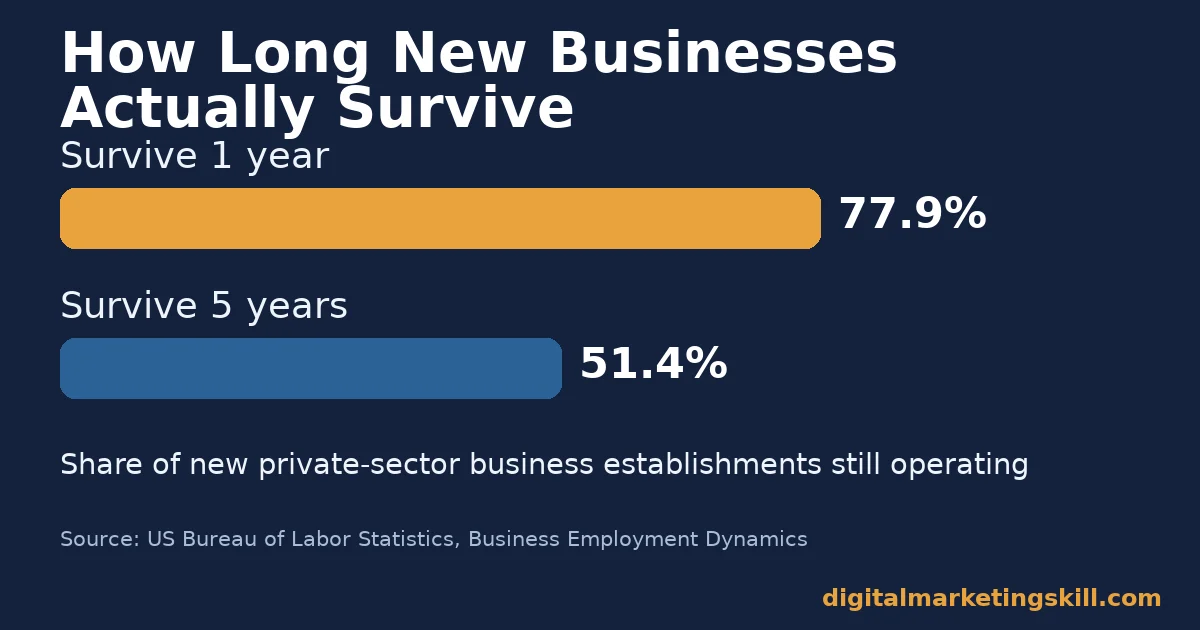
That one-year survival number looks forgiving. The five-year number is the honest one. A business can survive its first twelve months on launch excitement and a founder’s own network. After that, it has to win customers without that early push. That second stretch is where a validated price, not enthusiasm, starts to matter.
Validate With Real People, Not Your Own Opinion
The fastest way to avoid that trap: describe the product to a stranger before you build anything beyond a landing page or a prototype. Listen to why they would, or would not, buy it.
Dropbox’s own account of its early launch is a widely documented example of this. Before writing the full product, its founder posted a short demo video showing the file-syncing idea working. He added a simple email signup for early access.
Beta sign-ups reportedly jumped from 5,000 to 75,000 after the video spread through the tech community. That jump gave him real evidence of demand before he spent months building the actual product.
You do not need a viral video to copy the method. Describe your product to ten or fifteen people who match your target customer. Ask what they would pay, and why. Listen for one consistent reason across most of the conversations. Scattered, weak reasons mean the idea needs more work. A reason that repeats is a real foundation to price against.
Three Ways Online Businesses Price Their First Product
Once you know people want the product, you still have to set a price. Most first-time owners default to whichever model is easiest to calculate, not the one that fits their situation. Each of the three common models suits a different stage and a different kind of product, and switching models later is harder than choosing carefully the first time, because customers anchor on whatever price they saw first.
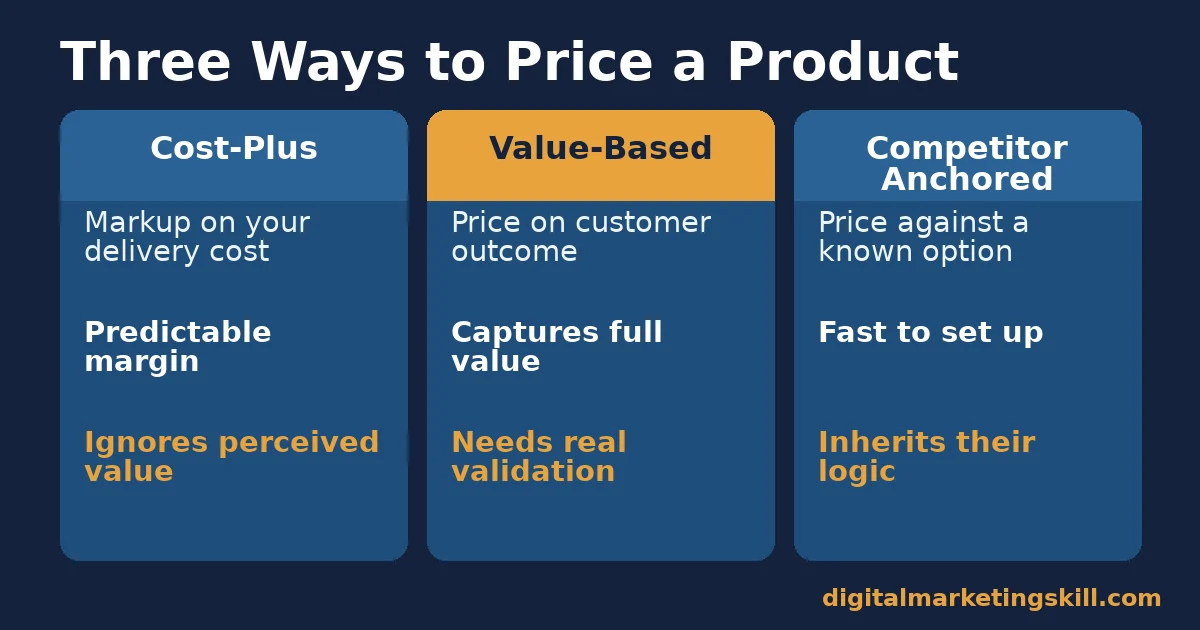
None of the three is universally right. The mistake is picking one by habit instead of matching it to what you sell and what your validation conversations told you. A physical product with thin, predictable margins behaves differently from a service where the customer’s time or income is on the line. Ask which model your validation conversations actually support before you lock in a number.
Cost-Plus Pricing: Built for Predictable Margins
Cost-plus pricing adds a fixed markup on top of your delivery cost. The margin is simple to calculate and hard to erase by accident. It works well for physical products with a clear unit cost, such as a manufactured good or a kit you assemble and ship, because the inputs stay stable.
The weakness: cost-plus pricing ignores how much the customer actually values the outcome. It leaves money on the table for anything with strong perceived value. It can also price you out of a commodity market where customers compare on price alone.
Value-Based Pricing: Built for Perceived Worth
Value-based pricing sets the price by what the outcome is worth to the customer, not what it costs you to produce. Peer-reviewed research on willingness to pay a premium consistently finds that perceived value, not production cost, drives how much people spend. A high price can itself signal quality. That is part of why premium brands explain a product’s value long before it reaches a shelf.
Value-based pricing fits services, software and coaching, anything where the outcome (time saved, income earned, a problem solved) is worth far more than your delivery cost. The risk: pricing on what you hope the value is, instead of what customers actually told you. That is why validation has to come first, before you even think about fixing where buyers quit before they pay.
Competitor-Anchored Pricing: Built for Fast Positioning
Competitor-anchored pricing sets your price relative to an established alternative. Go just below it to win on cost, or just above it to signal more value. It is the fastest model to set up, because the research is already public. It works well when customers are actively comparing you to a known option.
The downside: you inherit the competitor’s pricing logic, including any pressure it faces to discount. You also give up the chance to capture the full value you may be creating, if your product actually solves the problem better.
How to Lead With Each Pricing Model Once You Have Picked One
Picking a model is only half the job. Each one needs a different opening move once you start talking to customers and setting a live price, and mixing up the moves is where owners quietly undercut themselves.
Cost-Plus: Lead With a Hard Floor
Calculate your true delivered cost first. Include your own time at a realistic hourly rate, platform and payment fees, returns, and support time. Set your price at that floor plus the margin you need. Then treat the floor as non-negotiable. Any discount below it is a loss, not a sale.
Value-Based: Lead With the Customer’s Language
Price using the exact outcome your validation conversations surfaced, in the customer’s own words, not your product’s features. If customers told you they would pay for “getting my inbox to zero by Friday,” market the outcome, not the automation behind it. The outcome is what they are actually buying.
Competitor-Anchored: Lead With a Clear Difference
Name the one thing your offer does that the competitor does not. Let that difference justify your position above or below their price. A vague “better” does not hold up. A specific difference, such as “delivered in two days instead of two weeks,” does.
How to Measure Whether Your Online Business Is Actually Profitable
Four numbers tell you honestly whether the business works. Each one means something different, and none of them substitutes for the others. A healthy margin with no customers is just theory, and a flood of customers at a loss-making price is just a faster way to run out of cash.
- Break-even customer count is the number of paying customers you need each month to cover costs. Calculate it as monthly costs divided by profit per sale. It turns an abstract income goal into a concrete, trackable target.
- Gross margin is the share of each sale left after the direct cost of delivering it. Calculate it as (price minus direct cost) divided by price. A thin margin means you need far more customers to match the profit of a business with a wide margin.
- Customer acquisition cost (CAC) is what you spend, on average, to win one paying customer, including ad spend and outreach time. If CAC beats the profit from a single sale, you lose money on every new customer until they buy again.
- Retention rate is the share of customers who buy again, over a given period. Bain & Company’s research found a 5% lift in retention can raise profit by 25% to 95%. That makes retention a faster route to profit than chasing new customers, which is also why the habits that keep buyers coming back deserve attention from month one.
Read the Four Numbers Together, Not One at a Time
Read these four together, not alone. A low CAC with poor retention can still sink a business, because you keep refilling a leaking bucket. A slightly higher CAC paired with strong retention can be far more profitable over a year.
The One Decision Rule: Price for Value, Then Work Backward to the Customers You Need
The single most useful rule here: set your price from validated value first. Only then calculate how many customers you need. Do not pick a customer number you like and reverse-engineer a price to hit it.
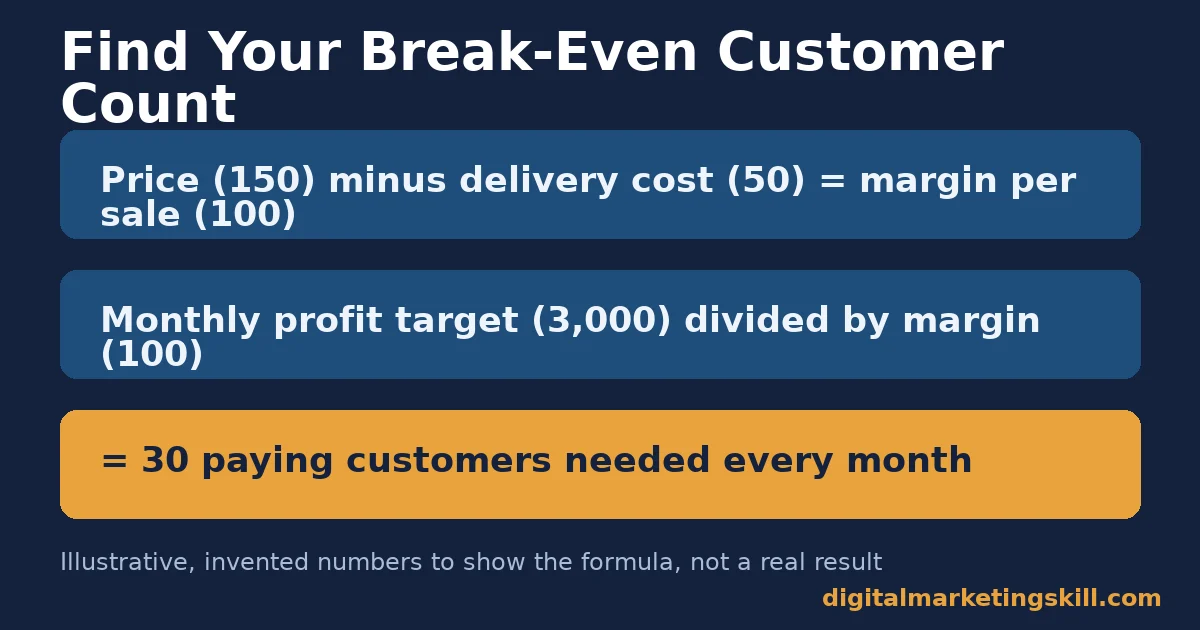
Here is an illustrative, invented example to show the arithmetic, not a real result. Say your validation conversations tell you customers would happily pay 150 for your product. Your direct cost to deliver it is 50, which leaves a gross margin of 100 per sale.
If your target is a profit of 3,000 a month, divide that by the 100 margin, and you need 30 paying customers a month. That single number is now something you can plan outreach around, instead of chasing a vague income figure with no connection to action.
If 30 customers a month looks unreachable given your current reach, you have two honest options. Raise the price, if your conversations support more value than you first charged. Or lower the profit target until the customer count matches a plan you can actually execute. Guessing a number and hoping marketing fills the gap is the trap this rule avoids.
Run this calculation again every time a cost changes, a fee rises, or you adjust your price. The customer number moves with it. Owners who treat break-even as a one-time exercise usually find the gap only when cash is already tight. Owners who recheck it monthly catch the drift early, while it is still a small adjustment.
A Real Case: What Validating Before Building Looks Like
Dropbox’s early launch, described above, is one of the most cited public examples of testing demand before building. A founder made a short video instead of the full product. He added a simple signup form. He used the jump in interest as proof of demand before writing most of the code.
The lesson that transfers to a smaller online business is not the exact tactic; you may not need a video. It is the sequence: prove interest cheaply, then build, instead of building first and hoping interest follows. That order, more than the tool you use to test it, is what separates a validated idea from a guess.
The limits of this case matter too. A viral signup list does not guarantee paying customers. A venture-backed company can absorb a slower path to revenue than a bootstrapped owner can, since it has outside funding to cover the wait. Treat this as a demonstration of the validate-first sequence, not a template to copy exactly.
Frequently Asked Questions About Starting an Online Business
How much money do I need to start a profitable online business?
There is no fixed figure. It depends on your delivery cost and how well you validate demand first. Many online businesses start with the cost of a website, basic tools, and the owner’s own time, then scale spending once a small number of validated customers confirm the price works.
How long does it take for an online business to become profitable?
It depends on your break-even customer count and how fast you can reach that many buyers. That is exactly why calculating the number early beats guessing a timeline. A business that needs 10 customers a month to break even will usually reach profit faster than one that needs 300.
Should I validate my idea even if I am confident it will work?
Yes. Confidence is not evidence. CB Insights’ review of failed venture-backed companies found weak product-market fit cited in 43% of the cases it could analyse. Those founders were confident too, and so were the investors who funded them.
What is the difference between cost-plus and value-based pricing?
Cost-plus pricing sets your price by adding a markup to your delivery cost. Value-based pricing sets your price by what the outcome is worth to the customer. Services and software usually suit value-based pricing better, because the customer’s gain from the outcome is often far larger than your delivery cost.
How many customers do I actually need to run a profitable online business?
Divide your monthly profit target by your margin per sale (price minus direct cost). A narrow margin means you need far more customers to hit the same profit target than a wide margin does. That is why pricing for value, not just cost, changes the entire plan.
Is it better to focus on new customers or repeat customers first?
Repeat customers are usually the faster route to profit. Bain & Company’s research found a new customer costs five to twenty-five times more than keeping an existing one. A new online business with a small customer base should still build a reason to buy again, before spending heavily to find new buyers.
Can I change my price after launch if I validated the wrong number?
Yes, and most owners need to. Treat your first price as a working estimate, not a permanent decision. If early customers pay without hesitation, you likely priced under your real value. If you hear consistent pushback on price, check whether you are reaching the right audience before you blame the product.
Do I need a large audience before I can start an online business?
No. A small group of validated, paying customers proves the idea faster than a large but untested audience ever will. Ten people who actually pay tell you more about whether the business works than ten thousand followers who have never bought anything.
Start by Validating One Offer, Then Price It for Value
Pick the one product or service idea you are most drawn to. Describe it to ten real people who match your target customer. Listen for a consistent reason they would pay. Price that offer against the value they describe. Calculate the exact number of customers you need to hit a realistic profit target, and build your first month of marketing around that number, not a vague income goal.
Digital Marketing Skill Institute’s Master Diploma in Digital & AI Marketing covers the practical side of this process. Nine courses cover offer positioning, pricing, and paid and organic customer acquisition.
The program adds unlimited one-on-one coaching and mentoring, plus real project work inside a US company. It is dual US and UK accredited and recognised in more than 100 countries, delivered 100% online, so you can build and test an online business from anywhere in your country.
See the full program on the Master Diploma page, browse more guides on the digital marketing blog, or go straight to apply when you are ready. Learn more at digitalmarketingskill.com, wherever you live, and see real outcomes on the reviews page. For income-related claims, DMSI’s own earnings disclaimer applies. Visit digitalmarketingskill.com to get started.
Every figure in this guide was checked against its original source before publication. Figures marked as illustrative are invented examples, not real results.
![9 Amazing Digital Marketing Skills to Make Money Online [With Proof]](https://digitalmarketingskill.com/wp-content/uploads/2019/07/9-Amazing-Digital-Marketing-Skills-to-Make-Money-Online-With-Proof-17.png)