

Most new short-term rental listings sit unseen on a crowded platform. The real work of short-term rental marketing starts before a single ad: a listing built to be found, a reason for guests to book direct, and a system that turns stays into reviews. This guide shows what the data says moves bookings, and the one thing to fix first.
Key Takeaways
- The market keeps growing. Grand View Research values the global short-term rental market at roughly $165.7 billion, projected to more than double within about a decade.
- Reviews decide bookings. A Phocuswright study for TripAdvisor found 53% of travelers will not book without reading reviews first. 83% said reviews helped them pick the right place to stay.
- Photos move the needle. Airbnb’s own data, shared at its Host Conference, found listings that upgraded to professional photography saw roughly 24% more bookings. That lift showed up within 60 days.
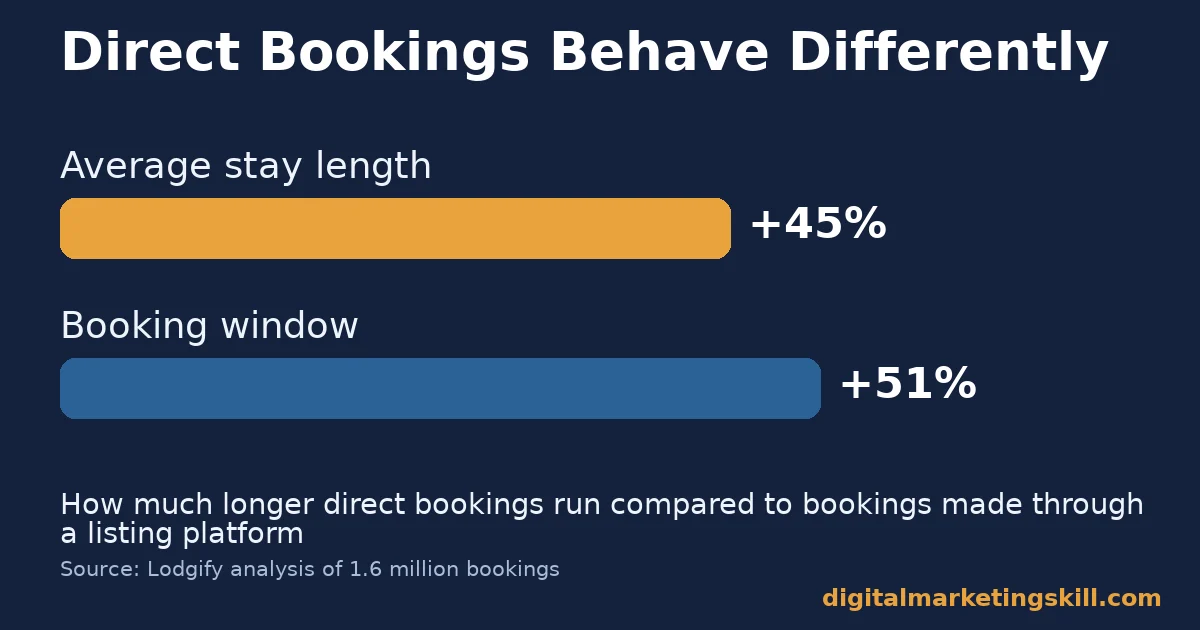
- Direct bookings behave differently. Lodgify’s analysis of 1.6 million bookings found direct bookings run 45.2% longer stays. Those same direct bookings also carry 51.3% longer booking windows than bookings made through a listing platform.
- Pricing is not a one-time setting. A Your.Rentals and PriceLabs study of 541 listings in 34 countries found dynamic pricing lifted gross revenue per unit by 36.3%. That gain was measured year over year.
In this guide
- What Most Short-Term Rental Marketing Advice Skips
- How Short-Term Rental Marketing Actually Works
- What Differs by Channel
- How to Strengthen Each Channel
- How to Measure Short-Term Rental Marketing
- The One Rule: Fix the Listing Before You Add a Channel
- A Real Case: What a Large Pricing Study Found
- Frequently Asked Questions About Short-Term Rental Marketing
- Start With the Listing, Then Build the Rest
What Most Short-Term Rental Marketing Advice Skips
Most advice on short-term rental marketing jumps straight to tactics. Post more photos. Run some ads. Ask for reviews. None of that is wrong. But it skips the order that actually matters. A listing nobody can find will not benefit from better ads. A guest who was never asked will rarely leave a review on their own.
This guide puts the pieces in order. It covers how platform listings, a direct website and reviews each work. It covers what to change for each, and how to measure real progress.
Treat every figure here as a useful signal, not a guarantee. Market-size estimates vary by research firm. Different firms publish figures for the same year that sit well above or below each other. Platform and booking-tool statistics come from companies with a product to sell, even when the underlying study is real. Read every number below as a snapshot, not a settled fact.
How Short-Term Rental Marketing Actually Works
A booking can come from one of three places. It can come from a listing platform’s own search results. It can come from your own website, found through search or social media. Or it can come from a returning guest who books you directly because they already trust you. Most hosts lean almost entirely on the first one.
That is understandable. Airbnb alone reports more than 9 million active listings and over 5.5 million hosts worldwide. Platform search is where most guests start looking. But platform search is also the most competitive channel, since every similar listing nearby competes for the same page of results.
Every platform listing carries its own cost too. Airbnb’s published fee structure charges hosts a 3% service fee under its split-fee model. Under its older single-fee model, that cost can run up to 15.5%, on top of a separate guest service fee the platform adds. That cost is part of why a working direct-booking channel matters once a listing is established.
Why Platform Economics Push Hosts Toward Direct Bookings
Every booking a platform sends you also costs you a slice of that booking’s revenue. Over a full year, that slice adds up. For a host who books every single night through a platform, it becomes a meaningful share of total income.
This is not a reason to avoid platforms. Most hosts need the discovery a platform provides, especially in the first year of a new listing. It is the reason a direct channel is worth building once a listing has some track record, so that growth over time, not just the first bookings, relies less on one channel’s fee structure.
Why Reviews Carry So Much Weight
Reviews sit underneath every channel, not just one. The Phocuswright research found that 83% of travelers said reviews helped them choose the right place. 53% said they would not book at all without reading some first.
A listing with strong photos and a fair price can still lose a booking if it has no reviews to back up the claim. This is why reviews earn their own section in this guide, rather than being treated as a minor finishing touch.
What Differs by Channel
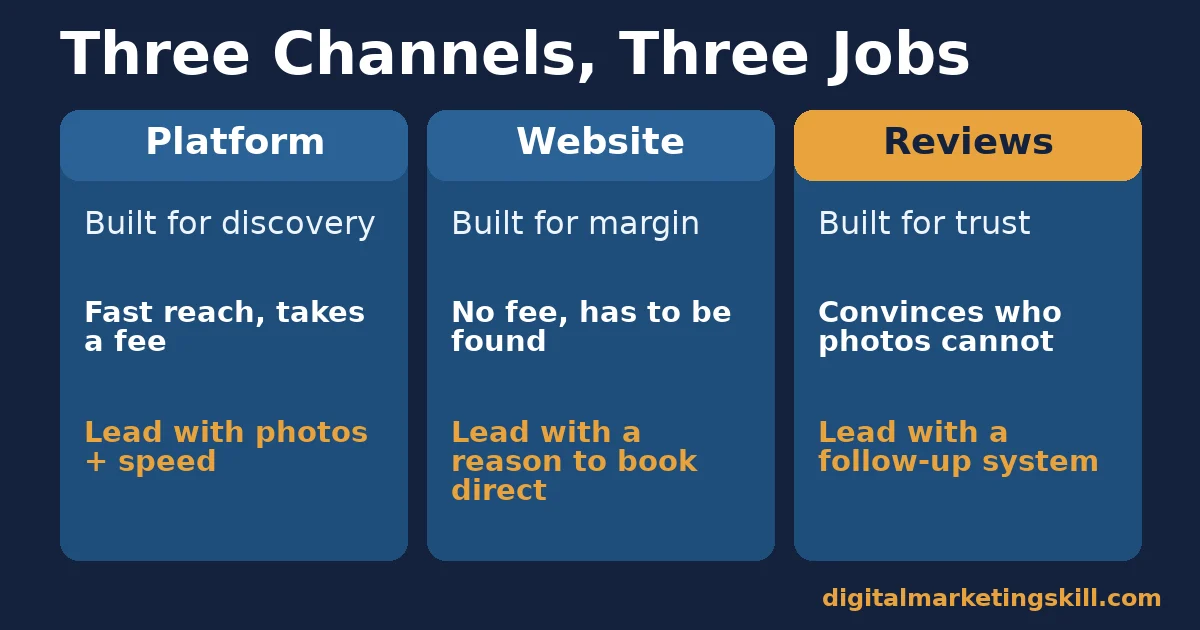
Platform listings, your own website and reviews are not the same job wearing different outfits. Each one earns a booking in a different way, and each breaks down for a different reason if you ignore it.
Treating all three the same is one of the most common mistakes in short-term rental marketing. A host who only ever thinks about the platform listing never builds the direct channel that keeps more of every booking’s revenue. Chasing only a direct website, meanwhile, often leaves a host struggling for the first wave of reviews a platform listing earns almost automatically.
Platform Listings: Built for Discovery
A platform listing is found by guests who are already searching with intent. It rewards signals the platform can measure directly. Photo quality, response time, and a price that holds up against nearby listings all count.
It is the fastest way to get in front of new guests. But the platform also takes a meaningful cut of every booking it sends you, as its own published fee structure shows.
Direct Website: Built for Margin
A direct booking skips the platform’s commission. It tends to come from a guest who already has some reason to trust you. Lodgify’s study found these bookings run noticeably longer and are planned further ahead than bookings made through a listing platform.
The cost is that a direct website earns nothing on its own. It has to be found through search, social media or a returning guest who already knows your name.
Reviews: Built for Trust
A review does the convincing that your own description cannot do by itself, because it comes from someone with nothing to gain. It compounds slowly. Every stay is a chance to earn one, and every unanswered question in a review thread is a chance to lose the next booking.
How to Strengthen Each Channel
Once you know what each channel actually rewards, the fix for each one looks different too. Work through these roughly in order. A platform listing earns the fastest wins. A review system compounds in the background from day one. Building a direct website pays off once you have guests who already trust you enough to come back.
Platform Listings: Lead With Photos and Response Time
Start with photos. Good photos matter most. Airbnb’s own data points to roughly a 24% booking increase after a move to professional photography. Pair that with a response rate close to 100% and a response time under a few hours. Both are signals the platform’s own ranking factors reward directly, not just guest convenience.
Price against comparable listings nearby rather than guessing. A platform that can see every similar listing’s price will quietly favor the ones that look fairly priced for what they offer.
Direct Website: Lead With a Reason to Book Direct
A direct website needs its own reason to exist beyond saving a commission. Give returning guests a small, clear incentive to book with you directly next time.
Make sure your site is findable through basic keyword research for your property type and area, not just your business name. A keyword planner tool can show whether anyone searches for your area and property type at all, before you invest in a site built around it.
Reviews: Lead With a Follow-Up System
Ask for a review at the moment a guest is happiest, usually right after checkout, with one simple message rather than a long form.
Respond to every review, good or bad, since public replies are read by the next guest as much as the review itself is. A small, consistent follow-up habit outperforms an occasional reminder sent only when bookings are slow.
How to Measure Short-Term Rental Marketing
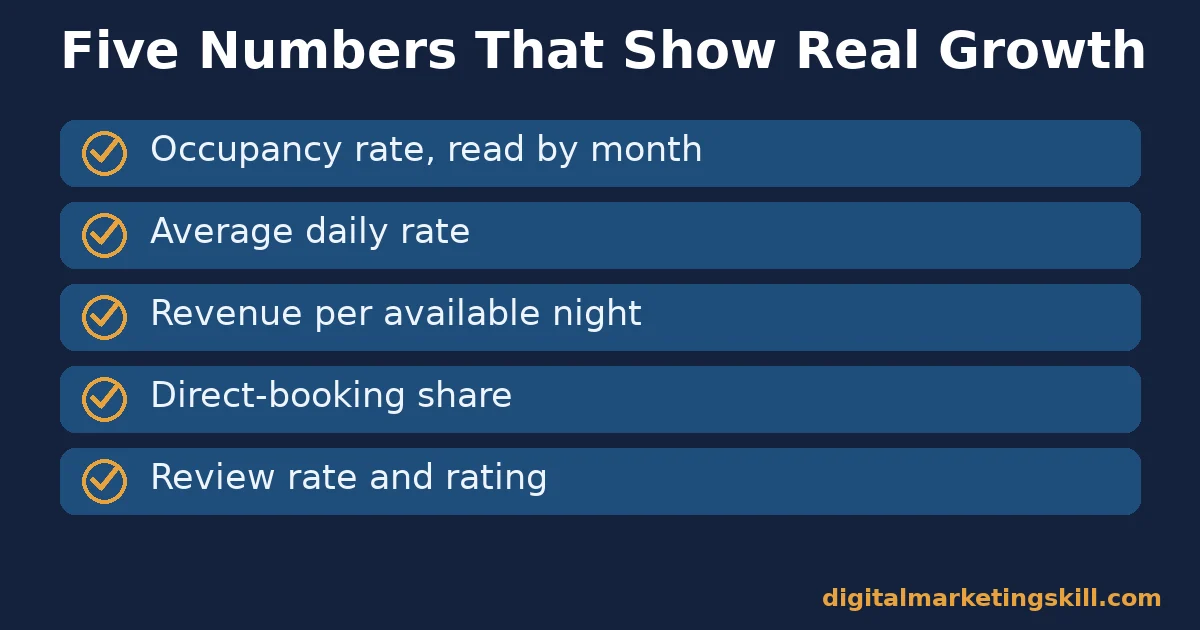
Tracking only the booking calendar hides which lever actually moved it. A busier month can come from many things. It can come from a better listing. It can come from a lucky season, or a nearby competitor going offline for a while. The calendar alone cannot tell these apart. These five numbers show what is actually working in your short-term rental marketing.
- Occupancy rate. The share of available nights that were booked. Read this by month, since seasonality can hide a real change in demand.
- Average daily rate. What you charge per booked night on average. A rising rate alongside steady occupancy usually means pricing, not marketing, moved revenue.
- Revenue per available night. Occupancy and rate combined into one number. It is the clearest single measure of whether short-term rental marketing is actually working.
- Direct-booking share. The percentage of bookings that did not come through a listing platform. A rising share means your own channels are starting to carry real weight.
- Review rate and rating. The share of guests who leave a review, and the average score. A falling review rate often shows up before a falling occupancy rate does.
Reading These Numbers Together
No single number tells the full story on its own. Rising occupancy with a falling average daily rate often means you discounted your way into more bookings. It does not mean demand for your listing actually grew. Rising direct-booking share alongside flat or falling total revenue is a warning sign, not a win. It can mean overall demand dropped while only its mix shifted.
Check these five numbers together. Do this at least once a month. A single bad week rarely means anything on its own, but a trend across two or three months, in the same direction across more than one metric, usually does.
The One Rule: Fix the Listing Before You Add a Channel
If your platform listing is not converting views into bookings, a new website or an ad budget will not fix that. Fix the listing itself first: the photos, the price, and the response time.
This applies even when a budget is available to spend. Money spent promoting a weak listing rarely closes the gap that better photos, a faster response time and a fairer price would close for free. Fix the fundamentals first, then let paid promotion do its job on a listing that already converts.
Here is an illustrative, invented example to show why. Imagine two identical short-term rental units in the same building. Owner A spends a fixed budget on ads pointing at a listing with average photos and a slow response time.
Owner B spends nothing on ads, but replaces the photos, tightens the response time to under an hour, and checks the price weekly against nearby listings.
Over a few months, Owner B’s listing typically climbs the platform’s own search results for free. Owner A keeps paying to push a weak listing in front of more people, with little to show for the spend once the ads stop. Once the fundamentals are fixed, Owner A’s ad budget would likely work far better on the same listing.
A Real Case: What a Large Pricing Study Found
Your.Rentals and PriceLabs studied 541 short-term rental listings across 34 countries. They compared each listing’s performance in the same period across two consecutive years, before and after dynamic pricing was switched on. The comparison controlled for season by matching equivalent periods year over year.
Gross revenue per unit rose 36.3%. Nights booked per unit rose 37.3%, and gross bookings rose 46.2%. Meanwhile, the average nightly rate itself barely moved.
So the clearest reading is that letting price respond to real demand, rather than setting one rate and leaving it, filled more nights rather than simply charging more per night.
Even so, the limit on this case matters. It is a vendor-run study of its own customers using its own pricing tool, not an independent trial. And 541 listings is a small slice of a global market.
It is also worth noting that hosts who adopt a dynamic pricing tool in the first place may already be more engaged with their listings than average, which could inflate the result somewhat. Treat the direction as credible and the exact size of the lift as one dataset’s result, not a universal promise.
Frequently Asked Questions About Short-Term Rental Marketing
Will AI tools change short-term rental marketing?
They are already changing how guests search and compare listings, but the fundamentals in this guide still apply. A listing with clear photos, honest details and real reviews gives both a human reader and an AI tool the same solid signal to work from. A thin listing with little evidence behind it struggles in either system.
How long does short-term rental marketing take to show results?
Listing changes such as new photos or a faster response time can shift platform ranking within weeks, since those signals are measured continuously. Building a direct-booking channel through your own website and repeat guests takes longer, usually several months of consistent effort.
Do I need a separate website if I already list on a platform?
Not immediately. A platform listing is the fastest way to get your first bookings and reviews. A direct website becomes worthwhile once you have enough repeat or referred guests to justify the ongoing cost of running it, since that audience is the one most likely to book direct.
What matters more for short-term rental marketing, price or reviews?
Both matter a great deal in short-term rental marketing, but reviews tend to matter first, before pricing has much chance to help at all. A fair price on a listing with no reviews still struggles to convert, since a large share of travelers say they will not book without reading reviews at all. Pricing has the bigger effect once a listing already has a track record.
How many reviews does a new listing need before guests trust it?
There is no fixed number in the data reviewed here, but the research is consistent that guests read several reviews, not just one, before deciding.
Prioritizing your first handful of reviews after launch matters more than optimizing anything else in the early weeks. A listing with five honest reviews will usually out-convert one with zero, even if every other detail is identical. Reviews build trust fast, and trust is what turns a browsing guest into a booked one.
Is paid advertising worth it for a short-term rental?
It can help once the listing itself is already strong, since ads sending traffic to a weak listing mostly waste the budget. Setting up paid social ads correctly, with a clear audience and a listing that is ready to convert, is a reasonable next step after the fundamentals are fixed.
Does social media actually bring bookings for a short-term rental?
Social media works best as a trust-builder and a direct-booking channel over time, rather than a fast source of new bookings. Content built around your property and local area, shared consistently, slowly builds the audience that eventually books direct.
How much should short-term rental marketing cost?
There is no fixed budget that fits every property. Photography is usually a one-time cost that pays back quickly given the booking lift the data shows above for short-term rental marketing done well. A direct website and any paid ads are ongoing costs, so it makes sense to fund those from the commission a platform would otherwise have taken on the same bookings.
Can one bad review undo good short-term rental marketing?
Rarely on its own. Travelers reading several reviews, not just the most recent one, tend to judge a pattern rather than a single comment. A thoughtful, specific reply to a bad review often does more to reassure future guests than the review itself does to scare them away.
Should I list on more than one platform at once?
Often, yes, once the first listing is already performing well. Spreading a new, unproven listing across several platforms at once splits your early reviews too thin. Trust takes longer to build anywhere when attention is split this way. Get one listing earning strong reviews and a steady response rate first. Only then expand to a second platform, carrying that track record with you.
Start With the Listing, Then Build the Rest
You do not need every channel working at once. Fix the platform listing first, add one measurement from this guide, and only then build out a direct website or ad spend.
Comparing your approach against strategies that help a small business beat larger competitors is a useful next step once the basics are in place. Short-term rental marketing competes in the same attention and search space as every other small, local business.
If you want structured help building these skills, the Digital Marketing Skill Institute’s Master Diploma in Digital & AI Marketing is worth a look. It includes an AI-Powered Google Specialist track and an AI-Powered Social Media Management and Advertising track, two of four AI-powered tracks totalling ten courses, with a Full Stack option for completing all four.
The program includes unlimited 1-on-1 coaching and mentoring, a U.S. Project Internship with a verified U.S. Work Reference Letter, and dual US and UK accreditation recognised in more than 100 countries. It is delivered 100% online, so you can learn short-term rental marketing and apply it anywhere in your country.
Explore the Master Diploma program, browse more guides on the Digital Marketing Skill Institute blog, or read student outcomes on the reviews page. When you are ready, apply here to start building these skills with Digital Marketing Skill Institute, a global institute training marketers at digitalmarketingskill.com.
Every figure in this guide was checked against its original source before publication. Figures marked as illustrative are invented examples, not real results.
![9 Amazing Digital Marketing Skills to Make Money Online [With Proof]](https://digitalmarketingskill.com/wp-content/uploads/2019/07/9-Amazing-Digital-Marketing-Skills-to-Make-Money-Online-With-Proof-17.png)






