
Not all digital nomad skills pay the same, and not all of them travel well. The ones that do share one trait: a client anywhere can hire you without ever meeting you. This guide shows you how to pick the right digital nomad skill first, then prove you can do it remotely, before you book any flight.
Key Takeaways
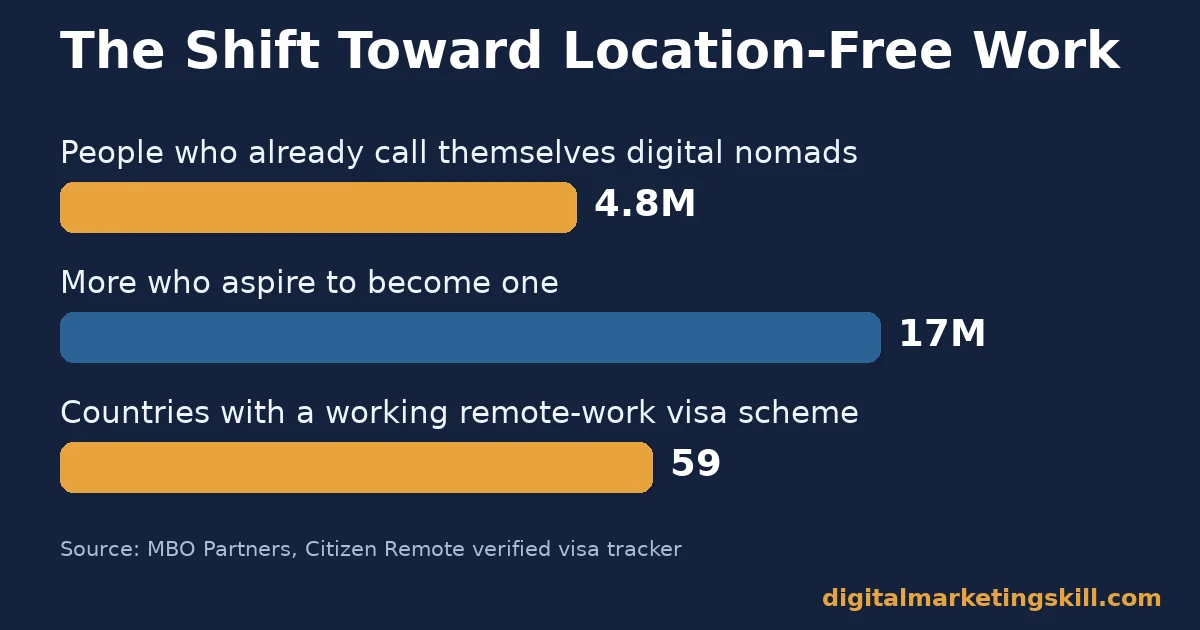
- About 4.8 million people already call themselves digital nomads, and another 17 million want to become one, per MBO Partners.
- A record 74.9 million Americans now earn income independently, per MBO Partners (US-only figure, but the shift toward independent, location-free work is a global trend).
- At least 59 countries run a working digital nomad or remote work visa scheme, per Citizen Remote’s verified tracker, which excludes visas that exist on paper but cannot actually be applied for.
- More than six billion people are online worldwide, per DataReportal, so remote clients are not limited to any one country.
- The World Economic Forum finds nearly four in ten core workplace skills are expected to change within a few years, which rewards people who can learn a new tool quickly over people with one fixed specialty.
In this guide
- Why Most “Digital Nomad Skills” Lists Do Not Help You Choose
- How a Skill Becomes a Remote Income, Not Just a Hobby
- Which Digital Nomad Skill Should You Learn First
- What It Actually Costs to Get Started
- How to Know You Are Ready to Pitch a Remote Client
- The One Decision Rule Before You Book a Flight
- A Real Case: Scaling One Skill Across Borders
- Frequently Asked Questions About Digital Nomad Skills
- Your Next Step
Why Most “Digital Nomad Skills” Lists Do Not Help You Choose
Most lists of digital nomad skills name twenty or thirty jobs and stop there. Copywriting. Design. Coding. Virtual assistance. The list is accurate, but it answers the wrong question.
The real question is not “which skills can be done remotely.” Dozens can. The better question is narrower: “which skill can I prove I am good at, fast enough to fund my travel?” Ask that instead.
Ground Rules for This Guide
Every figure here names its source and report, not a calendar year, because remote-work data changes quickly. Nothing here is an income guarantee; results depend on your market, effort and starting skill. Treat every number as a snapshot, not a settled fact.
The gap this guide closes is simple. Pick one skill. Prove it remotely. Only then worry about which country to work from.
How a Skill Becomes a Remote Income, Not Just a Hobby
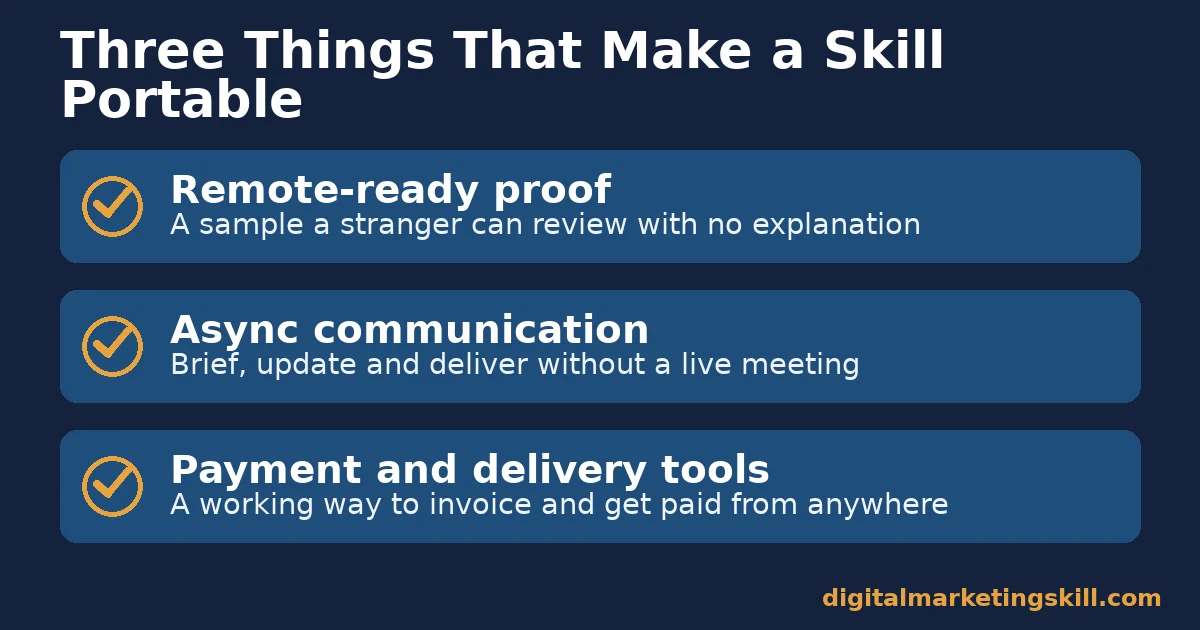
A skill only pays while you travel if a client can verify it without meeting you. That verification happens through three things working together.
Remote-Ready Proof
First, remote-ready proof: a portfolio, a recorded call, or a shared document a stranger can review in minutes. A skill you can only demonstrate in person is not yet a digital nomad skill, no matter how good you are at it.
Async Communication
Second, async communication: the ability to brief, update and deliver without a live meeting, across time zones. Clients hiring remote workers filter out people who need constant real-time check-ins, because time zones make that expensive for everyone.
Payment and Delivery Tools
Third, you need the tools to get paid and deliver work from anywhere. That means an international payment method, a reliable laptop setup, and a habit of backing up your work. None of this is glamorous. Skipping it is why some skilled people never actually go remote.
Miss any one of the three and a real skill stays stuck as a local job. Build all three around one skill, and that skill becomes location-independent.
A Worked Example: Two Writers, Same Skill
Here is an illustrative, invented example. Two people both learn content writing over the same three months. The first writes articles for a local blog and never leaves their city. The second writes two articles for a client in a different country, delivers everything by email, and gets paid through an online payment tool.
Both people can write well by the end of the three months. Only the second person has proven the three things that make a skill portable. Those are a reviewable sample, async delivery, and working payment. When a remote client compares the two, only the second writer looks nomad-ready on paper.
This gap is why some genuinely talented people stay stuck doing local work for years. They have the skill. They have never tested whether the skill travels.
Which Digital Nomad Skill Should You Learn First
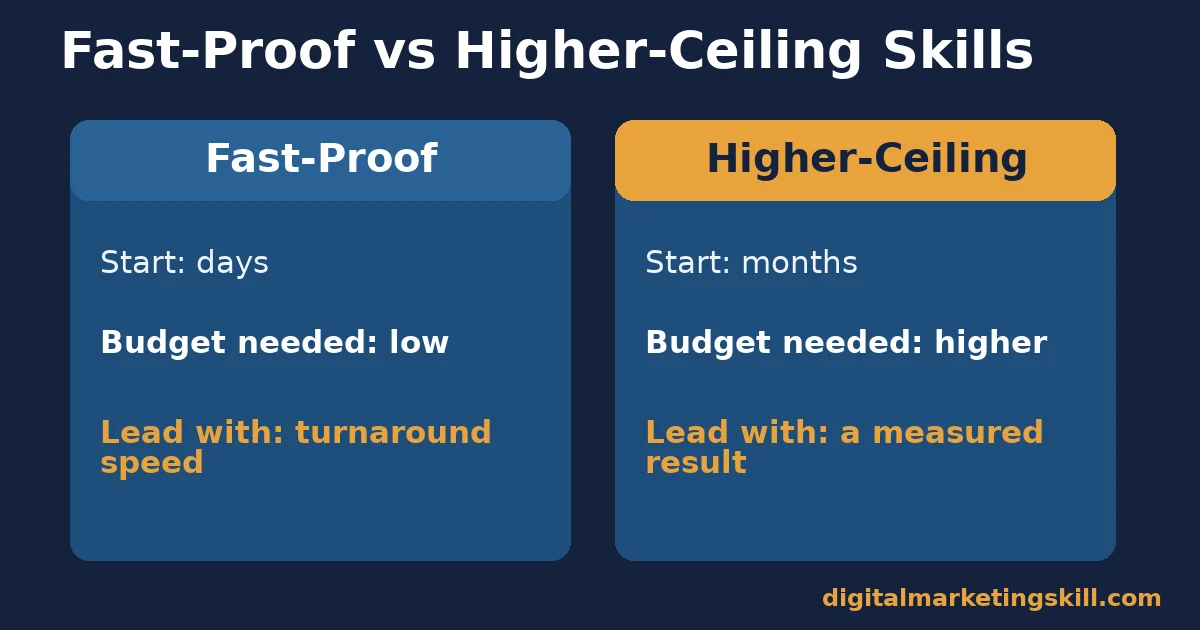
Instead of ranking thirty jobs, sort them by two things. How fast can you get your first paid proof? And how much budget does a client need to hire you?
Fast-Proof Skills: Built for Getting Paid Quickly
Content writing, virtual assistance, data entry, transcription and proofreading need almost no budget from a client. They also need very little setup from you. A first paid gig can happen within days of building a small sample.
The trade-off is pay per hour: these skills are easy to start, which means more competition and lower starting rates. US data from Payscale puts median freelance writer pay around $30 an hour, with the top 10% earning closer to $50 (US-only figure; rates vary a great deal by country and niche). They are a strong entry point, not usually a long-term ceiling.
Higher-Ceiling Skills: Built for Bigger Budgets
Digital marketing, SEO, paid-ads management, web development and marketing consulting take longer to reach a sellable standard. US web developers earn a median wage over $92,000 a year, per the Bureau of Labor Statistics. That figure is US-only. It is offered here only to show the pay gap between entry skills and higher-ceiling digital nomad skills, not as a global promise.
Clients expect a measurable result here, not just finished work. In exchange, the pay ceiling is much higher once you can show that result.
These skills reward people willing to spend a few months building one strong proof point before they pitch their first client.
You Can Mix the Two
Many successful digital nomads do not pick only one lane forever. They start with a fast-proof skill to fund the first months of travel. Then they build a higher-ceiling skill alongside it, using the income from the first to buy time for the second.
This sequencing matters more than people expect. Trying to learn a higher-ceiling skill with zero income cushion adds pressure that slows learning down. A small, steady fast-proof income removes that pressure.
You do not need to master both skills at once. Treat the first as a bridge, not a final destination, unless you grow to enjoy it on its own. Many people who start in transcription or virtual assistance later move fully into digital marketing once their second skill overtakes the first in pay.
Fast-Proof Skills: Lead With Turnaround Speed
If you start with a fast-proof skill, lead with turnaround time and reliability. That is what clients pay for at this price point. “I deliver clean transcripts within 24 hours” beats a long list of software you know.
Higher-Ceiling Skills: Lead With a Measured Result
If you start with a higher-ceiling skill, lead with a number instead: a traffic increase, a cost-per-click reduction, or a conversion-rate lift from a real or realistic test project. A client paying more expects to see what that spend bought last time.
What It Actually Costs to Get Started
Money matters here too, not just skill. Most digital nomad skills share a small, similar startup kit. You need a laptop, stable internet access, one or two paid tools for your chosen skill, and a profile on a platform where clients look for help.
Low-Cost Entry Skills
Writing, virtual assistance, transcription and data entry need almost no paid tools beyond what you likely already own. Your main cost is time spent building a sample strong enough to show a stranger.
Higher-Cost Entry Skills
Design, video editing, web development and paid-ads management usually need one or two paid software subscriptions before you can produce client-ready work. Budget for that software as a real cost, not an afterthought, when you plan your transition timeline.
Either way, the startup cost is small next to a university degree or a storefront business. That low barrier is exactly why competition is real. It is also why the proof points in this guide matter so much.
How to Know You Are Ready to Pitch a Remote Client
Three checkable signals tell you whether a skill is ready to travel with you, instead of relying on confidence alone.
Sample Strength
Sample strength. Can a stranger understand what you did and why it worked from your sample alone, with no verbal explanation? If you have to talk someone through it, it is not remote-ready yet.
Time-Zone Flexibility
Time-zone flexibility. Have you actually delivered work on a different schedule than your own daytime hours, even once? This is easy to assume and hard to prove until you have tested it.
Payment Readiness
Payment readiness. Do you have a working way to invoice and receive international payment today, not “eventually”? Clients move on quickly if payment setup becomes their problem to solve.
Track all three before you apply for remote work, not just the skill itself. A strong sample with no payment method ready still delays your first paycheck by weeks.
Why Measuring All Three Together Matters
Each signal alone is weak. A great sample with no payment method ready is just a hobby. Proven time-zone flexibility with no sample to show is just a claim. Payment readiness with neither of the other two is just an empty bank account waiting for work.
Put together, the three signals form a simple test. Can a stranger see your work, trust that you will deliver on their schedule, and pay you without friction? When the answer to all three is yes, one of your digital nomad skills is ready to travel.
Where to Find Your First Remote Client
Start close to home before you start global. Ask your current network, former colleagues or local small businesses whether they need help with your chosen skill, delivered remotely. A known contact who pays you once, remotely, counts as real proof.
From there, freelance marketplaces and niche online communities for your specific skill are usually faster than cold outreach to strangers. Build one strong profile, with the sample you already created, instead of spreading yourself across five half-finished ones.
Common Mistakes That Slow This Down
The most common mistake is applying before the sample exists. A profile with no work attached rarely converts, no matter how good the pitch text is.
The second common mistake is pricing too low out of fear. A very low price signals low confidence to a remote client. It also attracts the clients least likely to pay reliably. Price for the value of the result, not for the hours it took you personally to learn the skill. This single change in mindset is often what separates hobbyists from people who make real money from digital nomad skills.
The third mistake is skipping the payment and tax setup until a client asks for it. Sort out how you will invoice, receive payment and handle taxes before you pitch anyone, so a real opportunity never stalls on paperwork.
The One Decision Rule Before You Book a Flight
Apply this rule before committing to the digital nomad lifestyle: do not leave a stable income until one of your digital nomad skills has paid a real client at least twice, on two separate projects, without you being in the same room as them.
Here is an illustrative, invented example. Say you have learned content writing and have one local client. That is not proof yet, because “local” and “remote” are different skills. Instead, find a second client overseas, communicate only by email and video call, and deliver without meeting them. Two remote payments, from two different clients, is real proof. One local client is not.
A Real Case: Scaling One Skill Across Borders
Olajire Jacob, a Digital Marketing Skill Institute graduate, described charging an average of $500 to set up email-marketing flows for clients across the US, UK and Canada, all managed remotely, as shared in the Institute’s published student reviews. He later expanded that single skill into a $5,000-a-month service.
The detail worth noting is not the dollar figure, which will differ for everyone. The real point is that the entire service was delivered without being in the same country as any client. That is what makes a skill a genuine digital nomad skill, rather than just a remote-friendly hobby.
Results like this are not typical and are not guaranteed. They depend on the person’s market, effort and starting point. Read the Institute’s earnings disclaimer for full context before treating any single story as a predictor of your own outcome.
Frequently Asked Questions About Digital Nomad Skills
What is the single most useful digital nomad skill to learn first?
There is no universal answer, but digital marketing is a strong starting point. It combines writing, data and client communication into one skill set. Many businesses already have a budget set aside for it, which makes the first sale easier than in a newer, less understood field.
Do I need a degree to build digital nomad skills?
No. Clients hiring remote workers care about a sample they can review and a track record of delivering on time, far more than where or whether you studied formally.
How long does it take to build a digital nomad skill people will pay for?
It varies by skill. Fast-proof skills can produce a first paid gig within days of a strong sample. Higher-ceiling skills, such as SEO or paid ads, usually need a few months of practice before the proof is strong enough to pitch confidently.
Is 30, 40 or 50 too old to start learning digital nomad skills?
No. Clients care about your sample and your reliability, not your age. People across every age group successfully build location-independent skills; what matters is proof, not years of experience in any one format.
Which digital nomad skills are hardest to automate with AI tools?
Skills that combine strategy with judgment are harder to automate than purely mechanical tasks. Marketing consulting, client relationship management and complex problem-solving fall into this category. Even so, people who can direct AI tools well inside any skill tend to stay ahead of people who ignore those tools entirely. The safest position is not avoiding AI tools; it is learning to use them well inside a skill a client still trusts a human to own.
Do I need a digital nomad visa to start working remotely?
Not always. Visa rules vary by country and by how long you plan to stay. Always check the specific requirements for wherever you plan to be, rather than assuming one country’s rules apply everywhere. A growing number of countries now offer a formal visa route built for exactly this kind of work, which makes the paperwork simpler than it was a few years ago.
Can I build digital nomad skills while still working a full-time job?
Yes. Most people build their first remote proof points on evenings and weekends. A small side project or a discounted first client is enough to start. Keep your main income source until your digital nomad skills have paid twice, as the decision rule above recommends.
Do digital nomad skills work the same way for a complete beginner?
Yes, with one adjustment: spend more time on the sample before you pitch anyone. A beginner’s first sample often needs two or three honest revisions before it is strong enough to show a stranger. That extra round is normal, not a sign you picked the wrong skill.
Should I pick a skill based on what pays the most right now?
Not entirely. The highest-paying skill today may shift as tools and client budgets change. Pick a skill you can stay motivated to practise for months, inside one of the two categories above, and let the proof points guide your pace rather than chasing whichever skill looks hottest this week.
Your Next Step
If you want a structured way to build a genuine digital nomad skill, with direct coaching and a real internship instead of a simulated one, look at the Master Diploma in Digital & AI Marketing at the Digital Marketing Skill Institute.
It is built around four AI-powered tracks: AI-Powered Social Media Management and Advertising, AI-Powered Lead Generation and Email Automation, AI-Powered Google Specialist, and AI-Powered WordPress and SEO Specialist, totalling ten courses, with a Full Stack option for learners who want all four.
The program includes unlimited one-on-one coaching and mentoring, a U.S. Project Internship with a verified U.S. Work Reference Letter, and dual US and UK accreditation recognised in more than 100 countries. It is delivered 100% online, so you can build and prove your skill from anywhere in your country.
Review real outcomes on the student reviews page, compare the tracks on the Master Diploma program page, browse more guides on the blog, and when you are ready, apply here. Wherever you live, the right digital marketing skill travels with you, and you can start proving it today at the Digital Marketing Skill Institute.
Every figure in this guide was checked against its original source before publication. Figures marked as illustrative are invented examples, not real results.
