A brand collaboration is when two or more brands work together on a product, campaign, piece of content or event, so each reaches the other’s audience. The best collaborations pair brands that share customers but sell different things, like Taco Bell and Doritos, whose Doritos Locos Taco sold more than a billion units in its first year. Small businesses can use the same idea: a local café and a bakery, a fitness coach and a meal-prep brand, or a designer and a printer. A good brand collaboration gives both sides new customers for far less than advertising would cost.
This guide shows six collaborations that worked, the main types, how to find and pitch a partner and how to measure results. For the bigger picture, see our glossary entries on co-marketing and partnership marketing.
Key Takeaways
- Taco Bell launched the Doritos Locos Taco with Frito-Lay in 2012 and sold more than a billion units in the first year, according to Rutgers University.
- The launch was so popular that Taco Bell hired an estimated 15,000 extra workers to keep up.
- Spotify and Uber launched in-ride music in 10 cities, giving each brand a new reason for customers to use the other.
- IKEA and the LEGO Group spent around two years developing their BYGGLEK storage range before launch.
- The common thread is a shared audience and a product or experience neither brand could offer alone.
In this guide
- What Most Lists of Brand Collaborations Miss
- How Brand Collaborations Work
- Types of Brand Collaboration
- Six Brand Collaboration Examples
- Brand Collaboration Ideas for Small Businesses
- How to Plan a Brand Collaboration: Seven Steps
- How to Pitch a Partner
- What to Put in a Collaboration Agreement
- Common Brand Collaboration Mistakes
- How to Measure a Brand Collaboration
- The One Rule for Brand Collaborations
- An Illustrative Case
- Frequently Asked Questions About Brand Collaboration
- Your Next Step
What Most Lists of Brand Collaborations Miss
Most round-ups celebrate famous logos side by side. That makes collaborations look like a big-brand game. In reality, the logic works at any size. A collaboration simply lets you borrow trust: the partner’s customers already like them, so they are more open to you.
Lists also skip the hard part. Behind every successful collaboration is careful planning on who does what, who pays for what and how success will be measured. The Doritos Locos Taco, for example, took years of product development. Without that groundwork, many collaborations fizzle into one shared post that nobody remembers.
Finally, fit matters more than fame. A partner with a small but closely matched audience usually beats a big name whose customers would never buy from you.
How Brand Collaborations Work
Every collaboration has three parts.
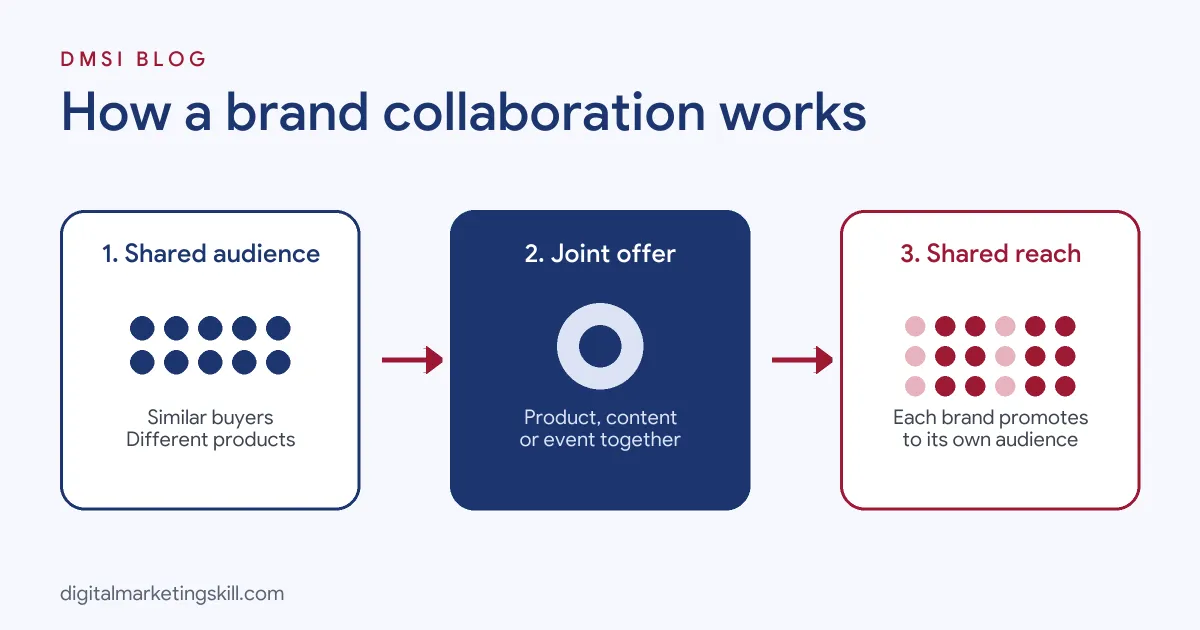
- A shared audience: both brands sell to similar people, but not the same product, so they are not competing.
- A joint offer: something new that exists because of the partnership, such as a product, bundle, piece of content or event.
- Shared promotion: each brand promotes the offer to its own customers, so both reach new people.
The best partnerships feel natural to customers. When people react with “of course those two belong together”, the collaboration has done half its job before launch.
Types of Brand Collaboration
Co-Branded Product: Built for Sales
A new product carrying both brands, like Doritos Locos Tacos or IKEA’s BYGGLEK. High effort, but it can create something customers cannot get anywhere else.
Product Integration: Built for Convenience
One brand’s service works inside the other’s, like Spotify music in Uber rides. It adds value to both without a new physical product.
Content Collaboration: Built for Reach
Joint videos, guides, webinars or Instagram Lives. Low cost and ideal for small businesses and creators.
Event or Experience: Built for Community
Pop-ups, workshops and events run together, sharing venue costs and guest lists.
Cause Partnership: Built for Purpose
A brand works with a charity or social cause, sharing a message both care about. It must be genuine, or customers will notice.
Creator Collaboration: Built for Trust
A brand partners with a creator on a product line or campaign. Read more in our guide to influencer marketing.
Six Brand Collaboration Examples
| Brands | Collaboration | Type | Lesson |
|---|---|---|---|
| Taco Bell and Doritos | Doritos Locos Tacos | Co-branded product | Combine two things fans already love |
| Spotify and Uber | Your music in your ride | Product integration | Make each service better together |
| GoPro and Red Bull | Extreme sports content | Content collaboration | Share a lifestyle, not just a logo |
| IKEA and LEGO | BYGGLEK storage | Co-branded product | Solve a real problem together |
| Local café and bakery | Breakfast bundle | Small business bundle | Small partners can share customers too |
| Coach and meal-prep brand | Joint 30-day challenge | Content and offer | Combine expertise and product |
1. Taco Bell and Doritos
Taco Bell worked with Frito-Lay, which makes Doritos, to create a taco shell made with Doritos flavour. It launched in 2012. According to Rutgers University, which profiled one of the food scientists behind it, Taco Bell sold more than a billion units in the first year and hired an estimated 15,000 workers to keep up. The idea worked because both brands had overlapping fans who loved bold, snackable food.
2. Spotify and Uber
In 2014, Spotify and Uber let riders connect their accounts and play their own music during trips in Spotify-enabled cars, starting in 10 cities, including London. Uber gave riders a more personal experience, and Spotify reached people in a new setting. Neither had to build anything outside its strengths.
3. GoPro and Red Bull
Both brands are built on adventure and extreme sport. GoPro cameras captured Red Bull events, and the footage drew huge audiences on both brands’ channels. In 2016, the two announced a wider content and distribution partnership. The lesson is that shared values and a shared lifestyle can be the core of a partnership.
4. IKEA and LEGO
After around two years of development, IKEA and the LEGO Group launched BYGGLEK in 2020, storage boxes with LEGO studs on top so children could build, play and store their creations. It solved a real problem for parents, mess, using each brand’s expertise: IKEA’s storage and LEGO’s play.
5. A Local Café and Bakery (Illustrative)
A café without its own pastry chef partners with a nearby bakery. The café sells the bakery’s pastries in a breakfast bundle with coffee, credits the bakery on its menu and social posts, and the bakery promotes the café to its customers. Both get new customers with no ad spend.
6. A Fitness Coach and Meal-Prep Brand (Illustrative)
A coach runs a 30-day challenge, and a meal-prep brand offers participants a discount code. They host joint Instagram Lives each week. The coach gets a valuable bonus for members, and the brand reaches motivated buyers.
Brand Collaboration Ideas for Small Businesses
- Bundle: combine products with a partner into a gift box or package deal.
- Giveaway: run a joint prize draw where entrants follow both accounts. Follow each platform’s promotion rules.
- Takeover: swap Instagram Stories for a day so each audience meets the other brand.
- Guest content: write a blog post, newsletter section or video for each other.
- Workshop: teach a class together, such as a florist and a photographer teaching phone photography of flowers.
- Referral swap: recommend each other to customers, with a discount code to track results.
- Limited edition: a small run of a product made together, such as a candle scented with a local café’s coffee.
How to Plan a Brand Collaboration: Seven Steps
- Set your goal. New customers, email sign-ups, sales or awareness. One main goal keeps decisions simple.
- Describe your ideal partner. Same customers, different product, similar values and quality.
- Make a shortlist. Look at brands your customers already follow, tag or mention. Check their engagement, not just follower count.
- Design the offer. Decide what the collaboration is: bundle, content, event or product.
- Agree the details in writing. Who does what, costs, timelines, how customer data is handled, who owns the content and how you split revenue.
- Plan joint promotion. Agree dates, posts, emails and tracking links for both sides.
- Review together. Share results honestly, and decide whether to repeat or change the partnership.
How to Pitch a Partner
Keep your first message short and focused on their benefit. A simple structure works well:
- Who you are: one line about your brand and your audience.
- Why them: show you know their brand and why your customers overlap.
- The idea: one clear collaboration idea, with what you will contribute.
- What they get: new customers, content, sales or reach.
- Next step: suggest a short call or ask a simple question.
For example: “Hi Sam, I run Leaf & Loaf, a plant-based bakery with 6,000 local followers. Many of our customers also love your yoga studio. Could we run a Saturday brunch-and-stretch session together next month? We will cover the food and promote it to our list. Free for a 15-minute call this week?”
What to Put in a Collaboration Agreement
You do not need a long legal document for a small collaboration, but you do need clarity. A one-page agreement, signed or confirmed by email, should cover:
- Scope: what you are creating together and what each side provides.
- Timeline: key dates for content, launch and wrap-up.
- Promotion: how many posts, emails or Stories each side will share, and when.
- Money: who pays which costs and how any revenue is split.
- Content rights: who can reuse photos, videos and copy, and for how long.
- Customer data: who collects email addresses, and how both sides follow privacy rules such as consent for marketing.
- Disclosure: how paid or gifted elements will be labelled, so you stay within advertising rules.
- Exit: what happens if one side needs to pull out.
Agreeing these points early protects the relationship as much as the business. Most collaboration disputes come from different assumptions, not bad intentions.
Common Brand Collaboration Mistakes
Choosing a Partner for Size, Not Fit
A big partner with the wrong audience brings few real customers. Fit beats fame.
No Written Agreement
Unclear roles and money cause disagreements. Write down who does what, even for small projects.
Uneven Effort
If one side promotes heavily and the other barely posts, trust breaks down. Agree the promotion plan up front.
No Tracking
Without separate codes or links, you cannot tell which side drove results.
Off-Brand Ideas
A collaboration that does not suit either brand confuses customers. It should feel natural.
How to Measure a Brand Collaboration
- New customers: use a unique discount code or link for each partner’s audience.
- Sales or sign-ups: revenue or leads from the collaboration offer.
- Audience growth: new followers and email subscribers during the campaign.
- Engagement: comments, shares and saves on joint content.
- Cost per customer: total costs divided by new customers, compared with your usual customer acquisition cost.
The One Rule for Brand Collaborations
Partner with brands your customers already love, and create something neither of you could offer alone. If the collaboration gives customers genuine value and feels natural for both brands, the promotion largely takes care of itself.
An Illustrative Case
Imagine a small Lagos jewellery brand and a local fashion photographer. Both target young professionals who care about style. The jeweller struggles with product photos, and the photographer wants more portfolio work and clients.
They agree a simple collaboration: the photographer shoots a styled campaign featuring the jewellery for free, and both brands post the images, tagging each other. The jeweller offers a 10% code to the photographer’s followers, and the photographer offers a discounted portrait session to the jeweller’s customers. They agree everything in a short written note.
Over the following month, both gain new followers, the jeweller sees orders using the photographer’s code and the photographer books new sessions. They plan a second shoot for the festive season. This case is an illustrative example, not a real result.
Frequently Asked Questions About Brand Collaboration
What is a brand collaboration?
It is when two or more brands work together on a product, campaign, content or event to reach each other’s audiences.
What is an example of a successful brand collaboration?
Taco Bell and Doritos created the Doritos Locos Taco, which sold more than a billion units in its first year.
How do I find a brand to collaborate with?
Look at brands your customers already follow and buy from, with a similar audience but a different product.
Can small businesses do brand collaborations?
Yes. Bundles, joint giveaways, Story takeovers, guest content and workshops are low-cost options.
What is the difference between a collaboration and sponsorship?
In a sponsorship, one brand pays to appear with another. In a collaboration, both brands contribute and share the benefits.
Do I need a contract for a brand collaboration?
A written agreement is wise, even for small projects. It should cover roles, costs, timelines, content rights and revenue.
How do I measure a collaboration’s success?
Use unique codes or links to track new customers and sales from each partner, and compare costs with your normal marketing.
What makes a collaboration fail?
Poor fit between audiences, unclear roles, uneven promotion and no way to measure results.
How long should a brand collaboration run?
Short campaigns of a few weeks are easiest to start with. If results are good, plan a longer or repeat partnership.
Your Next Step
Planning, pitching and measuring brand partnerships draws on content, social media, email and analytics skills. The Master Diploma in Digital & AI Marketing at Digital Marketing Skill Institute covers four tracks: Social Media Management and Advertising, Lead Generation and Email Automation, Google, and WordPress and SEO.
From day one, you work on a real U.S. company’s project through the U.S. Project Internship, so you finish with real results and a verified U.S. work reference letter. You also get unlimited one-on-one coaching. The program carries dual US and UK accreditation, is recognised in more than 100 countries, and runs 100% online over three months.
You can build those skills wherever you live, anywhere in your country. Read student reviews, then apply for the 65% partial scholarship to see if you qualify.
Every figure in this guide was checked against its source before publication: Rutgers University, press coverage of the Spotify and Uber launch, Tubefilter on GoPro and Red Bull, and IKEA’s newsroom. Examples 5 and 6 and the case above are illustrative examples, not real results.