A Facebook traffic strategy works when you match content to a clear goal. Organic posts build trust over weeks. Paid ads buy speed in days. Groups turn strangers into repeat visitors. Most businesses blend all three but measure none of them, so clicks stall. This guide shows the mix that moves traffic, and the numbers to track it.
Key Takeaways
- Organic Facebook Page posts now reach a median of about 0.063% of followers per post, according to Rival IQ’s social media benchmark report. An organic-only Facebook traffic strategy rarely moves a website on its own.
- DataReportal’s global survey found that 56.3% of internet users aged 16 and over say they used Facebook in the past month. The platform still carries real traffic potential despite falling organic reach.
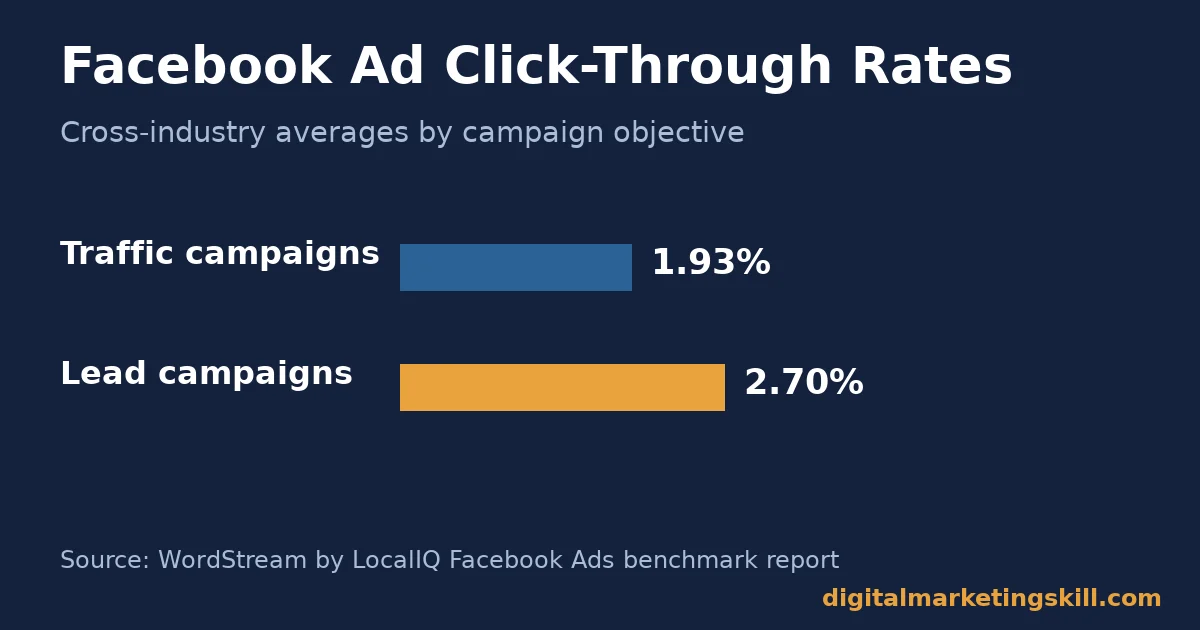
- WordStream by LocalIQ’s advertising benchmark data puts the average click-through rate for Facebook traffic-objective ads at 1.93%, and lead-objective ads at 2.70%. Average cost per click sits near $0.60 and $1.80.
- BrightLocal’s consumer review research found that 97% of people read reviews before choosing a business, and 85% say positive reviews make them more likely to use one. Social proof belongs inside a Facebook traffic strategy, not beside it.
- One named decision rule (below) tells you where to spend the next hour: organic content, paid ads, or a group. The choice depends on how fast you need traffic and how much budget you have.
In this guide
- The Gap Most Facebook Traffic Strategies Miss
- How Facebook Decides What Reaches a Visitor
- What a Facebook Traffic Strategy Looks Like By Channel
- How To Lead With the Right Channel For Your Goal
- Measuring a Facebook Traffic Strategy That Works
- The One Decision Rule For Where To Put Your Next Hour
- A Real Case: What Happened When the Content Changed
- Frequently Asked Questions About Facebook Traffic Strategy
- Build Your Facebook Traffic Strategy With the Right Training
The Gap Most Facebook Traffic Strategies Miss
Search any guide to Facebook marketing. You will find the same advice: post consistently, use eye-catching images, run some ads. That advice is not wrong. But it treats Facebook as one channel with one goal.
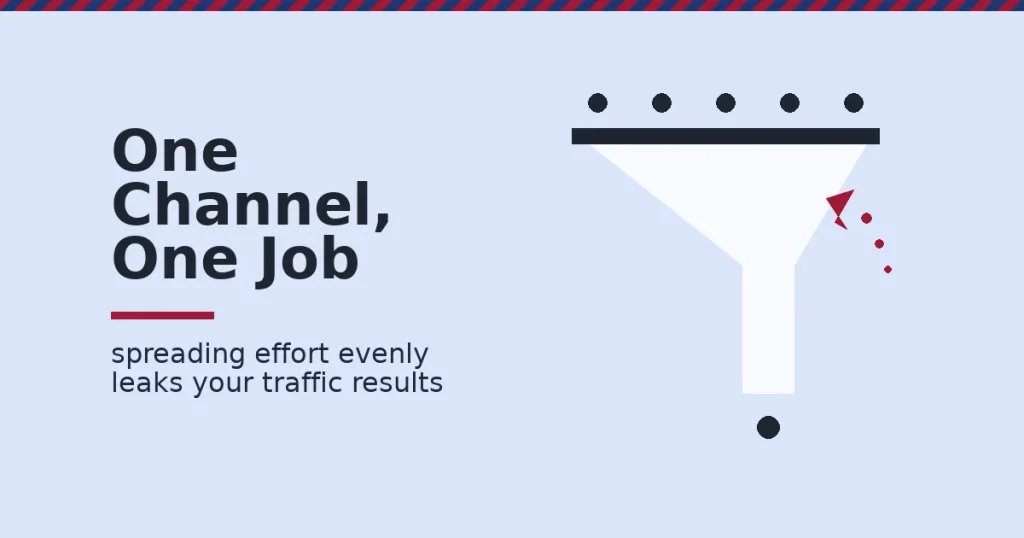
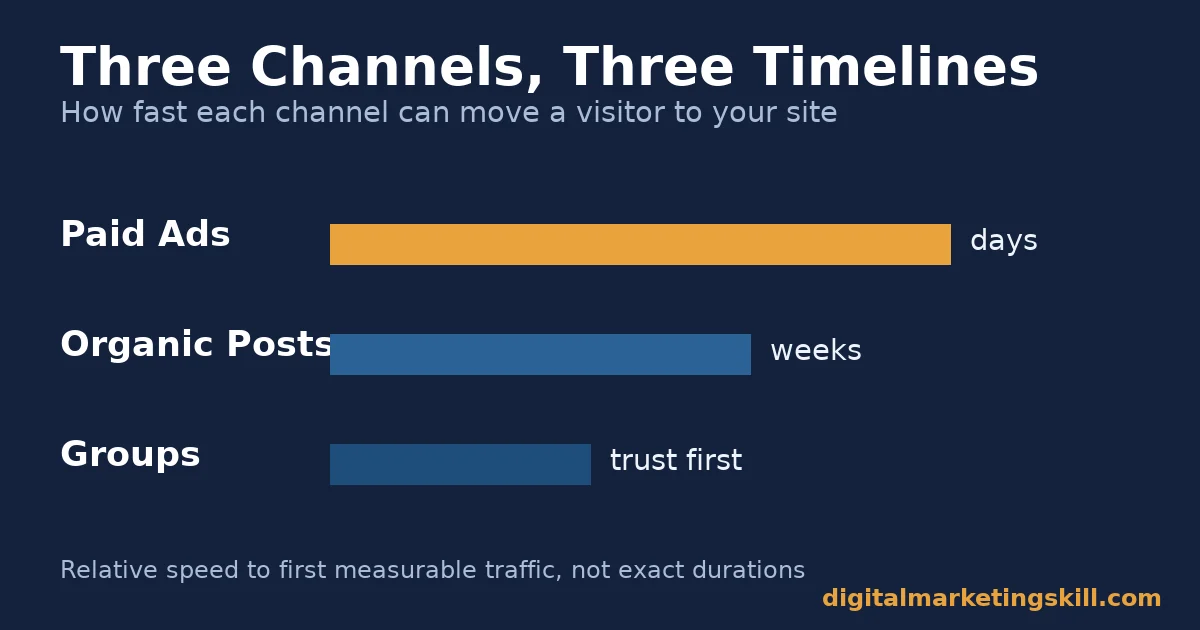
In practice, Facebook is three different channels. Organic Pages, paid ads, and Groups each move at a different speed. Each costs something different. Each earns a different kind of trust. A Facebook traffic strategy that ignores those differences spreads effort evenly across all three. The result is a mediocre outcome from each one.
Two ground rules before the detail. First, this is an informed approach built from public benchmarks and documented platform behaviour, not a guarantee. Every account’s results depend on its audience, niche, and budget. Second, algorithms and ad costs shift constantly. Treat the figures here as a snapshot of current reported ranges, not a permanent ranking. Re-check your own account’s Insights data every few months rather than trusting any single benchmark forever.
Keep a simple running log of each channel’s numbers in one place. Without that log, it is easy to remember the one post that did well and forget the ten that did not, which quietly skews an entire Facebook traffic strategy toward the wrong channel.
How Facebook Decides What Reaches a Visitor
Before you build a working Facebook traffic strategy, it helps to know what the Feed is actually doing. For the tactics that work alongside it, see this guide to ways to increase website traffic.
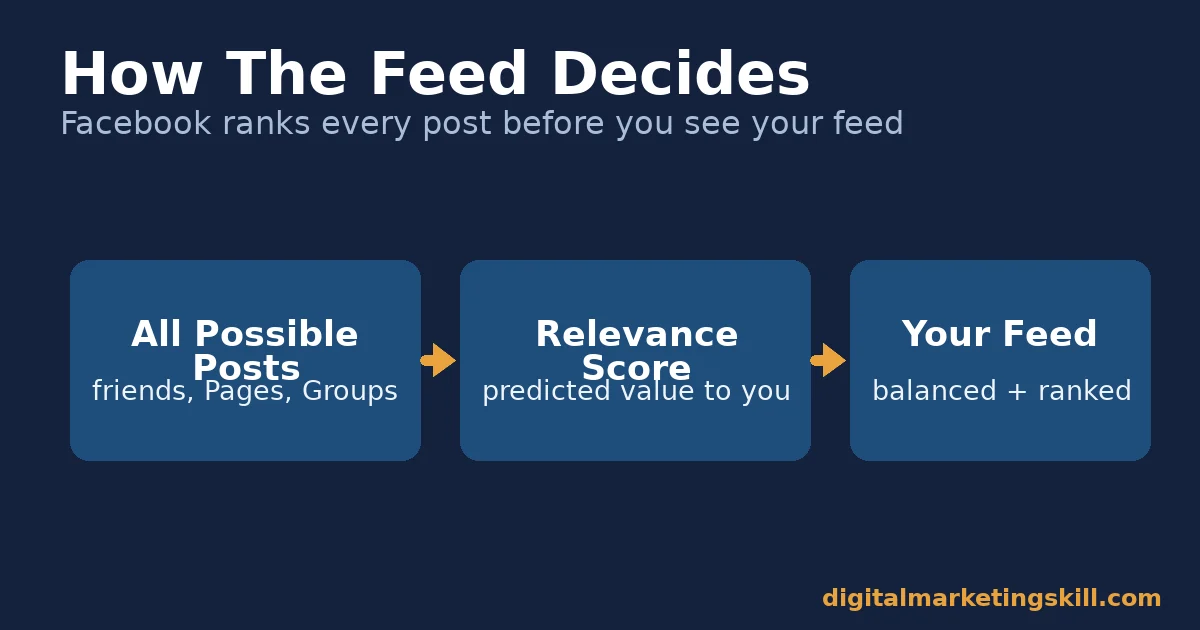
Meta’s own Transparency Center describes Facebook Feed ranking as a short series of steps. First, the system gathers everything you could possibly see: posts from friends, Pages you follow, and Groups you have joined. Next, it calculates a relevance score for each item, based on predicted value to you. Finally, it arranges your Feed to balance that connected content with recommended posts from accounts you do not follow.
Nothing in that process rewards a Page simply for existing, or for posting often. It rewards content a specific viewer is predicted to want.
Why the First Hour Decides So Much
That single fact explains most of the frustration business owners feel with Facebook. A post that gets no reaction in its first hour is read by the system as low-value. It then gets shown to fewer people afterward. Meta’s own notes on its approach to Feed ranking stress early, genuine engagement over total follower count.
Picture two Pages that each publish a post at the same time. One gets five comments in the first thirty minutes, because it asked a direct question its audience actually cares about. The other gets none, because it is a plain announcement. Facebook’s system treats the first post as more valuable to show around, and the gap between the two only widens from there. So the lesson is not “post more.” It is “give the first viewers a reason to react quickly.”
This also explains why paid ads behave differently. An ad buys placement directly. It bypasses the organic relevance contest entirely. That is why ads can move traffic fast even when organic reach is flat.
What a Facebook Traffic Strategy Looks Like By Channel
Each of the three channels below can send visitors to a website. But each does it on a different timeline, at a different cost. Treat them as three separate tools, not three versions of the same tool. Picking one and ignoring the other two is not wrong on its own; picking one without knowing what the other two are good for usually is.
Organic Pages: Built For Discovery, Not Instant Clicks
An organic Facebook Page post is free to publish. But it competes for a shrinking share of attention. It works best alongside a clear content marketing strategy that decides what you post before you post it.
Rival IQ’s benchmark data puts the median engagement rate per post at roughly 0.063% of followers. A Page with 10,000 followers can expect only a handful of reactions, comments, and shares on a typical post. Organic content’s real job is not the click. It is the slow build of a recognisable brand that a stranger trusts the second or third time they see it. That trust later makes a paid ad, or a link shared in a group, feel familiar rather than cold.
Paid Ads: Built For Speed, Not Loyalty
A Facebook ad guarantees placement in exchange for budget. That makes it the fastest of the three channels for driving a measurable spike in website visits.
WordStream by LocalIQ’s benchmark report lists an average click-through rate of 1.93% and an average cost per click of $0.60 for website-traffic campaigns. That rises to a 2.70% click-through rate and $1.80 cost per click for lead-generation campaigns, with an average cost per lead of $27.39. Those averages span every industry from automotive to education. A specific niche can sit well above or below them.
The number worth comparing is your own account’s cost per click after a few hundred dollars of spend, not the industry average on day one.
Audience targeting is what separates a cheap click from a cheap, useless click. Narrow the audience by real interest or past behaviour rather than broad age and location alone, and the same budget tends to reach people more likely to act once they land on your site.
Groups and Communities: Built For Trust, Not Reach
A Facebook Group built around a shared problem, not a shared brand, earns a different kind of attention than a Page. Members have opted into a topic. A genuinely useful answer, or a well-placed resource link, reaches people who are already listening, even though the total audience is smaller than a Page’s follower count.
The tradeoff is time. A Group has to be moderated and contributed to like a real community. That is slower to build than organic posting or an ad campaign. But it produces the warmest clicks of the three. For what to do once those clicks land on your site, see this breakdown of how to convert website traffic into leads.
How To Lead With the Right Channel For Your Goal
Knowing what each channel is built for only matters if it changes what you do next. Here is how to lead with each one, once you have picked a goal for the month.
Organic Pages: Lead With Consistent Value
Organic reach rewards predicted value, not frequency. So lead with fewer, better posts rather than many average ones. Identify the three or four questions your audience asks most often. Answer one per post, in plain language, and link back to a page on your website that answers it in full. Post at a steady rhythm you can keep for months. Stopping and restarting a Page resets the trust signals the ranking system has built up about it.
Paid Ads: Lead With a Clear, Measurable Offer
An ad is bought attention. So lead with one specific offer and one destination page, not a general introduction to your business. A visitor who clicks a Facebook ad has already decided to look. The ad’s job is to set the right expectation, so the landing page can close the loop.
Test one variable at a time: the image, the headline, or the audience. Let each test run long enough to collect a meaningful number of clicks before you judge it. A full walk-through of setting one up correctly is in this guide to Facebook ad setup.
Groups and Communities: Lead With Participation
Lead with answering, not announcing. Spend most of your time in a Group responding to other members’ questions with real help. Only occasionally share a link to your own content, and only when it directly answers what was asked.
A Group that feels like a funnel loses members quickly. A Group that feels like a resource keeps them, and keeps sending them to your website over time. This approach pairs well with the direct outreach tactics in this guide to finding customers on Facebook.
Measuring a Facebook Traffic Strategy That Works
A Facebook traffic strategy is only as good as what you measure afterward. These are the KPIs worth tracking every week, each defined in one sentence:
- Click-through rate (CTR) is the share of people who saw a post or ad and clicked it. It tells you whether the content is interesting enough to act on.
- Engagement rate is reactions, comments, and shares divided by followers or by reach. It tells you whether the content is valuable enough to interact with.
- Referral sessions is the number of website visits your analytics tool credits to Facebook as the source. It tells you how much traffic really comes from the platform, rather than from people who saw a post and searched for your name later.
- Cost per click (CPC), for paid campaigns, is your ad spend divided by clicks received. It tells you what a single visit costs, so you can compare that against the value of an average customer.
- Conversion rate is the share of Facebook-referred visitors who complete the action you wanted, such as a sign-up or a purchase. It tells you whether the traffic is the right traffic, not just more traffic.
Read these five together, not alone. A high click-through rate paired with a low conversion rate usually means the ad promised something the landing page did not deliver. A low click-through rate paired with a high conversion rate usually means your targeting is narrow but accurate. The fix there is scale, not a new creative.
How Often to Check These Numbers
Check these numbers on a fixed schedule, such as every Monday, rather than only when results feel disappointing. A Facebook traffic strategy reviewed on a schedule catches a slow decline early, while one reviewed only in a panic tends to overreact to a single bad week.
The One Decision Rule For Where To Put Your Next Hour
With limited time, use this rule. If you need traffic within days and have budget, run a small paid ad test. Got weeks instead of days, and no budget? Invest in organic content that answers your three or four most-asked questions. When your audience is a tight-knit niche, build or join a Group before you do either.
Illustrative, invented numbers: imagine a small business with $300 to spend this month, and a launch happening in two weeks. Following the rule, they put $200 into a short paid-ad test aimed at one landing page, to buy the speed they need before launch. They spend the remaining time on one well-researched organic post that answers their audience’s top question, to build the trust that makes the ad’s click feel familiar rather than cold.
They skip starting a new Group. Two weeks is not enough time for a Group to earn trust before the launch date arrives. If the same business had three months instead of two weeks, the rule would point the other way: more time for organic content and a Group, less reliance on paid spend to create urgency that does not yet exist.
A Real Case: What Happened When the Content Changed
Among the stories published on the Institute’s own student reviews page, a pattern shows up again and again. Students who struggled to get traction from generic promotional posts saw a change once they switched approach. They started answering specific audience questions. They paired that content with a small, targeted ad, rather than boosting posts broadly.
In several cases, the same core article was reused across organic posts, a Group discussion, and a short ad test, each framed slightly differently for its audience, instead of being written once and never revisited. That reuse is worth noting, because it means a single piece of research-backed content, done well, can carry a Facebook traffic strategy across all three channels instead of starting from a blank page for each one.
The common thread across these stories is not one tactic. It is the shift from “post about the business” to “answer a real question, then point people to the website.” That is the same principle behind the organic and paid sections above. As with any student outcome, results vary by effort, niche, and market, and the Institute makes no income or results guarantees; see the earnings disclaimer for details.
None of this requires a large team or a large budget. It requires picking one real audience question, answering it properly in one place, and then sharing that answer through the channel that fits your timeline, rather than spreading thin effort across every channel at once.
Frequently Asked Questions About Facebook Traffic Strategy
Is Facebook still worth using to drive website traffic?
Yes, for most businesses. DataReportal’s research shows that more than half of the world’s internet users aged 16 and over used Facebook in the past month. That keeps the audience large even as organic reach per post has fallen.
How often should a business post on its Facebook Page?
Post as frequently as you can while keeping real quality. Do not chase a fixed number. A small set of genuinely useful posts, each answering a real audience question, beats a high volume of filler content.
What is a good click-through rate for a Facebook ad?
Benchmark data from WordStream by LocalIQ puts the cross-industry average around 1.93% for traffic campaigns and 2.70% for lead campaigns. Treat anything near or above those figures as healthy, and track your own account’s trend over time as the real target, since your niche may sit naturally above or below the cross-industry figure.
Do Facebook Groups actually send traffic to a website?
They can, but only when links are shared sparingly and only in direct answer to a member’s question. A Group used mainly for self-promotion tends to lose members, along with the trust that made its traffic valuable in the first place.
Should a small business run ads, post organically, or both?
Both, but not in equal measure. Use the decision rule above. Let urgency and budget decide the split between paid and organic effort for any given month, rather than splitting time evenly by default.
How do customer reviews affect a Facebook traffic strategy?
Strongly. BrightLocal’s consumer research found that 97% of people read reviews before choosing a business, and 85% say positive reviews make them more likely to use one. Sharing genuine reviews inside Facebook content gives a click a reason to convert once it lands on a website.
What should the destination page look like for a Facebook ad?
It should match the promise made in the ad exactly: the same offer, the same language, and one clear next step. A mismatch between ad and landing page is the most common reason a good click-through rate still produces a poor conversion rate.
How long does it take to see results from a Facebook traffic strategy?
A paid-ad test can show a signal in days, since it buys placement directly. Organic content and Group participation usually need several weeks of steady effort before the trust they build starts showing up as a dependable number of website visits. Judging either channel after a single post is too early to tell much.
Build Your Facebook Traffic Strategy With the Right Training
A Facebook traffic strategy works best as one piece of a wider digital marketing skill set. You need to understand the audience, the content, the ad platform, and the analytics behind all three. Digital Marketing Skill Institute’s Master Diploma in Digital & AI Marketing covers nine practical courses built around exactly that mix. It comes with unlimited one-on-one coaching and mentoring, plus real project work inside a U.S. company, so what you learn gets tested on a live account rather than a hypothetical one.
The program is dual US and UK accredited, and recognised in more than 100 countries. It is delivered 100% online, so you can study from your country on your own schedule.
Wherever you live, the fundamentals of a working Facebook traffic strategy stay the same: clear measurement, the right channel for the right goal, and content built around real audience questions. Explore the Master Diploma in Digital and AI Marketing program, browse more lessons on the digital marketing blog, or go straight to the application page to start. Learn more about Digital Marketing Skill Institute at https://digitalmarketingskill.com/, or return to https://digitalmarketingskill.com/ any time to explore other free lessons.
Every figure in this guide was checked against its original source before publication. Figures marked as illustrative are invented examples, not real results.
![9 Amazing Digital Marketing Skills to Make Money Online [With Proof]](https://digitalmarketingskill.com/wp-content/uploads/2019/07/9-Amazing-Digital-Marketing-Skills-to-Make-Money-Online-With-Proof-17.png)