Real estate marketing is the set of channels, search, social, email and referrals, that turns a buyer’s or seller’s attention into a closed transaction. Nearly every buyer starts that search online. The channel mix matters, but follow-up speed decides who actually gets the lead. This guide compares the main channels. It gives one decision rule, a measurement checklist, and a real case built from a single online lead.
Key Takeaways
- Internet use in home search is now close to universal. The National Association of Realtors’ Real Estate in a Digital Age report found 97% of buyers used the internet in their search. That is a US figure, and it keeps climbing each year it is measured.
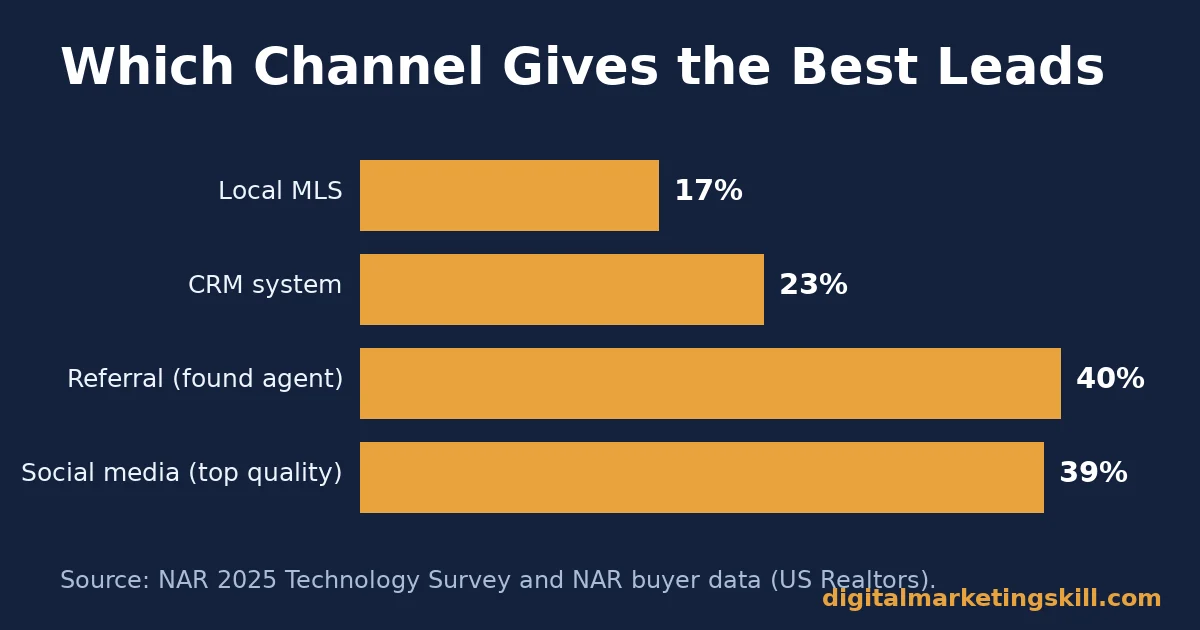
- Social media is the top source of quality leads for US Realtors. NAR’s 2025 Technology Survey, based on 1,241 responses from 49,233 invited Realtors, found 39% named social media their highest-quality lead source. CRM systems came next at 23%, then local MLS at 17%.
- Referrals still convert trust fastest. NAR data shows 40% of buyers found their agent through a friend, neighbour or relative.
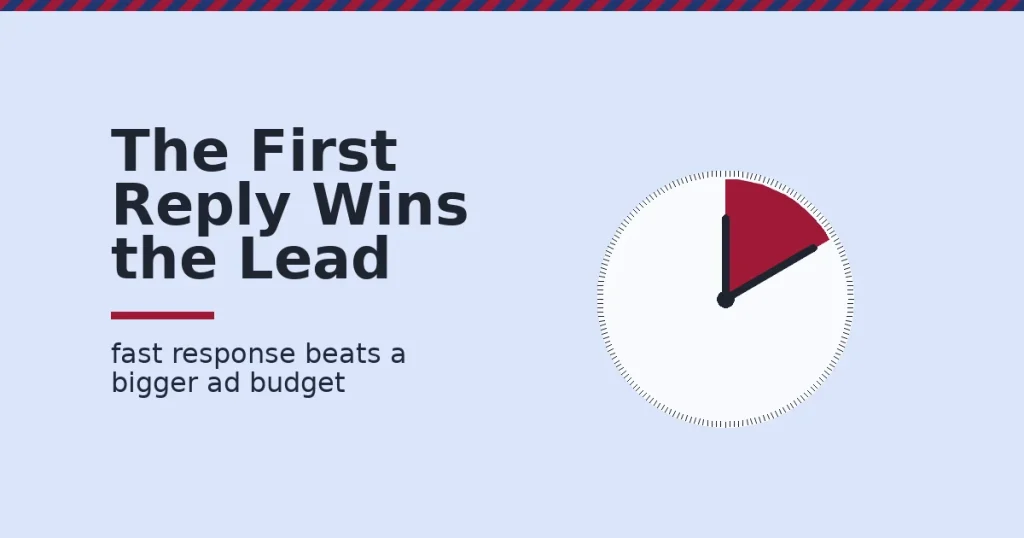
- Response speed changes outcomes more than most agents expect. Research from MIT Sloan and InsideSales.com found that contacting a lead within five minutes, instead of thirty, makes a company 21 times more likely to qualify that lead. The sample was US companies, and it measured qualification, not closed sales.
- A follow-up Harvard Business Review audit of 2,241 US firms found an average first-response time of 42 hours. 23% of companies never responded to a web lead at all.
In this guide
- What Most Real Estate Marketing Advice Skips
- How Real Estate Marketing Actually Works
- What Differs Between Real Estate Marketing Channels
- Most Buyers Search on a Phone, Not a Desktop
- How to Lead With Each Real Estate Marketing Channel
- How to Measure Real Estate Marketing Performance
- The One Decision Rule for Real Estate Marketing Spend
- A Real Case: One Online Lead, $1.54 Million in Transactions
- Frequently Asked Questions About Real Estate Marketing
- Where to Learn Real Estate Marketing Properly
What Most Real Estate Marketing Advice Skips
Most real estate marketing guides list channels: website, social media, email. Few explain why the order matters. Fewer still explain how fast you need to move once a lead appears. A channel list without a response plan wastes most of the leads it generates.
Two ground rules first. The figures here are mostly US data, because that is where the largest public research exists. The mechanics still apply anywhere, but treat exact percentages as a US benchmark, not a global constant. Second, a channel mix that works in a busy city will not automatically work in a small town. Test before you commit a full budget to one channel.
A third rule: these numbers describe averages across thousands of agents. Your own market, price point and audience will shift them. Use the figures to set a starting plan, then adjust based on what your own leads actually do.
None of this replaces local licensing, disclosure and advertising rules in your market. This guide covers the marketing mechanics, not the legal requirements, which vary by region and should come from your own licensing body, not a blog post.
How Real Estate Marketing Actually Works
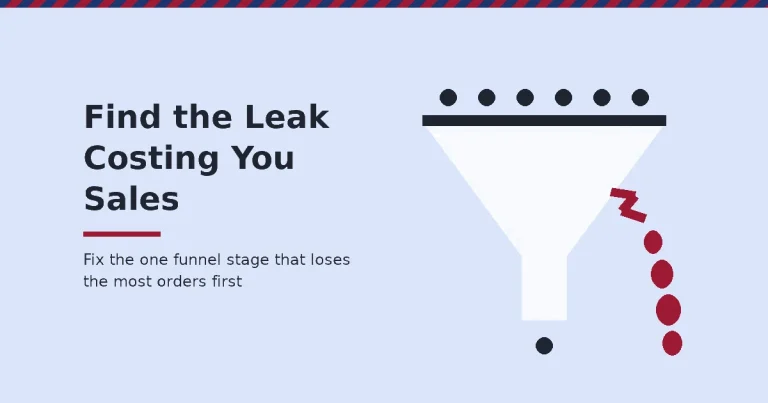
Real estate marketing has three jobs. Get found by someone searching. Earn enough trust that they reach out. Respond fast enough to keep that interest before a competitor does. Most agents spend their effort on the first job. Most underinvest in the third, even though the data says response speed carries as much weight as visibility.
A listing can rank well and look professional, and still lose the lead if nobody replies for two days. The HBR audit above found 23% of firms never reply to a web lead at all. Every one of those is a wasted marketing dollar, no matter which channel produced the lead.
This is partly a process problem, not a motivation problem. Leads arrive through different channels, at different times, often outside normal hours. Without a single place to catch them all, a form submission from a weekend open house can sit unread until Monday, by which point the buyer has likely called someone else.
Think of the three jobs as a chain. Visibility without trust gets ignored, and trust without a fast response gets lost to the next agent. Spending more on one channel rarely fixes this: fix the chain’s weakest link first, then add budget to whichever link already works.
What Differs Between Real Estate Marketing Channels
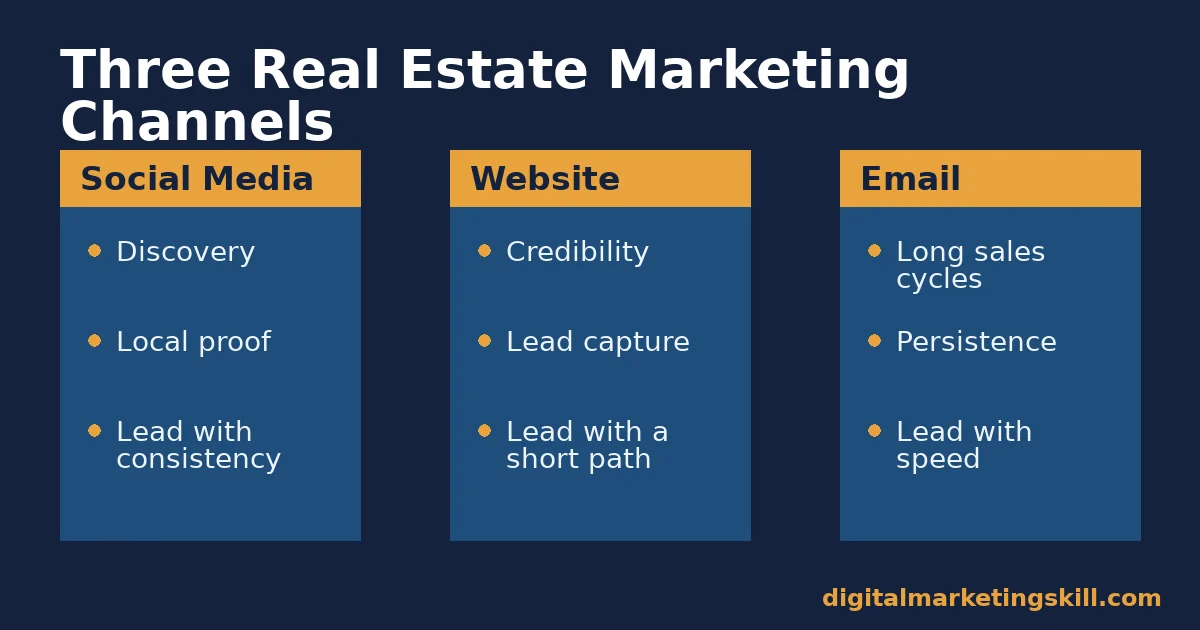
Three channel groups cover most of a real estate marketing plan: social media, your own website, and email or direct follow-up. Each earns attention in a different way. None works well alone: social media without a website sends an interested stranger nowhere to learn more, and email without either has nothing fresh to follow up about.
Social Media: Built for Discovery and Local Proof
Social media is where people browse without intending to buy yet. It works through repetition and local proof. The same agent’s name showing up near new listings, local market updates and client stories builds familiarity before anyone is ready to act.
Your Website: Built for Credibility and Lead Capture
A website is where a warm lead checks you out before calling. It needs to load fast, show real listings and testimonials, and make contacting you obvious. Unlike social media, a website is something you fully control. It should carry the clearest path to a form or phone number.
The listing descriptions and area guides you publish there are their own form of content creation. They keep working long after a social post has scrolled out of view, which is part of why a website pays off slowly but compounds.
Email and Follow-Up: Built for Long Sales Cycles
Property decisions often take months. Email and direct follow-up keep a lead warm across that gap, long after a single social post or website visit has been forgotten. This channel’s job is persistence, not first contact. The fuller case for why email earns that role is in this guide to the benefits of email marketing.
Most Buyers Search on a Phone, Not a Desktop
NAR’s Profile of Home Buyers and Sellers found 70% of buyers used a mobile or tablet device during their home search. Among Millennial buyers, that figure rose to around 80%. A listing page, a contact form or a photo gallery that is slow or clumsy on a phone loses most of your audience before they see the property.
This changes what “fast” means in practice. A website that loads well on an office laptop can still feel slow on a phone over mobile data, which is exactly where most of your buyers are searching from. Test your own listing pages on a phone, not just a desktop screen, before you trust how fast they feel.
It also changes how you write. Captions and listing descriptions get skimmed on a small screen, in short bursts, often while someone is doing something else. Lead with the detail a buyer cares about most, the price, the location, the bedroom count, rather than burying it under a long opening paragraph.
Forms matter here too. A long enquiry form that is tedious on a desktop becomes a reason to give up entirely on a phone keyboard. Keep the first form short, name, contact detail, and what they are interested in, and ask deeper qualifying questions later, once they have already said yes to a conversation.
How to Lead With Each Real Estate Marketing Channel
Knowing the category matters less than knowing what to prioritise first inside it. Each channel has one lever that moves results faster than the rest.
Social Media: Lead With Consistency, Not Production Value
Post on a fixed schedule before you worry about polish. A plain photo and an honest caption, posted every week, builds more familiarity than one expensive video posted once. Consistency is what turns a stranger’s scroll into recognition. It is the same skill covered in this guide to what a social media manager actually does day to day.
Website: Lead With a Short Path to Contact
Cut the number of clicks between a visitor landing on your site and reaching a contact form. A visitor who has to hunt for your number will often leave. They will call the next agent on the search results page instead. If you are deciding which platform to build that site on, the mechanics of a fast, simple landing page builder apply here too. Speed and a short form beat a page full of features nobody uses.
Email and Follow-Up: Lead With Speed, Then Persistence
Reply to a new lead within five minutes where you can. If that is not possible, build an automated first response, then follow up by hand within the hour. After that, stay in touch on a schedule for months. The MIT Sloan research above found the biggest gain sits in the first few minutes, not the tenth follow-up.
An automated first message is not a replacement for a human reply, only a bridge until you can send one. A short text or email that confirms receipt and sets a timeframe for a call keeps a lead from assuming they have been ignored, which is often the real reason a warm lead goes cold.
How to Measure Real Estate Marketing Performance
Four numbers tell you whether a channel is working. Each answers a different question.
- Lead source quality: which channel’s leads actually turn into appointments, not just form fills. Track this per channel. A channel with fewer leads but higher quality can outperform a channel with more volume.
- First-response time: minutes from lead capture to first contact attempt. This is the single number most tied to qualification rate, based on the response-time research above.
- Cost per appointment: ad or tool spend divided by booked appointments, not just leads. A cheap lead that never answers the phone is not actually cheap.
- Referral share: the percentage of your business from past clients and referrals. A rising referral share means your service, not just your marketing, is doing some of the selling for you.
Review these monthly, not just per campaign. Real estate sales cycles run for months, so a single week of data rarely tells you much. Keep all four numbers in one place, even a simple spreadsheet, next to your channel spend. A channel can look cheap on cost per lead and expensive on cost per appointment at the same time, if its leads rarely answer the phone.
Set a baseline before you change anything. Record your current first-response time, your lead source quality by channel, and your referral share for one full month before you adjust spend or process.
The One Decision Rule for Real Estate Marketing Spend
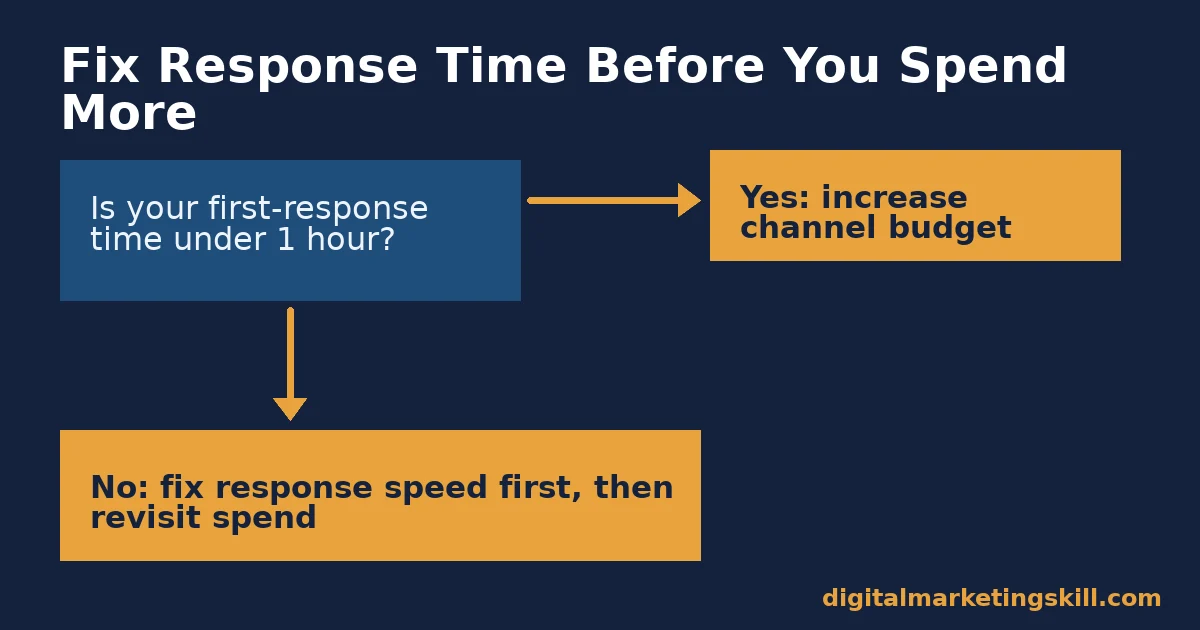
Fix your response process before you increase your channel budget. A faster reply to the leads you already get usually produces more appointments than a bigger ad spend feeding the same slow follow-up. Only increase spend on a channel once your average first-response time is under an hour.
Illustrative, invented numbers: an agent generating 40 leads a month at a 42-hour average response time might book 4 appointments. Cutting that response time to under an hour, with nothing else changed, could plausibly double or triple that number, based on the qualification multipliers in the research above. This is a worked example to show the logic, not a promised result.
The same rule applies in reverse when deciding what to cut. If budget is tight, trim the channel with the weakest lead source quality before you trim your response time or your follow-up tools. A smaller number of well-handled leads usually outperforms a larger number of mishandled ones.
A Real Case: One Online Lead, $1.54 Million in Transactions
Agent Josh Ziegelbaum’s team published an account, through the Trem Group, of a single lead captured from an online ad on their website. The prospect was not ready to buy right away. The team kept in touch with calls, emails and automated follow-up for months without a sale.
That lead bought a home roughly five months later. They returned to list a property around a year after the first contact. Combined, the purchase and the listing totalled $1.54 million in transactions from one lead.
Treat this with its limits in view. It is one named, published example, not an average outcome. The case itself frames it as an exceptional result of patience, not a typical return. What it shows is a mechanism worth copying: a lead that is not ready today is not a dead lead, if your follow-up system keeps it warm.
Most agents give up on a lead after two or three unanswered messages. This case covers roughly thirteen months from first contact to the second transaction, with no sale at all for the first five. The patience itself was the strategy, not a side detail.
The return on that patience shows in the second transaction. A one-off sale from the original lead would still have been a solid result, but the listing that followed a year later only happened because the relationship was still active when the seller was ready to list.
Frequently Asked Questions About Real Estate Marketing
What is real estate marketing?
Real estate marketing is the combination of channels, website, social media, email and referrals, that an agent or agency uses to get found by buyers and sellers and turn that attention into appointments and closed transactions.
Which channel generates the best real estate leads?
By the NAR 2025 Technology Survey, social media was the channel most Realtors rated as their highest-quality lead source, ahead of CRM systems and local MLS. Referrals still convert the fastest, because trust is already established.
How fast should I respond to a real estate lead?
As fast as possible, ideally within five minutes. Research from MIT Sloan and InsideSales.com found that response window makes a lead 21 times more likely to qualify, compared with waiting thirty minutes.
Do I need a website if I am already active on social media?
Yes. Social media builds familiarity, but a website is where a warm lead checks your credibility and finds a clear way to contact you. A social profile alone does not do that as well.
How many real estate marketing channels should I use at once?
Start with two: one discovery channel, usually social media, and one follow-up channel, usually email or calls. Add a third once your response time on the first two is reliably fast.
Is referral marketing still worth the effort against digital channels?
Yes. NAR data shows referrals account for a large share of buyers finding their agent. A referred lead typically needs less convincing than a cold one, because trust is already partly built.
What is the biggest real estate marketing mistake agents make?
Slow response time. An HBR audit found some firms take over 40 hours on average to reply to a web lead, and almost a quarter never reply at all. That wastes the marketing spend that generated the lead in the first place.
Should a new agent focus on social media or referrals first?
Start with social media, since new agents have not yet built a client base to draw referrals from. Treat every early transaction as the start of a referral pipeline for later, once you have clients to ask.
Does paid advertising work for real estate marketing?
Yes, but only as fast as your response process allows. Paid ads can produce volume quickly, and volume without a fast, consistent follow-up system mostly produces wasted spend rather than booked appointments.
How long does real estate marketing take to produce results?
Expect months, not days. Property decisions move slowly, so trust-building channels like social media and content need sustained, consistent effort before leads convert into appointments and closings.
Should I hire someone to run my real estate marketing, or do it myself?
Either can work, as long as whoever owns it treats response speed as seriously as content. A beautifully run social account paired with a 42-hour reply time will still lose most leads to a faster competitor, agency-run or not.
What should I track first if I am only measuring one thing?
First-response time. It is the single metric most closely tied to whether a lead ever becomes an appointment, and it is also the easiest one to fix without spending any extra money.
Do open houses still matter for real estate marketing?
Yes, as a lead-capture moment rather than a standalone strategy. Treat every visitor’s contact detail the same way you would treat an online form submission: a lead that needs a fast, tracked follow-up, not just a sign-in sheet.
Can a small or new agency compete with larger real estate marketing budgets?
Often yes, on response speed and consistency rather than spend. A small team that replies in minutes and follows up for months will frequently out-convert a larger budget spent on volume with a slow, inconsistent reply process.
Where to Learn Real Estate Marketing Properly
Building a real estate marketing system, not just a channel list, is exactly what the Digital Marketing Skill Institute’s Master Diploma in Digital & AI Marketing teaches. Its AI-Powered Lead Generation and Email Automation track covers fast follow-up and nurture sequences. Its AI-Powered Social Media Management and Advertising track covers the discovery side.
These are two of the four AI-powered tracks built from ten courses in the program, with a Full Stack option if you want all four. Every track includes unlimited 1-on-1 coaching and mentoring, a U.S. Project Internship with a verified U.S. Work Reference Letter, and a diploma with dual US and UK accreditation recognised in more than 100 countries, 100% online. You can build this skill set from anywhere in your country.
See the full track breakdown on the Master Diploma program page, read outcomes on the student reviews page, and browse more guides on the blog. When you are ready, apply here.
Wherever you live, the training and the U.S. internship travel with you online, starting at digitalmarketingskill.com. If you ever cite a graduate’s income result, check the earnings disclaimer first; this program makes no income or job guarantees, and results vary by effort and market. Learn more at digitalmarketingskill.com.
Every figure in this guide was checked against its original source before publication. Figures marked as illustrative are invented examples, not real results.