
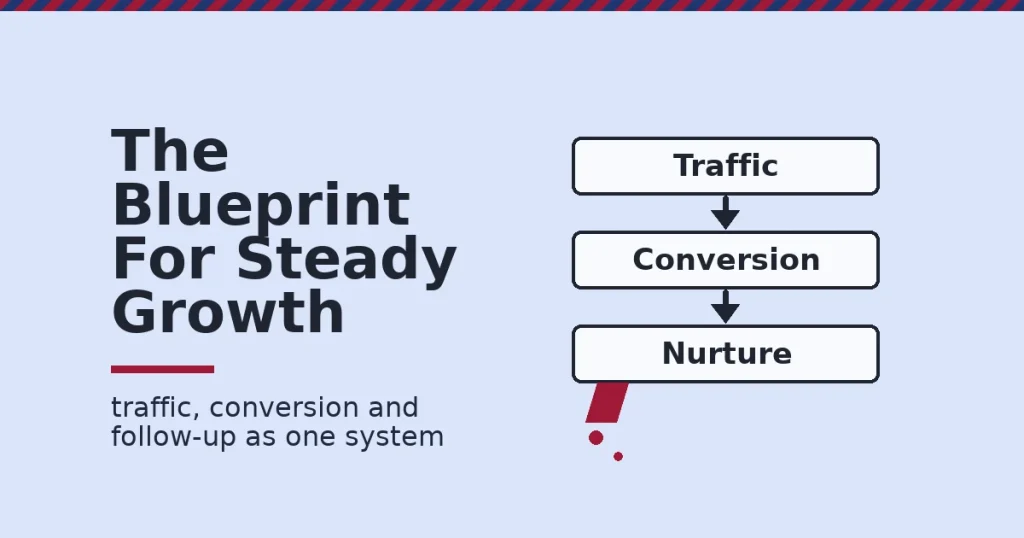
A digital marketing blueprint is a repeatable system, not a one-off campaign. It drives qualified traffic, converts visitors on your page, then nurtures every lead until they buy and return. Businesses that skip the third step keep paying for the same traffic twice.
Key Takeaways
- Most visitors never convert. Median landing page conversion sits at 6.6% across 41,000 pages and 464 million views, the widest benchmark study on record (Unbounce).
- Shorter forms convert far more. Average conversion runs near 17% at five form fields but falls under 7% once a form passes ten fields (Unbounce).
- Speed is part of the system. A 0.1-second faster page was linked to an average 8% lift in retail conversions across 37 brands and roughly 30 million sessions (Google, “Milliseconds Make Millions”).
- Email still earns trust at scale. Average email open rate across industries is 35.63%, even as inboxes get more competitive (Mailchimp).
- Nurture pays for itself. Industry estimates put email marketing ROI at roughly $36-$42 for every $1 spent, among the highest of any channel (Litmus, reported by Omnisend).
In this guide
- Why Most “Marketing Plans” Never Become a Digital Marketing Blueprint
- How the Three-Stage Digital Marketing Blueprint Works
- What Differs by Starting Point
- How to Lead With Each Stage
- Measuring Your Digital Marketing Blueprint
- The One Decision Rule
- A Real Case: Building a System Around One Channel
- Frequently Asked Questions About Digital Marketing Blueprints
- Build Your Digital Marketing Blueprint With Support
Why Most “Marketing Plans” Never Become a Digital Marketing Blueprint
Most businesses already do some marketing. They post on social media. They run the occasional ad. Maybe they send a newsletter. What they rarely have is a system: a defined, repeatable path from a stranger’s first visit to a paying, returning customer.
A digital marketing blueprint is that path made explicit. It names three stages, sets a goal for each, and tells you what to fix when a number falls short. Without a blueprint, marketing becomes a list of disconnected tactics that each live or die on their own. This guide reflects the same framework taught hands-on at Digital Marketing Skill Institute.
Ground rules before the detail. The benchmark figures below come from large datasets published by the companies that ran them. Read them as directional averages, not guarantees for your business. The worked examples are an informed framework built from that evidence, not a settled formula. Treat every number here as a snapshot, not a permanent ranking.
The cost of skipping a digital marketing blueprint shows up beyond marketing. CB Insights analysed 431 venture-backed companies that shut down. It found a clear, verifiable reason in 385 of them.
Poor product-market fit was the single largest cause at 43%, ahead of bad timing at 29%. A documented system will not fix a product nobody wants. But it removes a second, avoidable failure mode: a good product that nobody ever finds, converts or hears from again.
How the Three-Stage Digital Marketing Blueprint Works
The mechanism behind a digital marketing blueprint is simple to describe and hard to execute well. Traffic without conversion wastes ad spend. Conversion without nurture wastes the lead you already paid to acquire. All three stages have to work together, in order, and each stage has its own benchmark data below so you can judge your own numbers against a real baseline rather than a guess.
Stage One: Qualified Traffic
The goal of this stage is not visitors. It is the right visitors: people who already have the problem your product solves. That means choosing search terms, ad audiences and social channels based on intent, not reach. A smaller, interested audience converts better than a large, indifferent one.
Search and paid social both work, but they behave differently. LocalIQ’s search advertising benchmarks are built from thousands of advertiser accounts across more than 20 industries. They put average conversion rate at 8.18% and average cost per lead at $66.69.
Sprout Social’s Facebook benchmarks report a lead conversion rate of 7.72% with an average lead cost of $1.92. Paid social can be far cheaper per lead even when the conversion rate looks similar, which matters when you are choosing the first channel for a new digital marketing blueprint.
Whichever channel you choose, the traffic stage lives or dies on targeting, not volume. Our complete guide to lead generation covers how to define a qualified audience before you spend a dollar on reaching it. That avoids the common mistake of buying cheap, uninterested clicks that inflate traffic numbers without feeding stage two.
Stage Two: Converting Site Visitors
This is where most blueprints quietly fail. A landing page with no clear offer, a confusing form or a slow load time turns paid traffic into a sunk cost. Unbounce’s benchmark report, drawn from 41,000 landing pages and 464 million pageviews, found a median conversion rate of just 6.6%. Email traffic converted highest, at 19.3%.
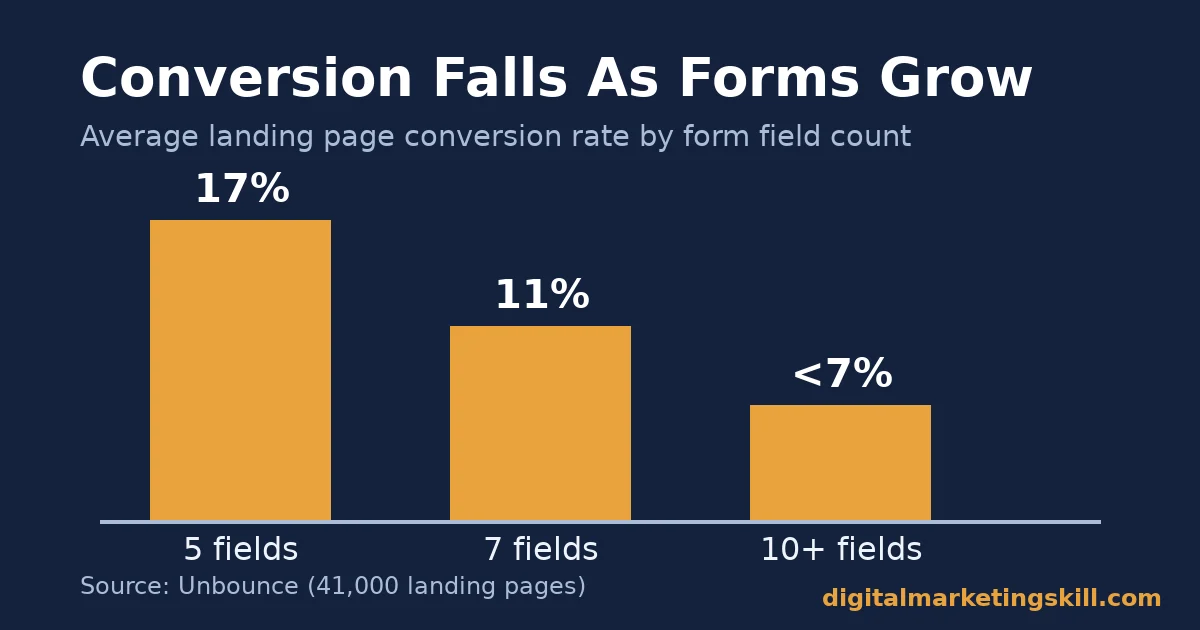
Form length is one of the clearest levers available in any digital marketing blueprint. The same Unbounce data shows conversion falling from roughly 17% at five fields to under 7% once a form passes ten fields. A summary of HubSpot’s analysis of over 40,000 landing pages found the same downward pattern. Every extra field is a reason for a visitor to leave.
Stage Two: Why Page Speed and Bounce Rate Matter
Page speed compounds the effect. Google’s “Milliseconds Make Millions” study, run with 55 and Deloitte across 37 brand sites and roughly 30 million sessions, found something striking. A 0.1-second improvement lifted retail conversions by an average of 8%, and travel bookings by around 10%.
Visitors who leave without converting are not automatically gone forever. A high bounce rate is usually a symptom with a fixable cause, from slow load times to a mismatch between what the ad promised and what the page delivers. Our guide on reducing bounce rate walks through the most common causes in order of impact.
The discipline of conversion rate optimization turns a one-time page fix into an ongoing testing habit for this stage. That habit is what separates a digital marketing blueprint that keeps improving from one that is built once and forgotten.
Stage Three: Nurturing Leads and Customers
A prospect rarely buys on the first visit. Most people need several touches with a brand before they trust it enough to pay. That is exactly what nurture sequences are built for. Treat this stage as a relationship, not a broadcast: keep giving useful information until the prospect is ready, rather than pushing a sale before trust exists.
Email remains the backbone of this stage in most digital marketing blueprints. Mailchimp’s own customer data puts the all-industry average open rate at 35.63% and click rate at 2.62%. Industry ROI estimates compiled by EmailToolTester, citing Litmus, put the return at roughly $36-$42 for every $1 spent, highest in travel and hospitality at around $53.
Nurture is also where retention gets built. A customer who trusts your emails is cheaper to sell to a second time than a brand-new visitor is to convert once. Skipping this stage means paying full price, every time, for a result nurture could deliver far more cheaply.
If you are still building the list this stage depends on, our breakdown of what actually moves email signup conversion rate covers the offer, placement and timing choices that fill a sequence with real subscribers rather than a trickle of sign-ups.
What Differs by Starting Point
The three-stage mechanism above stays the same for every business. But where you start changes which stage deserves your limited time first. A brand-new business and a growing one are solving different problems with the same digital marketing blueprint.
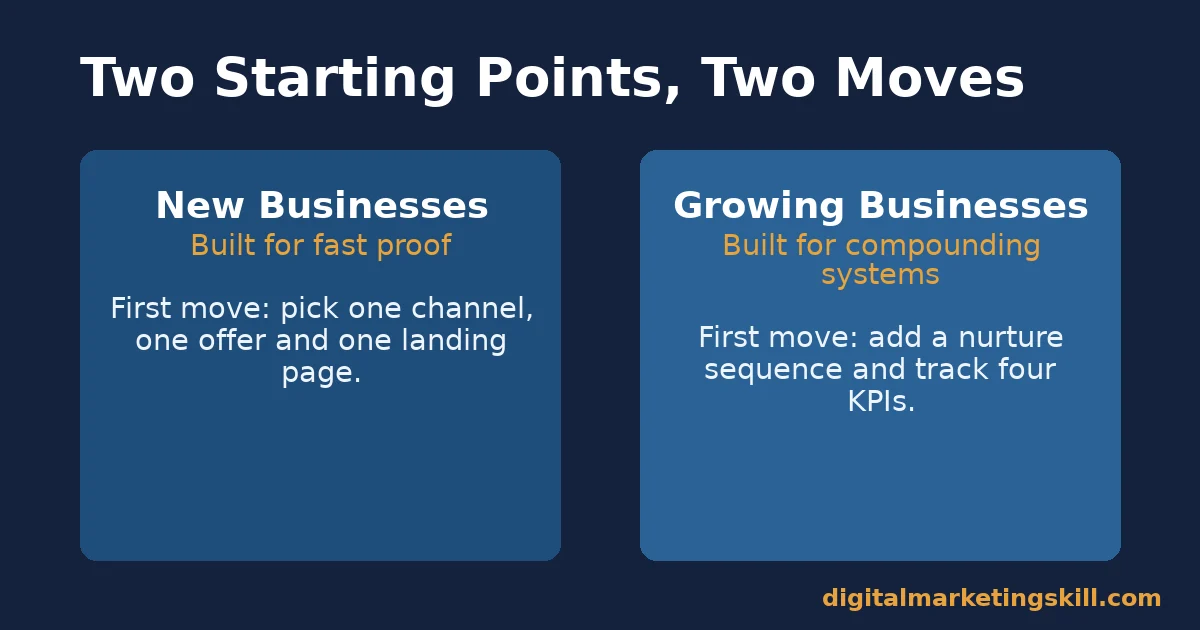
New Businesses: Built for Fast Proof
A new business has no data yet, so the priority is proof, not scale. The fastest way to get it is a single channel, a single offer and a single landing page, tested until it converts at a rate you can repeat. Spreading a small budget across five channels at once means never learning enough about any of them.
Growing Businesses: Built for Compounding Systems
A growing business already has traffic and some conversions. The priority shifts to the parts that compound: a documented nurture sequence, a small set of tracked KPIs and a repeatable way to test one variable at a time. The win here is no longer “does this work.” It is “how much better can this get.”
How to Lead With Each Stage
The sections below mirror the two starting points above. Start with whichever matches your business today. Forcing a growing-business playbook onto a brand-new one, or the reverse, usually wastes the first few months.
New Businesses: Lead With One Channel and One Offer
Pick the single channel where your buyers already search or scroll, and build one landing page around one clear offer. Keep the form short, since Unbounce’s data shows five fields converting far better than ten. Run the page for a few hundred visitors before judging it, because small sample sizes swing wildly.
Once that single page converts at a rate you can repeat, add one lightweight nurture step, such as a three-email welcome sequence, before you add a second channel. A new business with one proven path beats one with five untested ones.
Growing Businesses: Lead With Nurture Sequences and Measurement
If traffic and conversion already work, the highest-leverage move is usually building out the nurture stage properly. Add a welcome sequence, a re-engagement sequence for inactive leads, and a post-purchase sequence that asks for repeat business. Each sequence should have one measurable goal, not a vague “stay in touch” purpose.
Alongside nurture, put a small dashboard in place covering the four KPIs below. Review it on a fixed schedule. Change one variable at a time, and give each test enough traffic to be meaningful before you judge it.
Measuring Your Digital Marketing Blueprint
A blueprint without measurement is a guess with extra steps. Track it with a small number of defined metrics rather than a long dashboard nobody checks. Four numbers, checked on a fixed schedule, tell you more than twenty numbers nobody reviews.
Four Metrics That Show the Blueprint Is Working
- Traffic-to-lead conversion rate. The share of visitors who become a lead: an email, a form fill or a booked call. Unbounce’s 6.6% median is a rough industry yardstick, not a target for every page.
- Cost per lead. Total spend on a channel divided by leads generated. LocalIQ’s benchmark of $66.69 for paid search and Sprout Social’s $1.92 for Facebook lead ads show how much this varies by channel. Compare your own cost per lead across channels, not against an outside average alone.
- Email engagement rate. Open and click rate on your nurture sequences, benchmarked loosely against Mailchimp’s 35.63% open and 2.62% click averages. A sequence that consistently underperforms your own site average needs a subject line or content rewrite.
- Lead-to-customer rate. The share of leads that become paying customers within a set window. This is the number that proves whether your nurture stage is doing its job, not just sending emails.
If this last metric is the one holding you back, the fix usually sits in how leads are followed up with, not in generating more of them. Our deeper guide to lead conversion strategies covers the follow-up cadence, objection handling and offer sequencing that turns a stalled lead-to-customer rate around, without touching the traffic stage at all.
How to Read These Numbers Together
Read the four metrics as a chain. If cost per lead is low but lead-to-customer rate is also low, the traffic is cheap but poorly qualified. If traffic-to-lead conversion is strong but email engagement is weak, the landing page is doing its job and the nurture sequence is the weak link. Fixing the wrong stage first wastes a budget cycle on a problem that was never there.
The One Decision Rule
If you take one rule from this guide, make it this one. Never scale traffic spend on a stage of your digital marketing blueprint that is already underperforming its own benchmark.
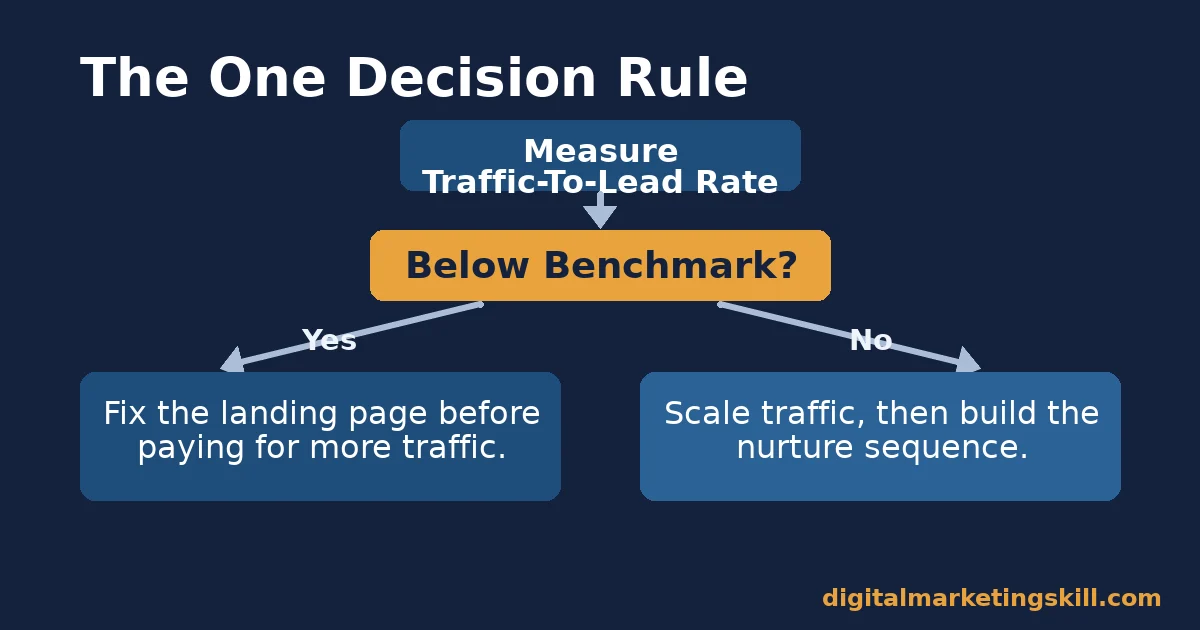
Here is an illustrative example, with invented numbers. A small services business sends 1,000 visitors a month to a landing page converting at 2%, well under the 6.6% industry median. It considers doubling ad spend to get more leads. Doubling traffic to an underperforming page would only double a disappointing result.
Fixing the page first, by cutting the form from nine fields to four and tightening the headline, lifts conversion to 5%. That more than doubles leads without spending another dollar on traffic. The same rule applies to nurture. Scaling traffic into a sequence with a 1% click rate just produces more unopened emails, not more customers.
Spend that same budget rewriting the first three emails in the sequence instead. The lift shows up as more conversions from leads you already paid to acquire. The rule also protects you from a common trap: judging a stage too early. A landing page needs a few hundred visitors before its conversion rate is reliable. Apply the decision rule after you have enough data, not after the first dozen visitors.
A Real Case: Building a System Around One Channel
Olajire Jacob, a Digital Marketing Skill Institute student, built his business by specialising in one part of the blueprint. He did not try to run all three stages everywhere at once. According to the DMSI reviews page, he charged an average of $500 to set up email marketing flows for clients across the US, UK and Canada, then scaled that service to $5,000 a month.
The lesson from this case is narrow by design. A focused offer around one stage of the blueprint, sold repeatedly, built a predictable business faster than trying to be a generalist across traffic, conversion and nurture at once. The nurture stage itself became the product. That is a useful reminder: the skill to build a digital marketing blueprint is also a marketable service on its own.
Individual results vary, and this is one published case, not a guaranteed outcome. See the Institute’s earnings disclaimer for context on income claims. Treat it as proof the three-stage model works in practice, not as a promise of a specific number for your own business.
Frequently Asked Questions About Digital Marketing Blueprints
What is a digital marketing blueprint?
It is a repeatable system with three stages: driving qualified traffic, converting visitors into leads or customers, and nurturing those leads until they buy and return. It replaces a list of disconnected tactics with a defined, measurable path.
How is a blueprint different from a marketing plan?
A marketing plan usually lists activities and dates: which posts to publish, which ads to run, when a campaign launches. A blueprint defines the mechanism connecting those activities to a result. A plan tells you what to do. A blueprint tells you why it should work and how to know if it did.
How long does it take to see results from a new blueprint?
Expect weeks, not days, before the data is reliable. A single landing page needs a few hundred visitors before its conversion rate means anything. A nurture sequence needs at least one full send cycle to show whether it converts leads into customers. Most businesses get a first reliable read within four to eight weeks.
What is the first step if I have no traffic yet?
Pick one channel where your buyers already search or scroll. Build one landing page around one offer, and send a small, steady stream of visitors to it before testing a second channel. Resist the urge to be everywhere at once.
How many touches does a lead need before they buy?
It varies by price and complexity. Most buyers need several meaningful touches with a brand before they trust it enough to pay, especially for higher-priced products or services. That is the core reason the nurture stage exists.
Do I need paid ads to make a blueprint work?
No. The traffic stage can run on organic search, content, referrals or social, as long as the visitors are qualified. Paid ads simply let you control volume and speed up testing of the other two stages.
How do I know if my blueprint is actually working?
Track traffic-to-lead conversion rate, cost per lead, email engagement rate and lead-to-customer rate together. Read them as a chain, not in isolation. If one metric sits well below your own historical average, that is the stage to fix first.
What tools do I need to start?
A landing page builder, an email platform that supports automated sequences, and an analytics tool to track the metrics above. None of this requires an enterprise budget. Most of these tools have a free or low-cost tier that is enough for a first version.
Should I rebuild my whole marketing around this blueprint at once?
No. Apply it to one channel and one offer first. Measure the four KPIs for a full cycle, then expand what works. Rebuilding every channel at once makes it impossible to tell which change actually moved the result.
Build Your Digital Marketing Blueprint With Support
Turning these three stages into a working digital marketing blueprint is exactly what Digital Marketing Skill Institute teaches hands-on. The Master Diploma in Digital & AI Marketing is built around four AI-powered tracks totalling ten courses. These include AI-Powered Lead Generation and Email Automation, covering the conversion and nurture stages in this guide, with a Full Stack option if you want to learn all four tracks together.
It comes with unlimited 1-on-1 coaching and mentoring and a U.S. Project Internship with a verified U.S. Work Reference Letter. The programme is dual US and UK accredited, recognised in more than 100 countries, and fully online.
You can study and apply this blueprint from anywhere in your country. Explore more guides on the Digital Marketing Skill Institute blog, read more student outcomes on the reviews page, and when you are ready, apply for the Master Diploma or start from the Digital Marketing Skill Institute homepage. Wherever you live, the same three-stage blueprint applies: fix the weakest stage first, then scale what already works.
Every figure in this guide was checked against its original source before publication. Figures marked as illustrative are invented examples, not real results.
