
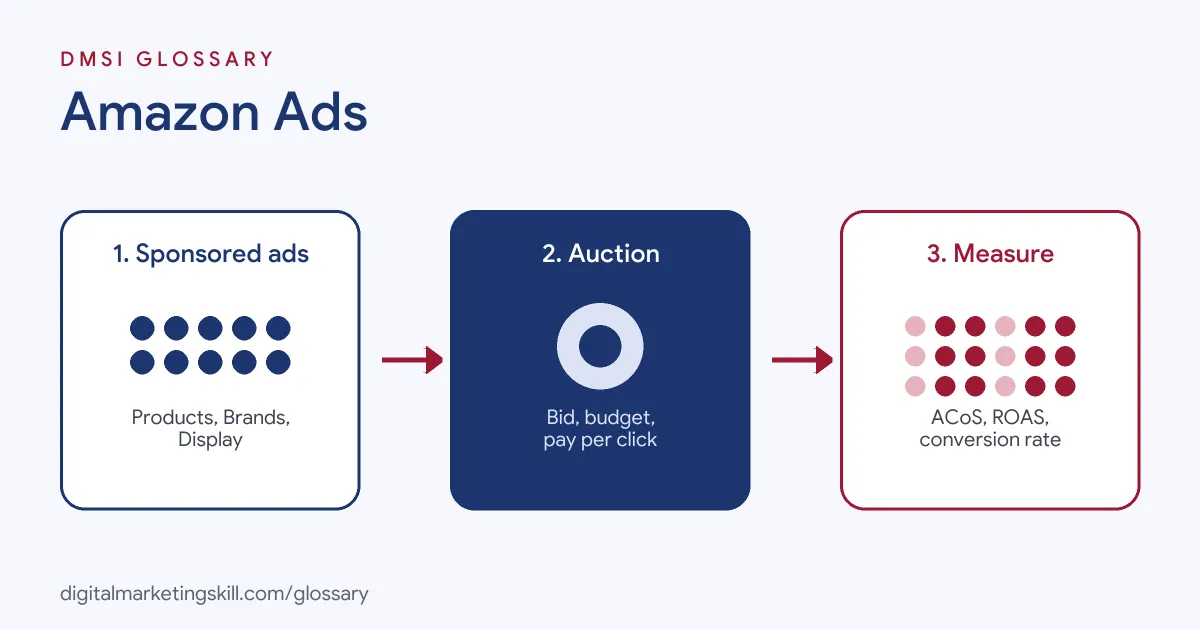
Amazon Ads is Amazon’s advertising platform. It lets businesses show ads to shoppers on Amazon and to viewers and listeners across Amazon-owned services and other websites and apps. The best-known formats are sponsored ads, which appear in Amazon search results and on product pages. Most of these work on a pay-per-click auction, so you set a bid and a budget and pay when someone clicks. So Amazon Ads helps sellers, brands and authors get their products seen at the moment people are ready to buy.
Key Takeaways
- Amazon Ads is Amazon’s own advertising platform, previously known as Amazon Advertising.
- The main self-service formats are Sponsored Products, Sponsored Brands and Sponsored Display.
- Amazon DSP and streaming TV ads reach audiences on and off Amazon, including Prime Video, Fire TV and Twitch.
- Sponsored ads use an auction, and you usually pay per click.
- Amazon says businesses that do not sell on Amazon can still use Amazon Ads.
What Is Amazon Ads?
Amazon is a huge online shop, but it is also a search engine for products. Many shoppers type what they want straight into the Amazon search bar. Amazon Ads lets businesses pay to appear in those results and in other places across Amazon. Amazon describes its platform as offering “easy-to-use, self-service advertising solutions, like sponsored ads and Brand Stores.”
Think of a supermarket. Brands pay for the best shelf spots at eye level or at the end of an aisle. Amazon Ads works in a similar way online. A sponsored product sits near the top of the results, so more shoppers see it. However, the ad still has to earn the sale with a good listing, fair price and strong reviews.
Today, Amazon Ads goes well beyond the shop. Amazon says it helps businesses “reach customers at scale through full-funnel advertising across streaming, shopping, and everything in-between.” That includes video ads on Prime Video, ads on Twitch and Fire TV, audio ads and display ads on other websites.
Why It Matters
Amazon Ads matters because it reaches people who are already shopping. Someone searching for “running shoes” on Amazon is often close to buying. So ads there can lead to sales faster than many awareness ads on social media. Canopy Management, an Amazon agency, notes that Amazon conversion rates are often far higher than a typical online store.
It also matters because competition is strong. For many products, the top of the results is full of sponsored listings. So sellers who skip advertising can be hard to find, even with a good product.
How Amazon Ads Works
Sponsored ads run on an auction. You choose the keywords or products you want to target, set a bid and set a daily budget. When a shopper searches, Amazon runs an auction among the eligible ads. It looks at your bid and how relevant your product is. Canopy Management explains that you usually pay “a cent more than the next-highest bidder, not your full bid.”
Here is the basic flow:
- Pick a goal. For example, more sales, a product launch or brand awareness.
- Choose an ad type. Most beginners start with Sponsored Products.
- Choose targeting. Use automatic targeting, where Amazon picks searches, or manual targeting, where you pick keywords and products.
- Set your bid and budget. Then launch the campaign.
- Review results. Check clicks, sales and costs in the advertising console, then adjust.
Amazon recommends “starting with sponsored ads, which appear in high-visibility placements across Amazon.”
Main Amazon Ad Types
Sponsored Products
These promote a single product listing. They appear in search results and on product pages. Canopy Management calls them the workhorses that usually drive the most direct sales. They are the easiest place to start.
Sponsored Brands
These are banner-style ads, often near the top of search results. They show your logo, a custom headline and several products. They can send shoppers to a product page or to your Brand Store. So they help build brand recognition as well as sales.
Sponsored Display
These target audiences and products rather than search keywords. They can appear on and off Amazon. Often, they are used for retargeting, which means showing ads to people who viewed a product but did not buy.
Amazon DSP
DSP stands for demand-side platform. Amazon DSP lets advertisers buy display, video and audio ads automatically, on Amazon and on other sites and apps. It uses programmatic advertising and Amazon’s shopping signals. Larger brands and agencies often use it.
Streaming TV and Video Ads
These run on services such as Prime Video, Fire TV and Twitch. They suit brands that want to reach people while they watch, much like TV adverts.
Brand Stores
A Brand Store is a free, multi-page shop for your brand on Amazon. It is not an ad, but ads often send shoppers there. Amazon notes that its solutions range “from no cost, like Brand Stores, to budgets you set.”
What Amazon Ads Cost and How to Measure It
There is no fixed price. You set your own budget and bids, and costs depend on your category, competition and season. Busy shopping periods, such as the weeks before major holidays, usually cost more per click. Canopy Management warns that a product with thin margins can lose money on each click, so check your numbers before you scale.
The key metrics are:
- Impressions: how often your ad was shown.
- Click-through rate: the share of people who clicked after seeing the ad.
- Cost per click (CPC): the average amount you paid for each click.
- Conversion rate: the share of clicks that became orders.
- ACoS (advertising cost of sales): ad spend divided by ad sales. Lower is usually better.
- ROAS: ad sales divided by ad spend. It is the flip side of ACoS.
For example, if you spend 100 on ads and make 400 in ad sales, your ACoS is 25% and your ROAS is 4. Whether that is good depends on your profit margin.
Examples of Amazon Ads in Action
Here are three simple, illustrative examples. They are not real businesses.
- A new kitchen brand launches a stainless steel water bottle. It starts a Sponsored Products campaign with automatic targeting. After two weeks, it finds the searches that led to sales and moves them into a manual campaign with higher bids.
- A self-published author runs Sponsored Products ads that appear on the pages of similar books. Readers who like that genre see the ad and click through.
- A skincare brand uses Sponsored Brands to show three products and a headline at the top of search results. Then it uses Sponsored Display to remind people who viewed a product but did not buy.
Best Practices
- Fix the listing first. Clear photos, a strong title, helpful bullet points, a fair price, stock and reviews all affect whether clicks turn into sales.
- Start with Sponsored Products. It is the simplest format and usually drives direct sales.
- Use automatic targeting to learn. Then move proven searches into manual campaigns.
- Add negative keywords. These stop your ads showing for searches that waste money.
- Do keyword research. Look at how shoppers describe your product.
- Give campaigns time. Canopy Management suggests two to three weeks of data before judging a campaign.
- Watch your margins. Set a target ACoS that still leaves you a profit.
Common Mistakes
- Advertising a weak listing. Ads bring traffic, but poor listings waste it.
- No negative keywords. Money leaks on irrelevant searches.
- Changing bids every day. Campaigns need time to collect data.
- Ignoring profit. High sales with a high ACoS can still lose money.
- Running out of stock. Ads stop helping if the product is unavailable.
Amazon Ads vs Google Ads
Both use auctions and keywords, but they work in different places. Google Ads reaches people searching the whole web, and it can send them to your own website. Amazon Ads reaches people already shopping on Amazon, and the sale usually happens there. Google also offers Shopping ads for products. So many ecommerce brands use both: Google to reach new searchers and Amazon to win sales on the marketplace.
Amazon Ads Skills and Careers
Brands, agencies and marketplace sellers hire people who can run Amazon campaigns. Job titles include Amazon PPC specialist, marketplace manager and retail media manager. The core skills are keyword research, bid management, reading reports and improving product listings. These skills also connect to wider paid search and ecommerce work. If you want to build practical paid advertising skills with guided projects, you can join the Digital Marketing Skill programme.
Frequently Asked Questions
Is Amazon Ads the same as Amazon Advertising?
Yes. Amazon Advertising is the older name. The platform is now called Amazon Ads.
Do I need to sell on Amazon to use Amazon Ads?
No. Amazon says that “Businesses that do not sell on Amazon can still use Amazon Ads to grow their business,” for example through display, video and streaming TV ads.
How do I run ads for Amazon products?
Open the Amazon Ads console or your seller account, create a Sponsored Products campaign, choose targeting, set a bid and budget, and launch.
How do I pay for Amazon Ads?
For sponsored ads, you usually pay when someone clicks. You control spending with daily budgets and bids.
What is ACoS?
ACoS means advertising cost of sales. It is your ad spend divided by your ad sales, shown as a percentage.
Does Prime Video show ads?
Yes. Amazon Ads includes streaming TV ads on Prime Video, along with Fire TV and Twitch.
Sources: Amazon Ads; Canopy Management: Does Amazon Advertising Work?; BigCommerce: What is Amazon Advertising?; Amazon Ads: Sponsored Products. We have no connection with these companies.