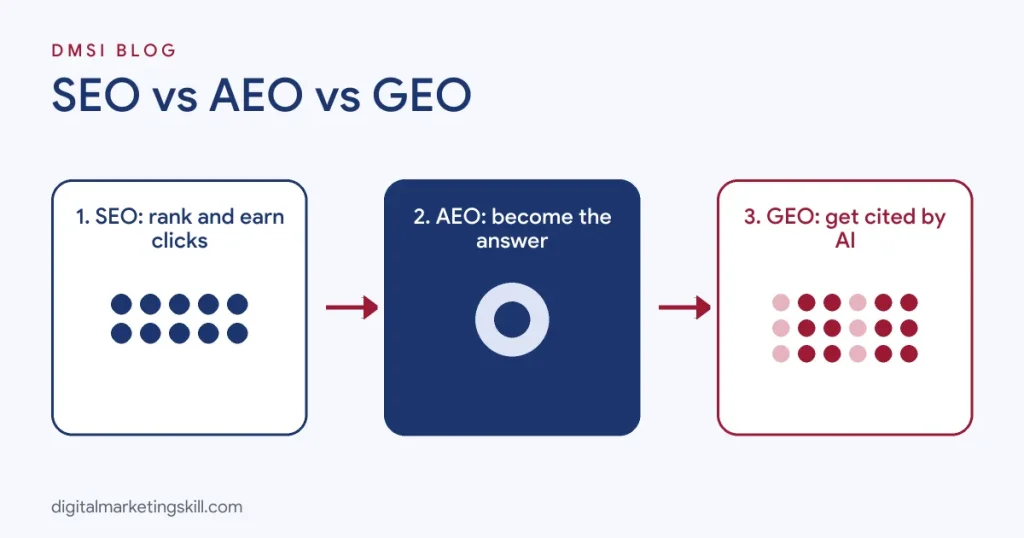
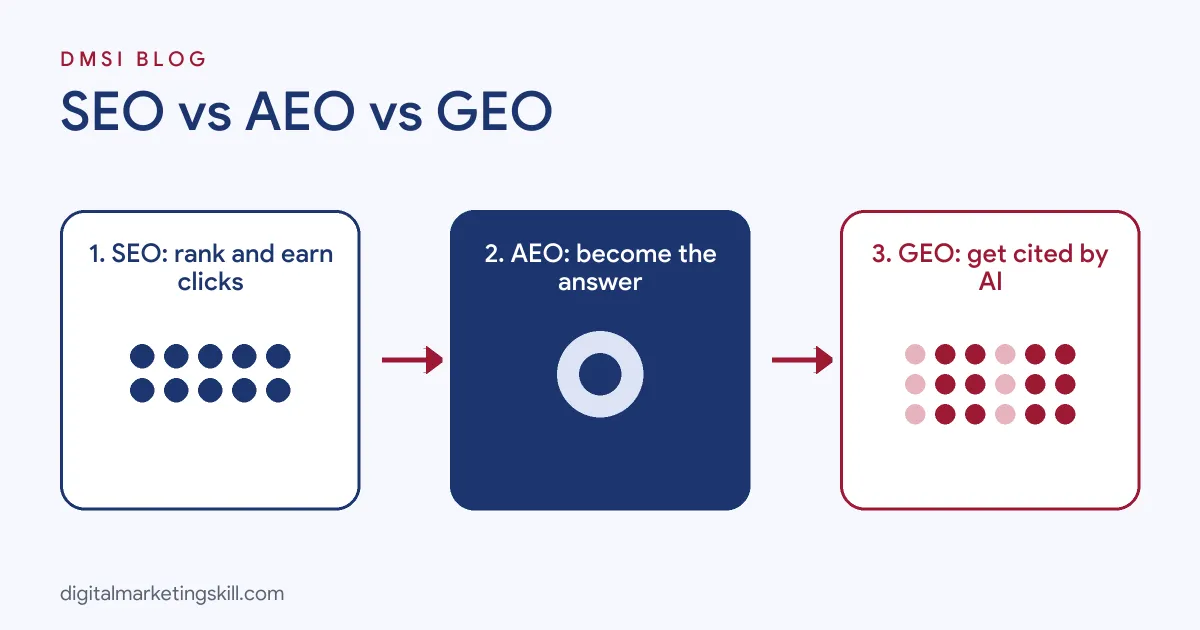
SEO, AEO and GEO are three ways of making your content visible in search, and the difference is where you want to appear. SEO (search engine optimisation) helps your pages rank in traditional results so people click through. AEO (answer engine optimisation) helps your content become the direct answer in featured snippets, voice assistants and AI answer boxes. GEO (generative engine optimisation) helps your brand get mentioned and cited inside AI-generated answers from tools like ChatGPT, Gemini, Perplexity, Google AI Overviews and AI Mode. They are not competing strategies. SEO is the foundation, AEO shapes your content into clear answers, and GEO builds the authority and reputation that make AI systems trust and recommend you. This guide explains each one, shows exactly how they differ, and gives you a practical plan to use all three together.
If you are confused by the alphabet soup, you are not alone. Agencies now sell SEO, AEO, GEO, AIO and LLMO as if they were separate services. Underneath the labels, most of the work overlaps. Knowing where it overlaps, and where it really differs, saves time and money.
Key Takeaways
- The term generative engine optimisation was introduced in a 2023 research paper by Princeton University and partner researchers, which found that adding citations, quotations and statistics could raise a source’s visibility in AI answers by up to 40%.
- Google states there are no additional requirements or special optimisations needed to appear in AI Overviews or AI Mode beyond being indexed and eligible for a snippet, which is why SEO remains the foundation of AEO and GEO.
- Adobe Express’s 2026 consumer survey found 14% of consumers are more likely to rely on ChatGPT than Google as a search engine.
- Early research by iPullRank, reported by Ahrefs, found only about 4.5% of Google AI Mode sessions ended in a click to a website, so being cited matters as much as ranking.
- SEO is measured in rankings and clicks, AEO in answer placements, and GEO in brand mentions and citations across AI tools.
In this guide
- SEO vs AEO vs GEO at a Glance
- What Is SEO?
- What Is AEO?
- What Is GEO?
- What About AIO, LLMO and Search Everywhere Optimisation?
- The Key Differences in Detail
- What the Three Have in Common
- What Most Comparisons Miss
- Are AEO and GEO Replacing SEO?
- How to Build a Combined Strategy: 10 Steps
- Which to Prioritise: Real-World Scenarios
- How to Measure SEO, AEO and GEO
- Myths and Mistakes
- An Illustrative Example
- Frequently Asked Questions
SEO vs AEO vs GEO at a Glance
| SEO | AEO | GEO | |
|---|---|---|---|
| Full name | Search engine optimisation | Answer engine optimisation | Generative engine optimisation |
| Main goal | Rank pages and earn clicks | Become the direct answer | Be mentioned and cited in AI-generated answers |
| Where you appear | Blue links, local pack, images, video results | Featured snippets, People Also Ask, voice answers, AI answer boxes | ChatGPT, Gemini, Perplexity, Copilot, Claude, AI Overviews, AI Mode |
| Unit of success | A ranking page | An extracted answer | A brand mention or citation |
| Key signals | Relevance, links, quality, technical health, page experience | Clear question-and-answer structure, concise definitions, lists, tables | Authority, consistent brand mentions, original data, freshness, trust |
| Content style | Comprehensive pages targeting keywords and intent | Direct answers under question headings | Expert, evidence-rich content that others reference |
| Off-site work | Backlinks and digital PR | Limited | Mentions, reviews, community presence, PR |
| Main metrics | Rankings, impressions, clicks, conversions | Snippet and answer placements | Share of voice in AI answers, citations, AI referral traffic |
| Maturity | Established since the 1990s | Grew with featured snippets and voice from the mid-2010s | Emerged in 2023 with generative AI search |
What Is SEO?
Search engine optimisation is the practice of improving your website so it ranks higher in search engines like Google and Bing for searches your audience makes. It has three main parts:
- Technical SEO: making sure search engines can crawl, render and index your pages, with fast load times, mobile-friendly design, secure HTTPS, clean site structure and no broken links.
- On-page SEO: matching content to search intent, using relevant keywords naturally, writing strong titles and meta descriptions, structuring pages with clear headings and linking related pages together.
- Off-page SEO: earning links and mentions from trusted sites, which signal authority.
SEO is still the foundation of everything else. Google’s documentation says a page must be indexed and eligible to show with a snippet to appear in AI Overviews or AI Mode. Many AI assistants also run web searches and draw on pages that already rank well. If your SEO basics are broken, AEO and GEO have nothing to build on. Our guide to keyword research is a good starting point.
What Is AEO?
Answer engine optimisation is the practice of structuring content so search engines and assistants can lift it as a direct answer. The term became popular with the rise of featured snippets, People Also Ask boxes and voice assistants like Siri, Alexa and Google Assistant, which read out one answer rather than a list of links.
AEO focuses on the shape of your content:
- Question-based headings that match how people ask (“How long does it take to learn SEO?”).
- A concise, complete answer of 40 to 60 words straight after the heading.
- Numbered steps, bullet lists and tables that are easy to extract.
- FAQ sections that answer related questions.
- Structured data such as FAQPage, HowTo, Product and Organization markup where it matches the page.
Today AEO also applies to AI answers. When an AI system builds a response, it looks for clear passages that answer each part of the question. Content shaped for AEO is easier for both search features and AI tools to use.
What Is GEO?
Generative engine optimisation is the practice of increasing how often and how favourably your brand and content appear in AI-generated answers. The term comes from a 2023 research paper titled “GEO: Generative Engine Optimization” by researchers from Princeton University, Georgia Tech, the Allen Institute for AI and IIT Delhi. The study tested ways to make sources more visible in AI-generated responses and found that methods such as adding citations, quotations from relevant sources and statistics improved visibility by up to 40%, while keyword stuffing did not help.
GEO goes beyond the page. AI systems form a view of your brand from everything they can find: your website, reviews, news coverage, expert roundups, videos, forums and directories. So GEO includes:
- Publishing original research, data and expert insight that others cite.
- Earning consistent, accurate brand mentions across trusted sites.
- Keeping facts about your business consistent everywhere (name, products, prices, locations).
- Being present on the platforms AI tools draw from, including video and review sites.
- Monitoring what AI tools say about you and correcting inaccuracies at the source.
For a full playbook, read our guide to generative engine optimization.
What About AIO, LLMO and Search Everywhere Optimisation?
New acronyms appear every few months. Most describe the same ideas with different emphasis:
| Term | Meaning | How it relates |
|---|---|---|
| AIO (AI optimisation) | Optimising for AI systems in general | A broad umbrella that overlaps with GEO |
| LLMO (large language model optimisation) | Optimising for how LLMs understand and mention brands | Very close to GEO; see our LLM optimisation entry |
| AI SEO | SEO adapted for AI search features | Often used to mean SEO plus GEO |
| Search everywhere optimisation | Being visible wherever people search: Google, YouTube, TikTok, Amazon, AI tools | The widest view; includes SEO, AEO, GEO and social search |
| VSO (voice search optimisation) | Optimising for spoken queries | A subset of AEO |
Do not get stuck on the labels. Ask instead: where does my audience search, and what do I need to do to show up there? For many brands the answer now includes platforms like TikTok, which we cover in Is TikTok a search engine?
The Key Differences in Detail
1. Goal: clicks vs answers vs influence
SEO wants the click. AEO wants to be the answer, which may or may not lead to a click. GEO wants your brand to be part of the AI’s response, often as a recommendation, which shapes decisions even without a visit.
2. Signals: links vs structure vs reputation
SEO leans heavily on relevance, quality and links. AEO depends on clear structure and concise answers. GEO depends on how widely and consistently trusted sources describe your brand, and on whether your content contains facts worth citing.
3. Scope: your site vs your page vs the whole web
SEO focuses mostly on your website. AEO focuses on individual passages within pages. GEO considers your entire digital footprint, because AI systems pull from many sources at once.
4. Platforms: search engines vs answer features vs AI assistants
SEO targets search engine results pages. AEO targets answer features inside those pages and voice assistants. GEO targets AI assistants and AI search modes, including Google AI Mode and AI Overviews.
5. Measurement: mature vs partial vs emerging
SEO has mature tools like Search Console and rank trackers. AEO can be tracked through snippet and People Also Ask monitoring. GEO measurement is still developing, relying on AI visibility tools, manual prompt testing and referral data.
6. Speed: months vs weeks vs ongoing
SEO results usually take months. AEO wins can come within weeks once a page already ranks on page one. GEO is ongoing, because AI answers change frequently and depend on your wider reputation.
What the Three Have in Common
The overlap is bigger than the differences. All three reward:
- Content that genuinely answers what people want to know.
- Clear, well-organised pages with descriptive headings.
- Accuracy, freshness and trustworthy sources.
- Visible expertise and experience behind the content.
- A crawlable, fast, technically sound website.
- A reputation earned through other people talking about you.
This is why the best practitioners treat SEO, AEO and GEO as one integrated discipline with three lenses, rather than three separate projects.
What Most Comparisons Miss
1. They are layers, not alternatives. Many articles present a choice: SEO or AEO or GEO. In practice, each layer depends on the one below. GEO without SEO fails because AI search draws on indexed, ranking content. AEO without SEO fails because answer features usually pull from pages already on page one.
2. Google says there is no secret AI optimisation. Google’s own guidance states that no special markup, AI text files or new optimisations are required to appear in its AI features. Be wary of anyone selling “GEO hacks”. An llms.txt file, for example, is not needed for Google’s AI features.
3. The biggest GEO lever is off your website. On-page tweaks help AI tools extract your content. But whether they recommend you depends on what reviewers, journalists, experts and customers say about you elsewhere. GEO is as much PR and brand building as it is SEO.
4. Success metrics must change. If AI answers reduce clicks, judging your work on traffic alone will make good work look like failure. Track conversions, branded search growth, AI mentions and the quality of visits alongside traffic.
Are AEO and GEO Replacing SEO?
No. AEO and GEO extend SEO rather than replace it. Traditional search still handles an enormous volume of queries every day, and AI features in Google are built on top of Google’s ranking systems. What is changing is how results are presented and how often people click.
The practical shift is in emphasis. In the past, many SEO teams focused on ranking positions for keywords. Now they also need to think about how their content is extracted into answers and how their brand is represented across the web. The skills needed are broader: content strategy, data, PR, technical SEO and analytics working together.
How to Build a Combined Strategy: 10 Steps
1. Fix your technical foundation
Make sure key pages are crawlable, indexed, fast and mobile-friendly. Allow search engine crawlers in robots.txt and check CDN or firewall rules. Decide deliberately whether to allow AI crawlers such as GPTBot.
2. Map topics and questions
List the topics your audience cares about and the questions they ask about each, including follow-up questions. Use People Also Ask, autocomplete, sales calls, customer emails and AI tools themselves for ideas.
3. Create one strong page per intent
Build comprehensive pages for each main search intent, then cover related questions within them or in supporting articles linked together.
4. Lead with the answer
Start pages and sections with a clear, self-contained answer, then expand. This serves AEO and helps AI systems quote you accurately.
5. Structure for extraction
Use question headings, short paragraphs, numbered steps, comparison tables and FAQ sections. Add structured data that matches what is visible on the page.
6. Add evidence and originality
Include statistics with sources, expert quotes, original data, examples and first-hand experience. These are the elements the GEO research found most effective, and they make your content worth citing.
7. Show expertise and trust
Use real author names and credentials, cite sources, keep an about page and contact details, and update content regularly.
8. Build your brand off-site
Earn coverage through digital PR, contribute expert commentary, collect genuine reviews, create helpful video and be active in relevant online communities. Our guide to quality backlinks explains how to earn links and mentions the right way.
9. Keep facts consistent everywhere
Update your Google Business Profile, directories, social profiles, product feeds and partner pages so AI tools see one consistent story about your business.
10. Measure and iterate
Track SEO, AEO and GEO metrics monthly (see below), test prompts in AI tools and improve the pages and sources that shape your visibility.
Which to Prioritise: Real-World Scenarios
| Business | Priority order | Why |
|---|---|---|
| New website with little traffic | SEO, then AEO, then GEO | Without indexing and rankings, nothing else works |
| Local service business (plumber, dentist, salon) | Local SEO, AEO, then GEO | Local pack and “near me” answers drive calls; AI tools rely on your business profile and reviews |
| Ecommerce store | SEO and product data, then GEO | Product feeds, reviews and comparison content shape both shopping results and AI recommendations |
| B2B software company | SEO and GEO together | Buyers increasingly ask AI tools for shortlists; reviews, comparisons and analyst mentions matter |
| Publisher or blog | SEO and AEO, then GEO | Answer-focused content wins snippets; original reporting earns AI citations |
| Course provider or coach | SEO, GEO, then AEO | People ask AI tools which course or provider to choose, so reputation and reviews matter |
If you have limited time, start with the work that helps all three: fix technical issues, improve your most important pages with clear answers and evidence, and earn genuine reviews and mentions.
How to Measure SEO, AEO and GEO
| Layer | Metrics | Tools |
|---|---|---|
| SEO | Impressions, clicks, average position, organic sessions, conversions | Google Search Console, Bing Webmaster Tools, GA4, rank trackers |
| AEO | Featured snippets won, People Also Ask appearances, voice answers | Rank trackers with SERP feature tracking, manual checks |
| GEO | Brand mentions and citations in AI answers, share of voice versus competitors, sentiment, AI referral traffic | AI visibility tools, manual prompt testing, GA4 referral data |
| All three | Leads, sales, branded search volume, assisted conversions | CRM, GA4, Search Console branded queries |
To see AI assistant traffic in GA4, filter session source for domains such as chatgpt.com, perplexity.ai and gemini.google.com. Our guide to Google Analytics for SEO shows the exact steps. Clicks from Google’s AI Overviews and AI Mode are counted inside Google organic search and the Web search type in Search Console.
For GEO, create a list of 20 to 50 prompts your customers might ask, such as “best digital marketing course for beginners” or “which CRM is best for small agencies”. Run them monthly across the main AI tools, record whether you are mentioned, cited or recommended, and note what is said. Over time, this shows whether your share of AI answers is growing.
Myths and Mistakes
- Myth: SEO is dead. AI search relies on indexed, high-quality web content. SEO has changed, not died.
- Myth: GEO needs special code. Google says no special markup or AI files are needed for its AI features. Good content and a strong reputation do the work.
- Myth: you need separate content for each. One well-structured, evidence-rich page can serve SEO, AEO and GEO at once.
- Mistake: keyword stuffing for AI. The original GEO research found keyword stuffing did not improve visibility in generative answers.
- Mistake: mass-producing AI content. Thin, scaled content can break Google’s spam policies and gives AI tools nothing worth citing.
- Mistake: ignoring off-site reputation. AI tools weigh what others say about you, not only what you say.
- Mistake: judging AI-era success by traffic alone. Track conversions and brand visibility too.
One rule to remember
Be findable (SEO), be quotable (AEO) and be trusted (GEO). If you do the work for all three on every important page, you do not need to choose between them.
An Illustrative Example
This is an illustrative scenario, not a real business. A small online accounting firm ranked on page one for “bookkeeping for freelancers” but noticed fewer clicks over a year, and AI tools rarely mentioned it when asked for freelancer accounting help. It used all three layers. For SEO, it fixed slow pages and merged three overlapping articles into one comprehensive guide. For AEO, it restructured the guide with question headings, a direct 50-word answer to each question and a comparison table of bookkeeping options. For GEO, it published a short annual survey of freelancers’ tax mistakes, pitched the findings to two industry publications, asked happy clients for reviews and made sure its services and prices were consistent across directories. Six months later, it held a featured snippet for two key questions, its survey was cited by several blogs, and AI tools began naming it in answers about freelancer bookkeeping. Organic traffic was roughly flat, but enquiries rose because visitors arrived better informed.
Frequently Asked Questions
What is the main difference between SEO and AEO?
SEO aims to rank your pages so people click through. AEO aims to make your content the direct answer shown in snippets, voice assistants and AI answer boxes, often without a click.
What is the difference between AEO and GEO?
AEO focuses on structuring individual answers so they can be extracted. GEO focuses on getting your brand mentioned and cited across AI-generated responses, which depends heavily on authority and reputation across the web.
Is GEO just SEO rebranded?
Partly. Much of GEO builds on SEO fundamentals, but it adds a stronger focus on brand mentions, original evidence and how AI tools describe you, plus new ways of measuring visibility.
Do I have to choose between SEO, AEO and GEO?
No. They work best together. SEO is the foundation, AEO shapes content into answers, and GEO builds the reputation that makes AI tools trust you.
Which should a small business focus on first?
Start with SEO basics, especially technical health, a strong Google Business Profile and pages that clearly answer customer questions. Then add AEO formatting and build reviews and mentions for GEO.
Do I need an llms.txt file for AEO or GEO?
Not for Google. Google says no new AI text files or special markup are needed for AI Overviews or AI Mode. Some other AI tools may read llms.txt, but it is optional and not a ranking factor.
How do I know if my GEO is working?
Test a fixed set of prompts in AI tools each month, track how often you are mentioned or cited, monitor AI referral traffic in analytics and watch for growth in branded searches and leads.
Does schema markup help AEO and GEO?
Accurate structured data helps search engines understand your content and can support rich results and answer features. It is not a guarantee of AI citations, and it must match what is visible on the page.
Will AI search reduce my website traffic?
For some informational queries, yes, because users get answers without clicking. Visits that do come from AI answers often convert better, so measure leads and sales as well as traffic.
Are AEO and GEO the same thing?
Some people use them interchangeably. Strictly, AEO started with featured snippets and voice answers, while GEO refers specifically to generative AI answers. In practice the tactics overlap a great deal.
What skills do I need for SEO, AEO and GEO?
Keyword and intent research, content writing and structuring, technical SEO, analytics, digital PR and an understanding of how AI search tools find and cite sources.
Your Next Step
Marketers who understand SEO, AEO and GEO together are in high demand as search changes. The Master Diploma in Digital & AI Marketing at Digital Marketing Skill Institute covers AI-powered Social Media Management and Advertising, Lead Generation and Email Automation, Google, and a WordPress and SEO track where you build and rank a real website.
From day one, you work on a real U.S. company’s project through the U.S. Project Internship, so you finish with real results and a verified U.S. work reference letter. You also get unlimited one-on-one coaching. The program carries dual US and UK accreditation, is recognised in more than 100 countries, and runs 100% online over three months.
You can build those skills wherever you live, anywhere in your country. Read student reviews, then apply for the 65% partial scholarship to see if you qualify.
Sources checked November 2026: Aggarwal et al., “GEO: Generative Engine Optimization” (2023), Google Search Central guidance on AI features, Adobe Express TikTok and search survey (2026), iPullRank research as reported by Ahrefs, and the Webclat, SEO Blast Off, BloggersPassion and LLMrefs comparison guides.