Growth hacking is a data-driven approach to growing a business quickly and cheaply by running fast experiments across marketing, product and sales, then scaling whatever works. The term was coined by Sean Ellis in 2010 to describe a role focused on one thing: growth. Instead of planning one big campaign, a growth hacker forms a hypothesis, runs a small test, measures the result and repeats, often working across the whole customer journey from first visit to referral. This guide explains what growth hacking means, how it differs from traditional marketing, the step-by-step growth hacking process, 15 tactics you can test, famous growth hacking examples and the skills you need to do it well.
Growth hacking is not a bag of tricks. It is a repeatable method. If you understand the method, you can apply it to a startup, a local business, an online course or a career as a digital marketer.
Key Takeaways
- Sean Ellis coined the term “growth hacker” in 2010 to describe someone whose true north is growth, as recorded in the history of the term on Wikipedia.
- Dave McClure’s AARRR or “pirate metrics” framework, presented in 2007, splits growth into five stages: acquisition, activation, retention, referral and revenue.
- Sean Ellis’s product-market fit test suggests a product is ready to scale when at least 40% of surveyed users say they would be “very disappointed” without it.
- Dropbox founder Drew Houston has said the company’s referral programme permanently increased sign-ups by 60%.
- Ellis and Morgan Brown’s book Hacking Growth (2017) describes growth hacking as a cross-functional process of rapid testing, not a single trick.
In this guide
- What Is Growth Hacking?
- Growth Hacking vs Traditional Marketing vs Growth Marketing
- What Most Growth Hacking Guides Miss
- How Growth Hacking Works: The AARRR Funnel
- The Growth Hacking Process in 7 Steps
- 15 Growth Hacking Tactics to Test
- Famous Growth Hacking Examples
- Principles of Effective Growth Hacking
- Risks and Limitations of Growth Hacking
- Growth Hacking Tools
- Skills You Need to Become a Growth Hacker
- Growth Hacking Mistakes to Avoid
- How to Measure Growth Hacking Results
- The One Rule of Growth Hacking
- An Illustrative Case
- Frequently Asked Questions About Growth Hacking
- Your Next Step
What Is Growth Hacking?
Growth hacking is a process of rapid experimentation across marketing channels, product features and customer touchpoints to find the most efficient ways to grow a business. A growth hacker uses data to decide what to test, runs small, cheap experiments and doubles down on the few that move the numbers.
The word “hacking” has nothing to do with breaking into computers. It means finding a clever shortcut. In growth hacking, the shortcut is learning faster than competitors what actually makes people sign up, stay and tell their friends.
Where the Term Came From
Sean Ellis, who led early growth at Dropbox and Eventbrite, wrote in 2010 that startups should hire a “growth hacker”: a person whose every decision is judged by its impact on growth. At the time, many startups had little money for advertising. They needed people who could combine marketing creativity with analytics and a basic understanding of the product to find growth that traditional marketing missed.
Andrew Chen helped popularise the idea in 2012 with an essay arguing that growth hacker was “the new VP of marketing”. Since then, the term has spread from Silicon Valley startups to e-commerce brands, apps, agencies and even large corporations, which now run their own growth teams.
Growth Hacking in One Sentence
Find out what makes your best customers love you, then run fast, measurable experiments to get more people to that moment, keep them there and turn them into promoters.
Growth Hacking vs Traditional Marketing vs Growth Marketing
People often use these terms interchangeably, but they differ in focus, speed and scope. Our glossary explains growth marketing in more detail.
| Factor | Traditional marketing | Growth hacking | Growth marketing |
|---|---|---|---|
| Main goal | Awareness and leads | Rapid growth of one key metric | Sustainable growth across the funnel |
| Focus | Top of funnel | Whole funnel, often product-led | Whole funnel and long-term relationships |
| Budget | Often large campaign budgets | Lean, low-cost experiments | Mixed, scaled on proven channels |
| Speed | Quarterly or annual campaigns | Weekly test cycles | Ongoing testing plus planned campaigns |
| Typical owner | Marketing team | Growth hacker or small growth team | Growth marketing team |
| Best for | Established brands | Startups and new products | Scaling businesses |
In practice, growth hacking has matured into growth marketing. Many companies now use “growth marketing” for the same mindset, because “hacking” can suggest quick tricks rather than disciplined testing.
What Most Growth Hacking Guides Miss
Most articles about growth hacking jump straight to famous stories: Dropbox’s free storage, Hotmail’s email signature, Airbnb’s Craigslist integration. These stories are useful, but copying them rarely works. They worked because each one fitted a specific product, audience and moment.
What these guides miss is the order of operations:
- Product-market fit comes first. Growth hacking a product that people do not truly want only speeds up how quickly they leave. Sean Ellis himself recommends checking product-market fit before pushing for growth.
- Retention beats acquisition. If new users leave within a week, every pound or dollar spent bringing them in is wasted. Fix the leaky bucket before pouring in more water. See our glossary entry on customer retention.
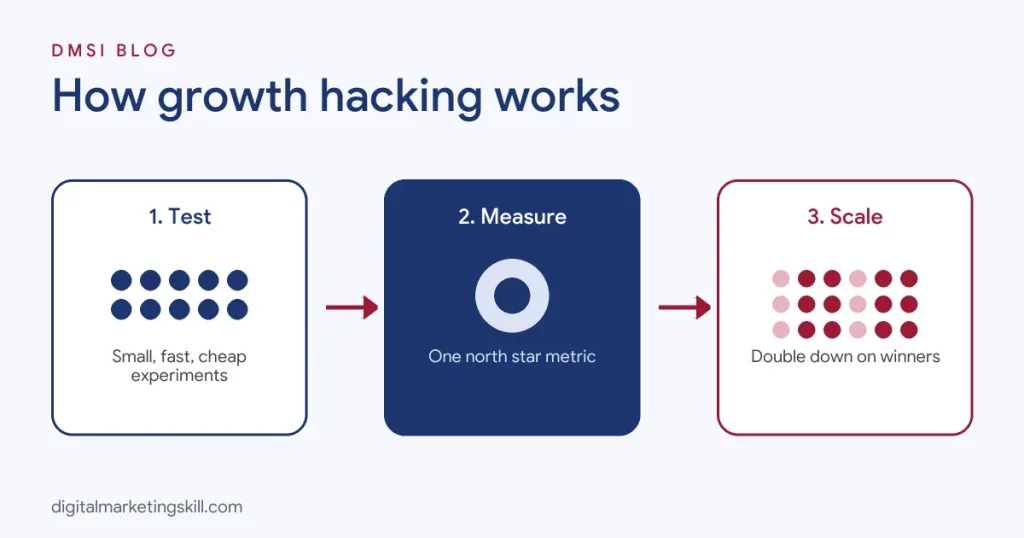
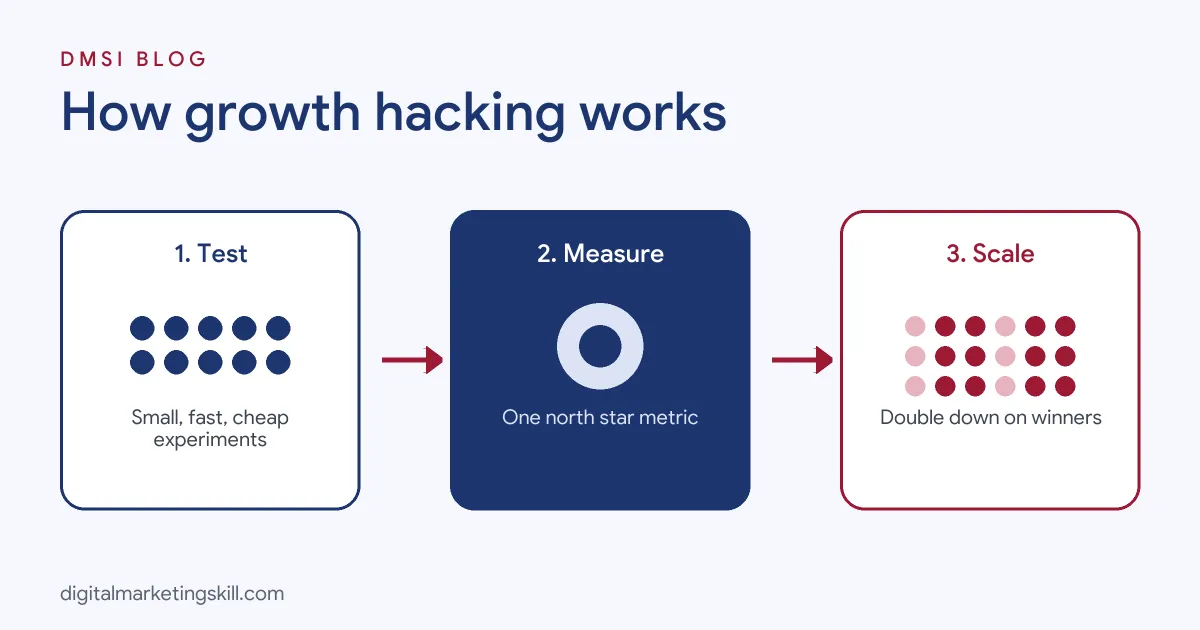
- The process matters more than the hack. The real advantage comes from running many small tests every week, not from finding one magic idea.
- Ethics matter. Tactics that spam people, mislead them or break platform rules may produce a short spike, then damage trust, deliverability and brand reputation.
This guide covers the tactics, but it starts with the process, because that is what makes growth repeatable.
How Growth Hacking Works: The AARRR Funnel
Most growth teams map their work to the AARRR framework, nicknamed “pirate metrics” because the acronym sounds like a pirate’s growl. Investor Dave McClure introduced it in 2007 to help startups focus on the metrics that matter at each stage of the customer journey. It builds on the classic marketing funnel, but it continues past the first sale.
| Stage | Question it answers | Example metrics | Example experiments |
|---|---|---|---|
| Acquisition | How do people find us? | Visitors by channel, cost per visitor, customer acquisition cost | New SEO topics, partnerships, ad audiences |
| Activation | Do they have a great first experience? | Sign-up rate, onboarding completion, time to first value | Shorter sign-up forms, welcome checklists |
| Retention | Do they come back? | Day 7 and day 30 retention, churn rate | Re-engagement emails, new feature prompts |
| Referral | Do they tell others? | Invites sent, referral conversion rate, viral coefficient | Double-sided rewards, share prompts |
| Revenue | Do they pay? | Conversion to paid, average order value, customer lifetime value | Pricing tests, upgrade prompts, bundles |
Some teams add a sixth stage, awareness, at the start, creating AAARRR. Whatever version you use, the point is the same: find the weakest stage of your funnel and focus experiments there first.
The Aha Moment
Activation centres on the “aha moment”, the point where a new user first experiences the core value of your product. For a photo app it may be the first edited photo; for an online course it may be completing the first lesson. Growth teams study what their most loyal users did early on, then redesign onboarding to guide every new user to that moment faster.
The Growth Hacking Process in 7 Steps
Growth hacking works as a loop. Each cycle usually lasts one or two weeks, and every result feeds the next round of ideas.
1. Confirm Product-Market Fit
Survey active users and ask how they would feel if they could no longer use your product. If fewer than about 40% say “very disappointed”, focus on improving the product and understanding your best customers before chasing growth.
2. Choose a North Star Metric
Pick one metric that best reflects the value customers get, such as weekly active users, orders per month or lessons completed. A clear north star metric keeps the whole team pulling in the same direction.
3. Analyse Your Funnel
Use analytics to find where people drop off. If 1,000 people visit, 100 sign up and only 10 come back next week, retention is your bottleneck, not traffic.
4. Generate Ideas
Brainstorm experiments aimed at the bottleneck. Good ideas come from customer interviews, support tickets, competitor research, analytics and team members outside marketing, such as engineers and customer service staff.
5. Prioritise With ICE
Score each idea from 1 to 10 for Impact, Confidence and Ease, then average the scores. The ICE framework, popularised by Sean Ellis, helps teams pick the tests most likely to pay off quickly.
| Idea | Impact | Confidence | Ease | ICE score |
|---|---|---|---|---|
| Cut sign-up form from 6 fields to 3 | 7 | 8 | 9 | 8.0 |
| Launch a referral reward | 8 | 6 | 5 | 6.3 |
| Rebuild the whole website | 6 | 4 | 2 | 4.0 |
6. Run the Experiment
Write a clear hypothesis, such as “If we cut the sign-up form to three fields, sign-ups will rise by 15% because there is less friction.” Then test it, ideally with an A/B test that splits traffic between the old and new versions.
7. Analyse, Learn and Scale
Check whether the result is statistically meaningful, record what you learned and decide whether to scale, iterate or drop the idea. Failed tests are useful too, because they tell you where not to spend time.
15 Growth Hacking Tactics to Test
These tactics are grouped by funnel stage. Treat each one as a hypothesis to test, not a guaranteed win.
Acquisition Tactics
- Search-led content. Publish genuinely useful articles that answer the questions your customers search for. Content compounds over time, unlike paid ads. Start with our guide to content marketing.
- Free tools and templates. Calculators, checklists and templates attract links, shares and sign-ups because they solve a problem instantly.
- Partnerships and integrations. Partner with businesses that already serve your audience, through co-marketing, bundles or product integrations.
- Community participation. Answer questions in the online communities and groups where your customers gather, with helpful answers rather than spam.
- Creator collaborations. Work with creators whose audience matches yours. Our guide to influencer marketing covers how to choose them.
Activation Tactics
- Remove friction from sign-up. Ask for fewer details, allow social sign-in and delay non-essential questions.
- Guide users to the aha moment. Use checklists, progress bars and short tooltips that walk new users to their first success.
- Optimise landing pages. Test headlines, proof and calls to action on each landing page. Our guide to conversion rate optimisation explains the method.
Retention Tactics
- Behaviour-based emails. Send messages triggered by what people do or do not do, such as a nudge when someone stops logging in. See our guide to email marketing.
- Habit-building features. Streaks, reminders, saved progress and personalised recommendations give people reasons to return.
- Community and customer success. Groups, live sessions and proactive support make customers feel part of something and less likely to leave.
Referral Tactics
- Double-sided referral rewards. Reward both the person who refers and the new customer, as Dropbox did with extra storage. Our glossary entry on referral marketing explains the mechanics.
- Built-in sharing. Make the product more useful when shared, such as collaborative documents or shareable results.
Revenue Tactics
- Freemium and free trials. Let people experience value before paying. Our glossary explains the freemium model.
- Pricing and upgrade tests. Test annual plans, bundles and upgrade prompts shown at the moment users hit a limit.
Famous Growth Hacking Examples
These examples are widely cited. Learn the principle behind each one rather than copying the tactic.
Hotmail: The Viral Email Signature
In the 1990s, Hotmail added a line to the bottom of every email sent by its users inviting recipients to get their own free email account. Every email became an advert, delivered by a trusted friend. Principle: let product usage spread the product.
Dropbox: Rewarding Referrals
Dropbox offered extra free storage to both the person who invited a friend and the friend who joined. Founder Drew Houston has said the referral programme permanently increased sign-ups by 60%. Principle: make the reward part of the product, so referring feels like a benefit, not a favour.
Airbnb: Borrowing an Existing Audience
Early on, Airbnb made it easy for hosts to also post their listings on Craigslist, a site that already had huge traffic from people seeking accommodation. Principle: go where your audience already is.
LinkedIn: Importing Contacts
LinkedIn encouraged new members to import their email contacts and invite colleagues, helping the network grow as each member brought in others. Principle: products that become more valuable with more users should make inviting easy.
What These Examples Have in Common
Each tactic was built into the product or the customer journey, cost little to run and became more powerful as the user base grew. None relied mainly on large advertising budgets.
TikTok: Personalisation as a Growth Engine
TikTok’s “For You” feed learns from what each person watches and shows them more of it, so new users find content they enjoy within minutes. Principle: getting users to value quickly through personalisation drives both activation and retention.
Principles of Effective Growth Hacking
- Data first: decisions start from analytics and customer research, not opinions.
- Fast cycles of testing: small, quick experiments beat large, slow projects.
- Cross-functional input: marketing, product, sales, support and engineering all contribute ideas and insight.
- A focus on retention: keeping users is as important as attracting them, because retained users compound growth.
- Scalable mechanisms: the best tactics, such as referrals or built-in sharing, grow automatically as the user base grows.
Risks and Limitations of Growth Hacking
- Short-term thinking: chasing quick spikes can come at the expense of brand and long-term value.
- Poor fit: a tactic that worked for a consumer app may fail in B2B or a regulated industry.
- Acquiring without retaining: growth that leaks away through churn wastes money.
- Vanity metrics: sign-ups or followers that never become active, paying customers can hide real problems.
- Losing user trust: aggressive tactics, such as spammy invites or dark patterns, damage reputation.
- Cultural expectations: what feels clever in one market can feel intrusive in another, so test locally.
Growth Hacking Tools
You do not need a large software budget. Most growth teams rely on a small stack:
| Job | Example tools | What it helps you do |
|---|---|---|
| Web analytics | Google Analytics 4 | See traffic sources, conversions and drop-off points |
| Product analytics | Mixpanel, Amplitude | Track user actions, retention and cohorts |
| Search insights | Google Search Console, keyword tools | Find what people search for and how you rank |
| Testing | Optimizely, VWO | Run A/B tests on pages and features |
| Email and automation | Mailchimp, HubSpot, SendPulse | Send behaviour-based messages at scale |
| Behaviour insight | Hotjar, Microsoft Clarity | Watch heatmaps and session recordings |
Tools only help when someone asks the right questions. Start with one analytics tool, one testing method and a simple spreadsheet to log every experiment.
Skills You Need to Become a Growth Hacker
Growth hackers are often described as “T-shaped”: broad knowledge across many marketing channels, with deep expertise in one or two. The core skills are:
- Analytics: reading data, building funnels and spotting patterns.
- Experimentation: writing hypotheses, running A/B tests and judging results honestly.
- Channel knowledge: SEO, paid social, email, content and marketing automation.
- Copywriting and psychology: understanding what motivates people to act.
- Product thinking: seeing how product changes, not only campaigns, can drive growth.
- Basic technical skills: editing web pages, using no-code tools and working with developers.
If you are new to the field, our guide to what digital marketing is covers the channels growth hackers use every day.
Growth Hacking Mistakes to Avoid
- Scaling before product-market fit. Growth amplifies whatever you have, including problems.
- Chasing vanity metrics. Followers and page views mean little if they do not lead to active, paying customers.
- Copying famous hacks blindly. A tactic that suited Dropbox may not suit a local bakery.
- Ending tests too early. Small samples produce misleading results. Wait for enough data before deciding.
- Testing too many things at once. Change one main variable per test so you know what caused the result.
- Ignoring ethics and rules. Spam, fake reviews and misleading claims can bring penalties, legal trouble and lasting damage to trust.
How to Measure Growth Hacking Results
Measure each experiment against the metric it was designed to move, and track a few business-level numbers every month:
- North star metric: the single number that reflects customer value.
- Customer acquisition cost (CAC): what it costs to win a customer.
- Customer lifetime value (LTV): how much a customer is worth over time. A healthy business usually earns far more over a customer’s lifetime than it spends to acquire them.
- Retention by cohort: how many users from each sign-up month are still active later.
- Experiment velocity: how many tests you run each month and what share produce a win.
Keep an experiment log with the hypothesis, dates, result and lesson for every test. Over time, this log becomes your company’s growth playbook.
The One Rule of Growth Hacking
Learn faster than everyone else. The companies that grow quickest are rarely the ones with the cleverest single idea. They are the ones that run the most well-designed experiments, learn from every result and keep the customer’s real needs at the centre of every test.
An Illustrative Case
Imagine a small online yoga studio in Manchester with 2,000 free sign-ups a month but only 3% becoming paying members, and most of those cancel within two months.
The founder checks product-market fit by surveying active members and finds strong loyalty among people who complete at least three classes in their first week. That becomes the aha moment. She chooses “members completing three or more classes a week” as her north star metric.
Using ICE scores, she prioritises three tests: a simplified sign-up form, a seven-day starter challenge emailed to every new member and a “bring a friend free” reward. Over eight weeks, the starter challenge lifts the number of new members reaching three classes in week one, paid conversion rises from 3% to 5% and cancellations fall. The referral reward performs modestly, so she keeps it but stops promoting it heavily.
She spent almost nothing on ads. Growth came from understanding her best members and guiding everyone else to the same experience. This example is illustrative, not a real business, but it shows how the growth hacking process works in practice.
Frequently Asked Questions About Growth Hacking
What does growth hacking mean?
Growth hacking means using fast, low-cost experiments across marketing, product and sales to find the most efficient ways to grow a business, then scaling what works.
Who invented growth hacking?
Sean Ellis coined the term “growth hacker” in 2010. Andrew Chen helped popularise it in 2012, and Ellis later co-wrote Hacking Growth with Morgan Brown.
What are the growth strategies in marketing?
Common growth strategies include search and content marketing, referral programmes, partnerships, conversion rate optimisation, email automation, retention programmes and pricing tests, all measured against clear goals.
How do you growth hack a startup?
Confirm product-market fit, choose a north star metric, find the weakest stage of your funnel, brainstorm and prioritise experiments, test them quickly and scale the winners.
Is growth hacking the same as growth marketing?
They are closely related. Growth hacking began as a startup approach focused on rapid, low-cost growth, while growth marketing applies the same testing mindset to long-term, sustainable growth across the whole funnel.
Is growth hacking only for startups?
No. Startups popularised it, but e-commerce brands, apps, agencies, schools and large companies all use growth experiments to improve acquisition, retention and revenue.
Is growth hacking legal and ethical?
Growth hacking itself is simply testing and optimisation. Some tactics, such as spam, scraping personal data without consent or fake reviews, can break laws and platform rules, so always stay within them.
What is the AARRR framework?
AARRR, or pirate metrics, is Dave McClure’s framework for measuring growth across five stages: acquisition, activation, retention, referral and revenue.
Do I need to code to be a growth hacker?
Not necessarily. Basic technical skills help, but many growth marketers use no-code tools, analytics platforms and testing software without writing code.
How long does growth hacking take to work?
Individual experiments can show results in days or weeks, but building a reliable growth engine usually takes months of consistent testing and learning.
Your Next Step
Growth hacking draws on many skills at once: analytics, SEO, paid ads, email automation and conversion optimisation. The Master Diploma in Digital & AI Marketing at Digital Marketing Skill Institute covers AI-powered Social Media Management and Advertising, Lead Generation and Email Automation, Google, and a WordPress and SEO track where you build and rank a real website.
From day one, you work on a real U.S. company’s project through the U.S. Project Internship, so you finish with real results and a verified U.S. work reference letter. You also get unlimited one-on-one coaching. The program carries dual US and UK accreditation, is recognised in more than 100 countries, and runs 100% online over three months.
You can build those skills wherever you live, anywhere in your country. Read student reviews, then apply for the 65% partial scholarship to see if you qualify.
Every claim in this guide was checked against its source before publication: Wikipedia’s history of growth hacking, Sean Ellis and Morgan Brown’s Hacking Growth (2017), Dave McClure’s Startup Metrics for Pirates (2007), Sean Ellis’s product-market fit survey, and Drew Houston’s Dropbox Startup Lessons Learned talk. The case above is an illustrative example, not a real result.